
Guide to Maintaining Swimming Pools in Austin’s Climate
Maintaining a pool in Austin requires a fundamentally different approach than what you’ll find in most pool care guides. The combination of limestone-filtered hard water, summer temperatures exceeding 100°F, and strict drought regulations creates challenges that standard maintenance protocols simply don’t address.
At Bluewater Pools, we’ve spent years working with Austin-area pools and learning what actually works in Central Texas conditions. This guide covers the Austin-specific strategies we rely on: adjusted chemical targets for our hard water, seasonal protocols for cedar pollen and freeze events, and practical solutions for maintaining water quality when draining isn’t an option.
Why Austin Pools Need a Different Approach
Most pool maintenance advice comes from regions with soft water and moderate climates. Apply those recommendations here, and you’ll fight a losing battle against calcium scale, algae blooms, and equipment damage.
Three factors make Austin unique:
Hard water from limestone aquifers. Municipal water in Austin comes from the Colorado River and groundwater sources like the Edwards and Trinity Aquifers. This water passes through extensive limestone formations, entering your pool with calcium hardness levels already near or exceeding the upper limits of standard recommendations (200-400 ppm). Where other regions add calcium to prevent plaster damage, we’re constantly managing excess calcium that wants to deposit on every surface.
Extreme thermal stress. Summer air temperatures regularly exceed 100°F, pushing water temperatures into the low 90s. At these temperatures, calcium becomes less soluble (promoting scale formation) and chlorine demand increases dramatically. Winter brings the opposite problem: rapid temperature swings of 50°F in 24 hours stress equipment and can shift water chemistry from scale-forming to corrosive overnight.
Unique biological loading. The winter pollination of Ashe Juniper (cedar fever season) blankets pools in waxy, hydrophobic pollen that resists normal filtration and creates massive chlorine demand. Spring brings oak tannins that stain plaster and feed algae growth.
Understanding Austin’s Water Chemistry Challenges
The chemistry principles are the same everywhere. What changes in Austin is where your baseline starts and how aggressively you need to manage it.
Managing Hard Water and Calcium Buildup
Evaporation is the core problem.
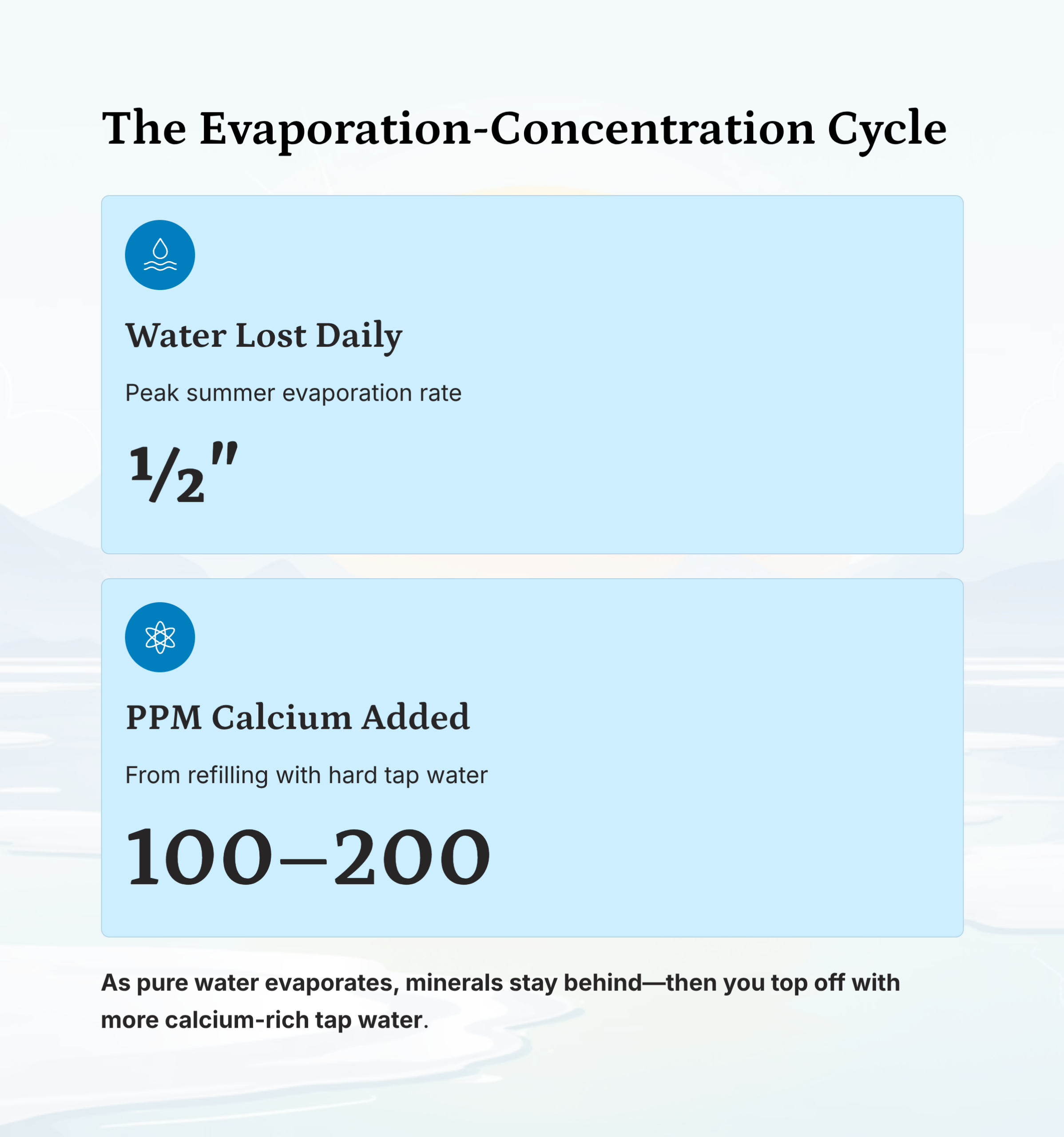
An uncovered Austin pool can lose 1/4 to 1/2 inch of water daily during summer, according to Alliance Pools and Patio. As pure water evaporates, it leaves minerals behind. You then top off with more calcium-rich tap water. This cycle can increase calcium hardness by 100-200 ppm per season.
Since draining to lower calcium is often prohibited by drought regulations (see below), chemical sequestration becomes your primary defense. Sequestering agents surround calcium ions with a molecular structure that prevents them from precipitating as scale. Products formulated for high-TDS or saltwater environments work best.
One critical point: chlorine oxidizes sequestering agents over time. If you stop regular dosing, the previously sequestered calcium gets released and scale forms rapidly. Monthly maintenance doses are essential, not optional.
When calcium hardness exceeds 800-1000 ppm, sequestrants alone won’t cut it. Mobile Reverse Osmosis filtration services have emerged as an alternative that filters out minerals without draining, helping pool owners comply with conservation mandates.
The LSI Factor: Why Standard Chemical Ranges Don’t Work Here
The Langelier Saturation Index (LSI) determines whether your water will deposit scale or corrode surfaces. It’s calculated from pH, temperature, calcium hardness, total alkalinity, cyanuric acid, and total dissolved solids.
In Austin, managing to the LSI isn’t optional. It’s the difference between a pool that stays clear and equipment that lasts versus constant scale buildup on salt cells, clogged heater cores, and rough calcium nodules on surfaces.
Here’s the issue: high calcium combined with high summer water temperatures naturally pushes Austin pools toward scale-forming conditions (LSI above +0.3). To compensate, you need to run pH and alkalinity lower than traditional recommendations suggest.
While a standard guide might recommend pH of 7.5 and alkalinity of 100 ppm, an Austin pool at 90°F with 600 ppm calcium hardness needs pH around 7.2-7.4 and alkalinity of 70-80 ppm to maintain balanced LSI.
Winter creates the opposite risk. Cold water is more aggressive and will leach calcium from plaster if chemistry isn’t adjusted to compensate for temperature drops.
Optimal Chemical Targets for Austin Pools
Standard industry ranges assume moderate temperatures and balanced source water. These adjusted targets account for Austin’s specific conditions:
Parameter | Standard Range | Austin Summer Target | Austin Winter Target | Why It's Different |
pH | 7.2 - 7.8 | 7.2 - 7.4 | 7.4 - 7.6 | Lower summer pH compensates for high LSI driven by heat and calcium |
Total Alkalinity | 80 - 120 ppm | 70 - 90 ppm | 90 - 110 ppm | Lower TA reduces carbonate available for scale formation in hot water |
Calcium Hardness | 200 - 400 ppm | 350 - 550 ppm (managed) | 250 - 400 ppm | Higher levels unavoidable; mitigate with sequestrants. Avoid below 250 in winter to prevent etching |
Cyanuric Acid | 30 - 50 ppm | 50 - 60 ppm | 30 - 40 ppm | Higher CYA needed to shield chlorine from intense UV; lower in winter to increase efficacy |
Free Chlorine | 1.0 - 3.0 ppm | 4.0 - 6.0 ppm | 2.0 - 3.0 ppm | High organic load and UV demand require higher residuals to prevent algae |
Phosphates | < 100 ppb | < 100 ppb | < 200 ppb | Must be near zero during spring/summer to starve algae fueled by oak pollen and tannins |
These aren’t arbitrary numbers. Each adjustment addresses a specific pressure point in Austin’s environment. Through years of working with local pools, we’ve found these ranges provide the best balance between surface protection and practical maintenance.
Seasonal Pool Care in Central Texas
Austin pool ownership is a year-round commitment. The operational approach shifts across three distinct seasons.
Spring: The Pollen Defense (February – May)
Cedar fever season (December through February) dumps massive amounts of waxy, hydrophobic pollen into pools. This pollen floats on the surface, clogs filters, and can consume an entire chlorine residual overnight as the sanitizer tries to oxidize the lipids.
Chemical strategy: Enzymatic digestion works better than chlorine alone for pollen. Broad-spectrum pool enzymes break down the non-living organic bonds in pollen, making it easier for filters to capture and reducing the scum line on tiles. Increase your chlorine baseline to 3.0-5.0 ppm to handle the additional oxidant demand.
Mechanical strategy: Skimmer socks (disposable nylon liners for skimmer baskets) are arguably the most cost-effective tool for Austin springs. They trap pollen at the skimmer before it reaches your pump or filter. During peak cedar season, plan to replace them daily.
Increase pump runtime to 24 hours at low speed. Constant circulation prevents pollen from settling and staining surfaces.
Don’t forget drainage: Spring storms in Austin can be severe. Clear deck drains before storm season to prevent fertilizer-laden patio runoff from washing into your pool.
Summer: Managing Heat and Evaporation (June – September)
The goal shifts to preventing algae and controlling the evaporation-concentration cycle that drives calcium buildup.
Monitor cyanuric acid monthly. If you’re using trichlor tablets, CYA will climb steadily. When it exceeds 50 ppm, switch to liquid chlorine to prevent further accumulation. High CYA (above 100 ppm) renders chlorine ineffective against algae unless you maintain free chlorine at 7.5% of the CYA level, which is impractical and hard on swimmers.
Control evaporation. A solar cover (bubble or liquid) reduces water loss significantly. Less evaporation means less calcium concentration and less need to add calcium-rich tap water.
Watch your water level. Keep it at the midpoint of the skimmer tile. Lower levels expose the tile line to drying and intense sun, baking calcium scale onto tiles that becomes nearly impossible to remove chemically.
Fall and Winter: Freeze Protection (October – January)
Unlike northern climates where pools are winterized and covered, Austin pools typically remain active year-round. The primary concern becomes protecting equipment from freeze damage during cold snaps.
Active freeze protection relies on the principle that moving water doesn’t freeze easily. Your automation system should activate “Freeze Mode” when air temperature reaches 34-35°F. This mode must turn on all pumps: main filter pump, booster pumps, and any auxiliary pumps for water features. A stagnant waterfall pipe will freeze and burst.
One common failure point: pools left in “Service” or “Timeout” mode after maintenance. These modes bypass automation logic, and freeze protection won’t activate. Always verify the system is in “Auto” before leaving.
If power fails during a freeze (a real concern after Winter Storm Uri), you have 1-2 hours to execute passive shutdown:
- Turn off breakers at the equipment pad
- Open all drain plugs on the pump pot, filter tank, heater manifold, and chemical feeders
- Open the air relief valve on the filter and remove pump lids to break vacuum
- If draining isn’t possible, wrap equipment in heavy blankets or thermal covers
For more detailed winterization strategies, check our pool maintenance services page.
Choosing the Right Sanitization Method
The cyanuric acid problem in Austin deserves special attention. Many residential pools rely on trichlor tablets (3-inch pucks) for convenience. These tablets are approximately 50% cyanuric acid by weight. For every 1 ppm of chlorine added via trichlor, you add 0.6 ppm of CYA.
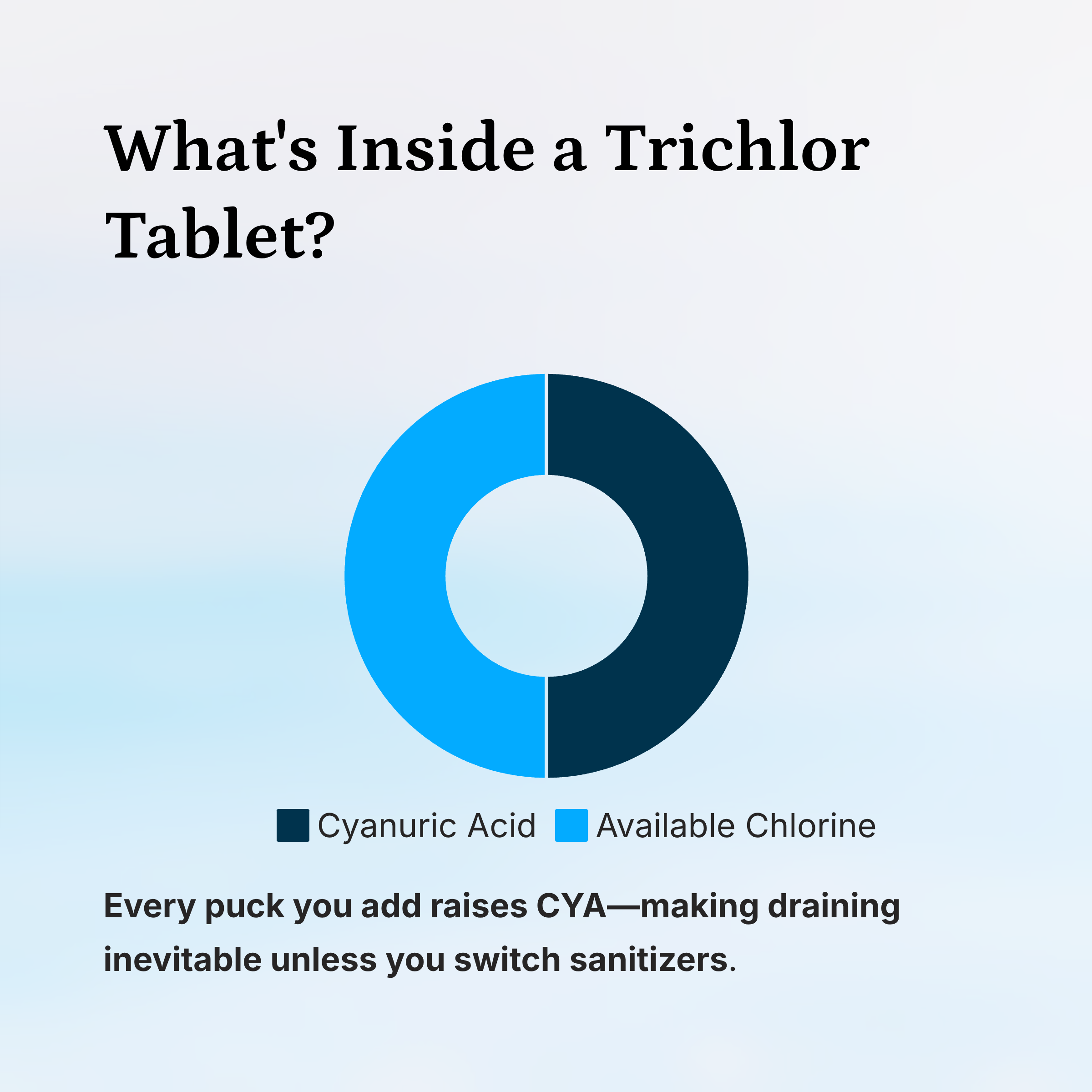
In a region where water conservation prevents regular draining, relying on a sanitizer that necessitates frequent drain-downs to lower CYA is counterproductive.
Better approaches:
Liquid chlorine (sodium hypochlorite) adds no CYA. It requires more frequent application (daily or via a peristaltic feed pump), but it prevents the “chlorine lock” that happens when CYA climbs too high.
Saltwater chlorine generators produce unstabilized chlorine from dissolved salt. You add the exact amount of CYA needed (typically 50-70 ppm for salt systems in Texas) and maintain it, avoiding the steady climb caused by tablets.
Strategic tablet use still has its place. Trichlor tabs work well during heavy rainfall periods (which dilute CYA) or for short-term vacation coverage. Just don’t rely on them as your primary sanitation method.
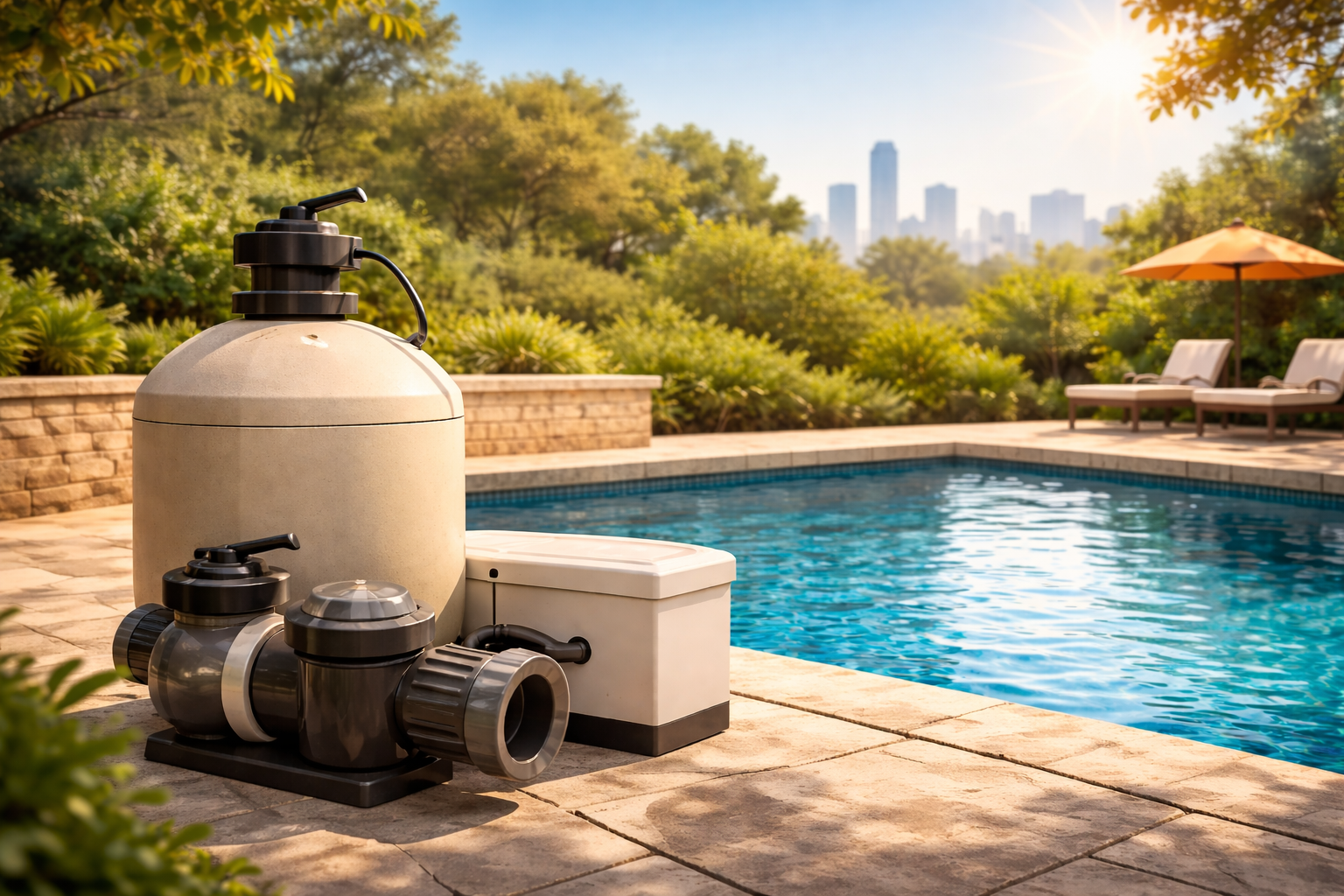
Filtration Systems for Austin’s Conditions
Your filter choice has significant implications for water conservation and maintenance labor. This matters in Austin, where drought regulations can restrict water waste from backwashing.
Filter Type | Pollen Performance | Water Conservation | Maintenance Needs | Austin Verdict |
Diatomaceous Earth (DE) | Excellent. Traps particles down to 3-5 microns, clears pollen haze efficiently | Poor. Backwashing discharges hundreds of gallons | High. Grids need manual cleaning; backwash alone often insufficient during pollen season | High performance, high waste. Best for clarity but challenging during Stage 2+ drought |
Cartridge (Large Tank) | Good. Traps 10-20 microns, adequate for most pollen | Excellent. Cleaned via spray-down, no backwash line needed | Medium. Cartridges require removal and chemical soaking to remove pollen oils | Recommended. Most drought-compliant option with no discharge permit issues |
Sand/Glass Media | Fair. 20-40 microns, often allows pollen through | Poor. Requires frequent, long backwash cycles | Low. Easiest to clean but least effective | Not recommended. Generally insufficient for Austin's clarity standards |
Large-capacity cartridge filters (400-500 sq. ft. quad-cartridge vessels) eliminate the legal complications of disposing DE-laden backwash water and conserve thousands of gallons annually.
Navigating Austin’s Water Restrictions
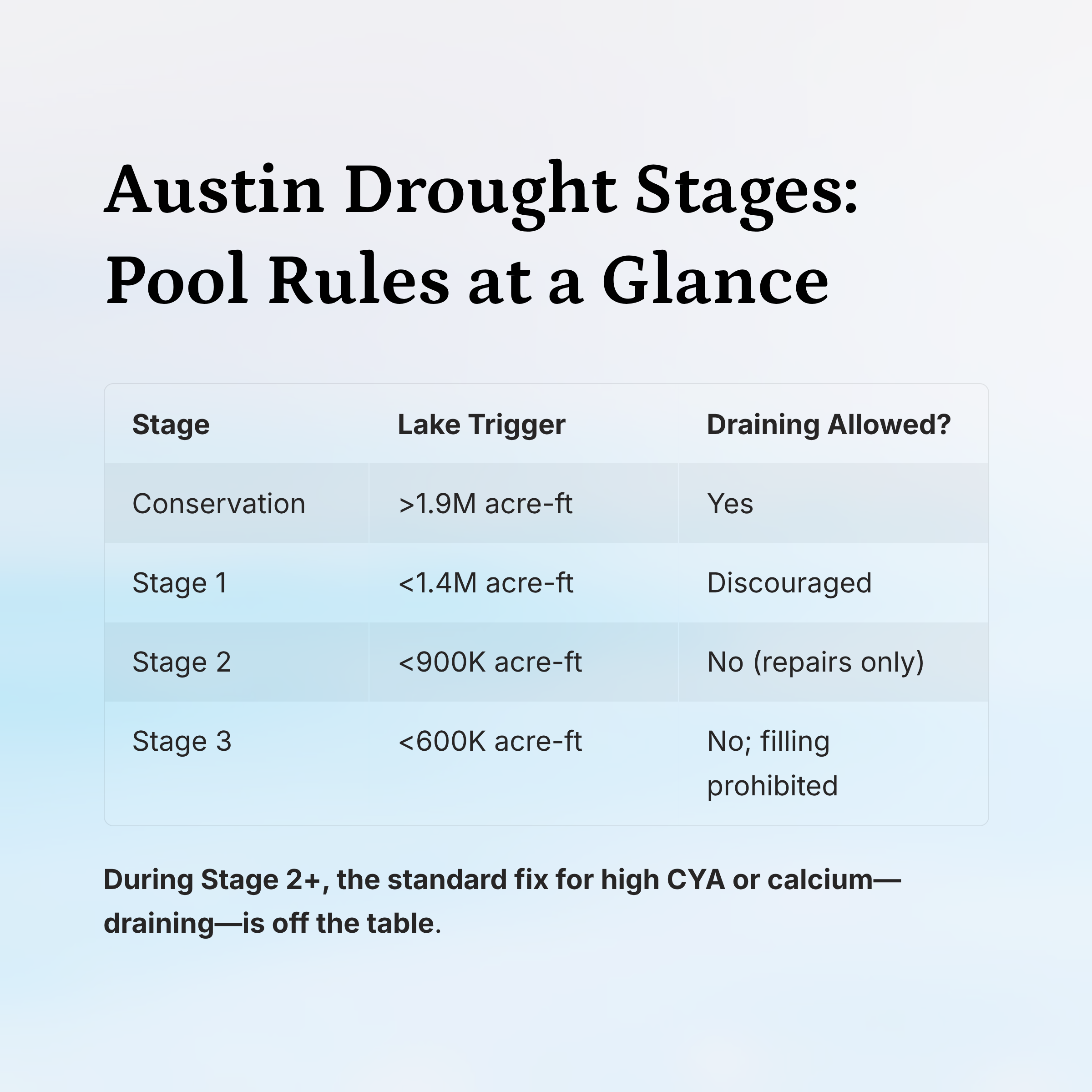
Pool operators in Austin function under strict regulations designed to protect regional water resources. Understanding the City of Austin’s drought contingency plan is essential.
Conservation Stage (baseline): Filling, topping off, and draining all allowed.
Stage 1: Filling and topping off allowed. Draining discouraged.
Stage 2: New pool filling allowed. Topping off to maintain operation allowed. Draining and refilling existing pools is prohibited except for emergency repairs like leak detection. Aesthetic draining (for acid wash, for example) requires a variance.
Stage 3/Emergency: Filling and topping off prohibited. Pools must be covered to retain water.
During Stage 2 or higher, managing cyanuric acid and calcium hardness becomes critical because the standard remedy (draining) isn’t available. This reinforces why proactive strategies matter: liquid chlorine to prevent CYA rise and sequestrants to manage calcium before levels become unmanageable.
For discharge, it’s illegal in Austin to release pool water directly into storm drains if it contains pollutants. Water must be dechlorinated (below 0.05 mg/L), neutral pH, and free of algae. The preferred method is discharging onto your own lawn, provided it doesn’t create runoff onto neighboring property.
What Austin Pool Maintenance Actually Costs
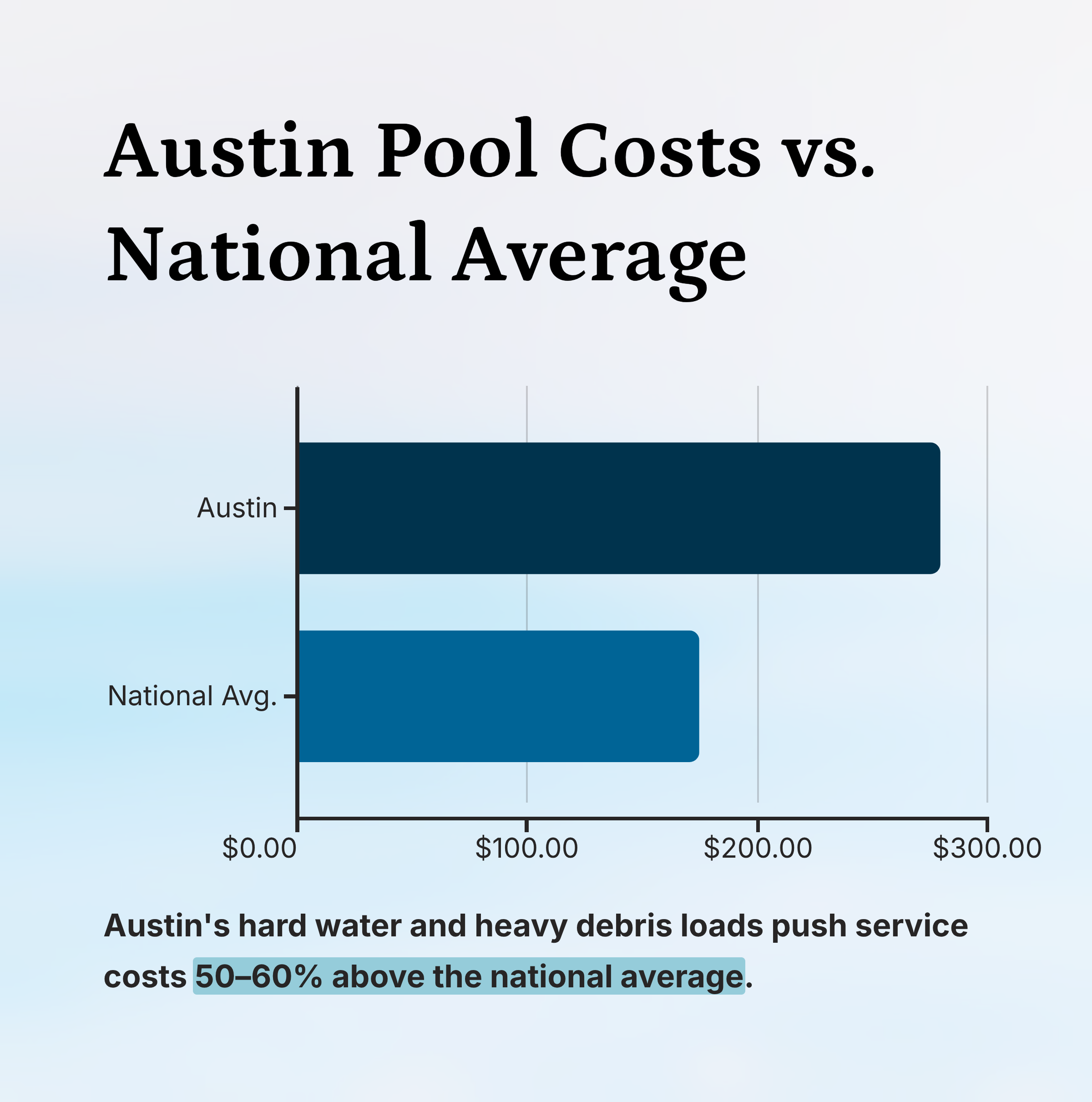
The specific demands of our climate result in higher ownership costs than national averages.
Professional weekly service in Austin typically runs $240-$320 per month, compared to the national average of $150-$200. The difference reflects the labor intensity of managing heavy debris and high chemical consumption in our market.
DIY chemical costs average $50-$100 per month during swim season. Saltwater pools have lower monthly chemical costs ($20-$40) but require expensive salt cell replacements ($500-$800) every 3-5 years, according to Texas Real Estate Source.
Intermittent costs to budget for:
- Filter deep cleaning: $150-$250 every 4-6 months
- Green pool remediation: $500-$1,000+ for neglected pools
- Bead blasting (tile calcium removal): $800-$1,300 depending on pool size ($7-$10 per linear foot)
- Pump motor replacement: $500-$800
- Full variable speed pump replacement: $1,500-$2,500
- Heater replacement: $3,000-$4,500
The hidden cost of Austin pool ownership is the periodic need for expensive remediation caused by hard water. Budgeting an extra $1,000 annually into a reserve fund for these eventualities is a practical financial strategy.
Making Austin Pool Care Manageable
Success with Austin pools comes down to shifting from reactive maintenance to proactive management:
- Respect the LSI. Standard chemical ranges don’t work here. Manage pH and alkalinity based on actual water temperature and calcium levels, not textbook recommendations.
- Use sequestrants consistently. Monthly dosing is the only viable defense against scale when you can’t dilute by draining.
- Choose sanitizers strategically. Move away from trichlor tablets toward liquid chlorine or salt systems to prevent CYA accumulation.
- Prepare for freeze events. Active freeze protection works until the grid fails. Have a passive shutdown plan ready.
- Comply with conservation rules. Adopt cartridge filtration, use covers, and practice responsible discharge.
The technical demands are real, but they’re manageable with the right approach. Whether you handle maintenance yourself or work with professionals, understanding these Austin-specific factors makes the difference between constant problems and a pool that stays swimmable year-round.
Get Help With Your Austin Pool
Bluewater Pools provides pool services throughout the Austin area, with CPO-certified technicians who understand the specific challenges of maintaining pools in Central Texas. If you’re tired of fighting algae, scale, and unpredictable water chemistry, call us at 512-886-7665 or email info@bluepoolwater.com to schedule an assessment.