Does a Pool Increase Your Home’s Value in Texas?
Yes. In Texas, a well-maintained pool adds roughly 7% to 10% to a home’s market value, outperforming the national average of 1.5% to 7%. For a $400,000 home, that translates to approximately $28,000 to $40,000 in added value. At Bluewater Pools, we service pools across Austin and San Antonio, and the relationship between consistent upkeep and resale value comes up constantly with homeowners. The data confirms what we see in practice: pool condition matters just as much as whether a pool exists at all.
That said, the financial picture is more nuanced than a simple yes. Pools rarely recoup their full installation cost at resale, annual ownership expenses run $2,600 to $7,600, and not every buyer sees a pool as an asset. Understanding the full picture is what lets you make a smart decision about the investment.
Why Texas Pools Outperform the National Average
Climate is the decisive variable. Texas summers routinely exceed 100°F for weeks at a time, and the swim season runs six to eight months or longer. In most Texas neighborhoods, a pool isn’t a luxury amenity. It’s an expected feature.
Tom Casey, Vice President of Anthony & Sylvan Pools, made the case plainly: “If you are in a warm climate, like Florida or Texas, it will increase your property’s value, and it may make your house more attractive to buyers.”
Zillow research shows homes with saltwater pools sell for roughly 1.5% more than comparable homes nationally. Redfin places the national average closer to 7%, and the NAR’s 2023 Remodeling Impact Report pegs typical cost recovery for an inground pool at 56% of the $90,000 average installation cost, meaning homeowners recover about $50,400 at resale nationally.
Texas consistently exceeds those benchmarks.
Metric | Texas | National Average |
Home value increase | 7–10% | 1.5–7% |
Dollar value added | $15,000–$50,000+ | Varies widely by metro |
ROI at resale | 30–60% | 5–56% |
NAR cost recovery | N/A (national only) | 56% of $90,000 installation cost |
Typical inground pool cost | $45,000–$150,000 | $50,000–$100,000+ |
Sources: NAR 2023 Remodeling Impact Report; Redfin; Zillow Research; Realtor.com, May 2025; Angi, September 2024.
Pool Premiums by Texas Metro
Pool value is not uniform across the state. Redfin’s metro-level analysis found Austin ranked second nationally for pool value-add in dollar terms, with pools adding approximately $52,000 to a typical home’s value. Realtor.com’s May 2025 national analysis named Austin among the top five U.S. metros for homes listed with a swimming pool, alongside Miami, Phoenix, Orlando, and Tampa.
Metro | Pool Value Premium | Notes |
Austin | ~$52,000 | #2 nationally for dollar value-add (Redfin); top 5 for pool listing share (Realtor.com, 2025) |
Houston | $16.42/sq ft | Well-maintained suburban pools add $25,000–$50,000 |
Dallas-Fort Worth | $50,000–$80,000 (luxury suburbs) | Agent estimates; 13.8% of DFW homes have pools |
San Antonio | ~$18,600–$26,575 (estimated) | Based on 7–10% of $265,750 median home price |
San Antonio lacks metro-specific data from major research firms, but industry professionals across Central Texas consistently describe pools as highly desirable given summer temperatures that regularly exceed 95°F. Hannah Jones, Senior Economic Research Analyst at Realtor.com, noted: “The presence of a pool continues to drive a premium and be a popular item to include in listings.”
If you’re in the San Antonio area or the Austin metro, you’re already in two of the strongest pool-value markets in the country.
What Actually Determines How Much Value Your Pool Adds
Not all pools are created equal in the eyes of appraisers and buyers. Six factors consistently determine whether a pool moves the needle meaningfully or barely at all.
Pool type
Inground pools (particularly concrete/gunite and fiberglass) are the only types that reliably add resale value. Above-ground pools add essentially no appraised value and can actually deter buyers, according to analyses from Redfin, Angi, and Orchard. Texas appraisers treat inground pools as permanent improvements and isolate their value using the paired sales comparison method.
Saltwater systems are increasingly preferred by buyers due to lower long-term chemical costs ($70 to $100 per year versus $300 to $800 for traditional chlorine pools).
Neighborhood expectations
In Texas subdivisions where 30% to 50% of homes have pools, the absence of a pool can work against your competitive position at resale. Allen Markel of Texas Premier Realty put it directly: “In Texas, we are in a geographical location where pools are more desirable. Typically, it’s best to buy a home with a pool, versus buying a home and installing a new pool.”
In starter-home neighborhoods where the median price sits below $300,000, an expensive installation may not generate proportional returns.
Condition and maintenance history
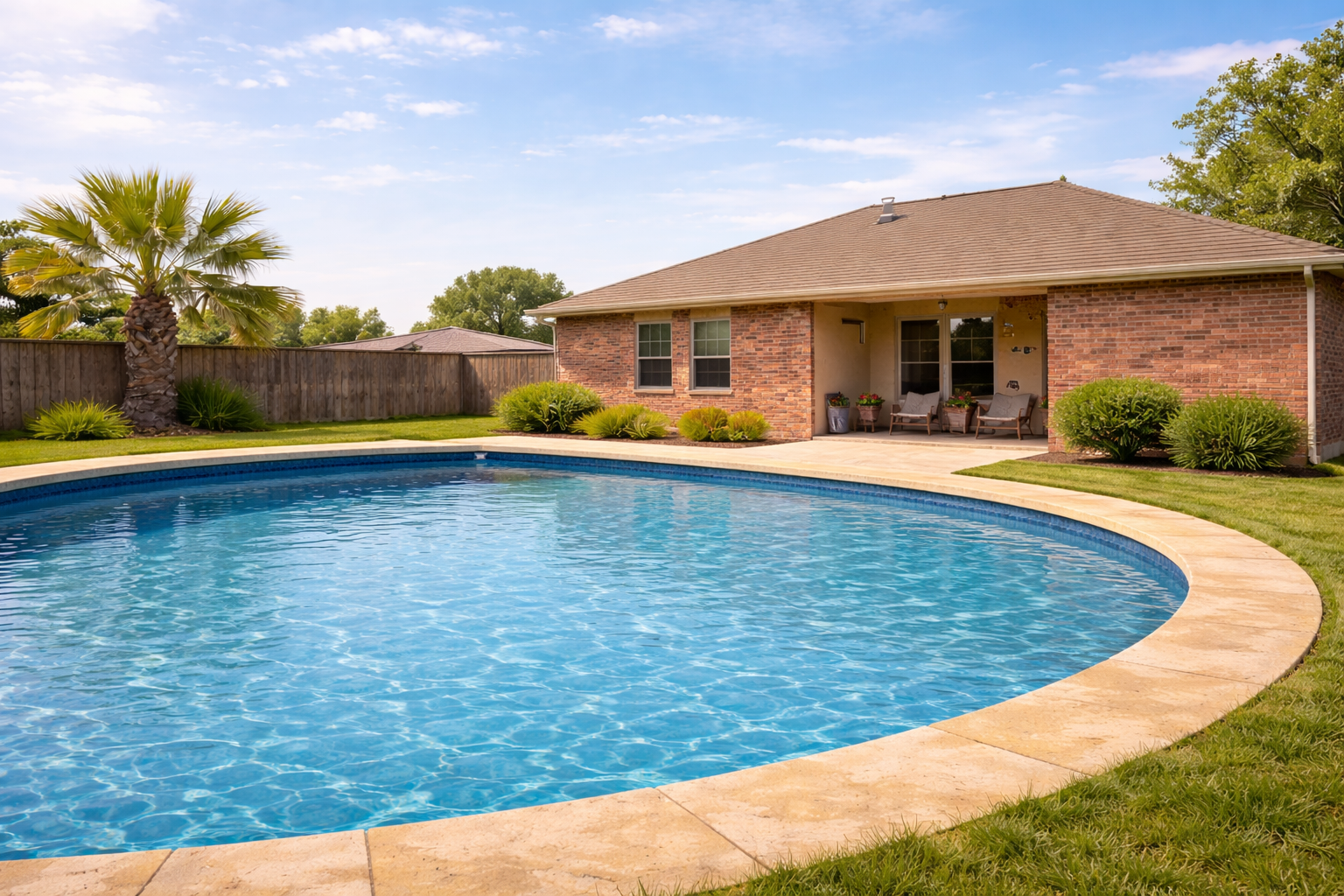
This is where we see the biggest variation in our work at Bluewater Pools. A pool resurfaced within the last five to seven years signals lower near-term repair risk and commands a stronger premium. Aging pumps, cracked surfaces, and outdated filtration are red flags that cause buyers to discount their offers.
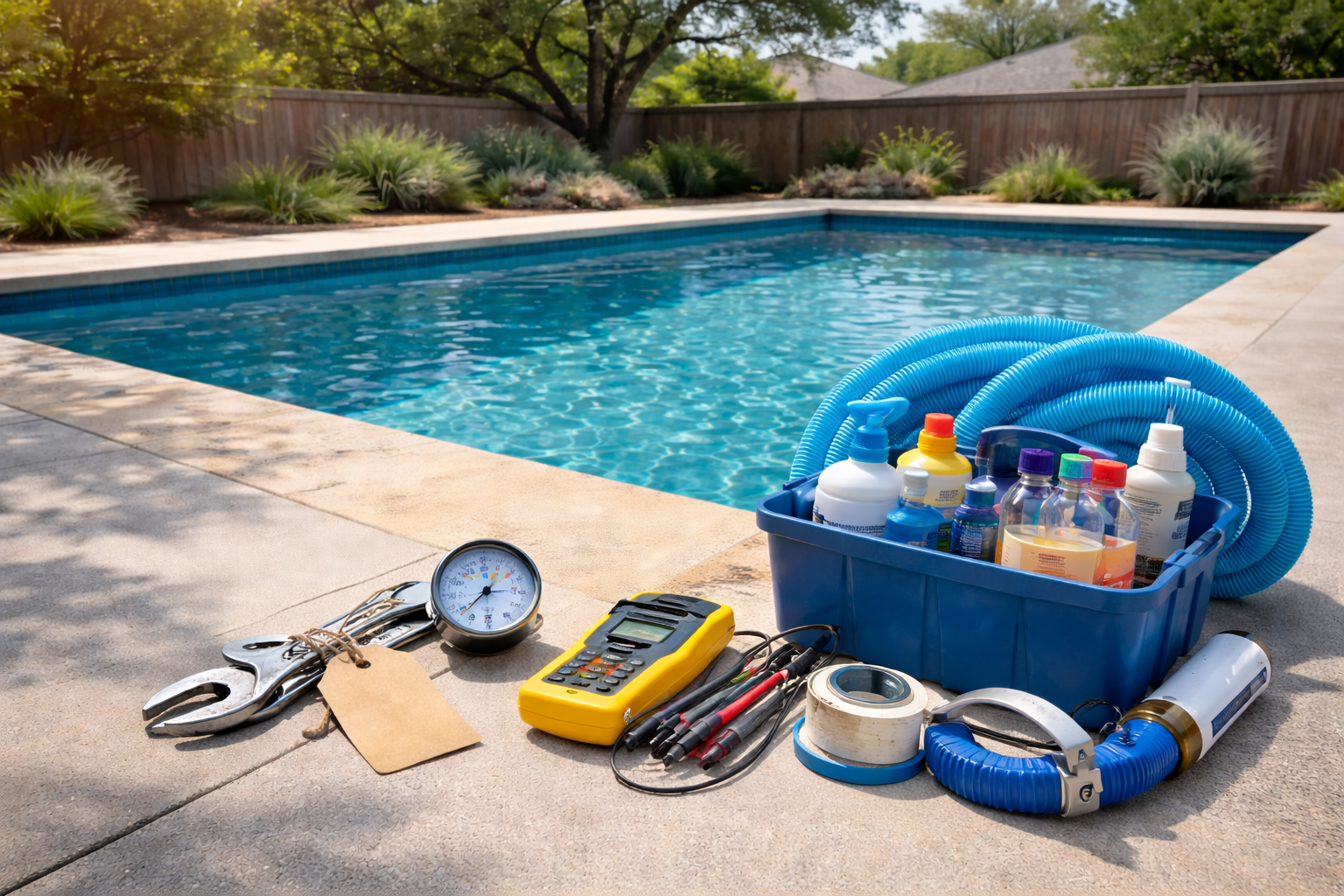
Common Texas pool repairs range from $250 to $1,200 for pumps, $300 to $1,200 for heaters, and $75 to $800 for filters. Buyers mentally subtract visible wear from what they’re willing to pay.
Remaining yard space
Pools add the most value when there’s still usable outdoor space alongside them. A pool that consumes the entire backyard reduces versatility and narrows buyer appeal.
Complementary outdoor features
Outdoor kitchens, fire pits, professional landscaping, LED lighting, and tanning ledges all increase a pool’s perceived value. The NAR Remodeling Impact Report gave comprehensive outdoor living improvements (including pools) a perfect 10 out of 10 “Joy Score,” the highest rating of any outdoor project surveyed.
Post-pandemic demand shift
According to Realtor.com data, homes with pools listed for 54% more than comparable non-pool homes as of April 2025, with the premium peaking at 61% in January 2022 at the height of pandemic-driven demand. Dr. Jessica Lautz, NAR Deputy Chief Economist, tied the shift to how people began using their homes: “The COVID-19 pandemic changed the way Americans use their homes for daily living, relaxation and entertainment. Homeowners have embraced their outdoor spaces.”
The Real Cost of Pool Ownership in Texas
The ROI question can’t be answered without accounting for what a pool costs to own year over year.
Installation costs vary significantly by pool type:
- Fiberglass: $30,000 to $85,000
- Concrete/gunite: $50,000 to $100,000+
- Vinyl liner: $30,000 to $50,000
- Luxury Houston-area custom pools: $60,000 to $150,000+
Annual operating costs add up quickly, and Texas’s climate makes them higher than in most states. Extreme heat accelerates chemical consumption, UV exposure breaks down chlorine faster than in cooler climates, and evaporation can drop water levels by more than two inches per week during summer.
Expense | Monthly Cost | Annual Cost |
Professional weekly cleaning | $120–$300 | $1,440–$3,600 |
Pool chemicals | $50–$100 | $600–$1,200 |
Electricity (pump, heater) | $30–$150 | $360–$1,800 |
Equipment repairs (average) | -- | $200–$1,000 |
Insurance increase | $10–$50 | $120–$600 |
Total estimated range | $210–$600 | $2,720–$8,200 |
Sources: Texas pool maintenance costs; Angi/HomeAdvisor; The Zebra; Insurance Information Institute.
On the insurance side, inground pools typically raise Texas homeowner’s insurance premiums by 10% to 30%. The Insurance Information Institute recommends increasing liability coverage to $300,000 to $500,000 and considering an umbrella policy, typically $200 to $300 per year for $1 million in coverage.
Pools also raise a home’s appraised value, which means a corresponding property tax increase. That ongoing cost compounds annually and is easy to overlook when estimating ROI.
The Downsides Worth Factoring In
Steve Gary, a Dallas-Fort Worth listing agent with Orchard, was blunt about the math: “Pools are not a good financial investment; return is approx. 30% of what you paid. But if you have children, a swimming pool is priceless because you know where your children are playing.”
A few specific risks are worth understanding before making the investment.
Pools narrow the buyer pool. The NAR’s 2025 Profile of Home Buyers and Sellers found that only 24% of buyers had children under 18, the lowest percentage ever recorded. Buyers without children are more likely to view a pool as an ongoing maintenance obligation than an amenity.
Liability exposure is real. Texas classifies pools as “attractive nuisances” under state law, meaning property owners can face liability for injuries to trespassing children regardless of permission. Texas Health & Safety Code Chapter 757 mandates fences at least 48 inches tall with self-closing, self-latching gates. Non-compliance can result in fines of $200 to $1,000 per day.
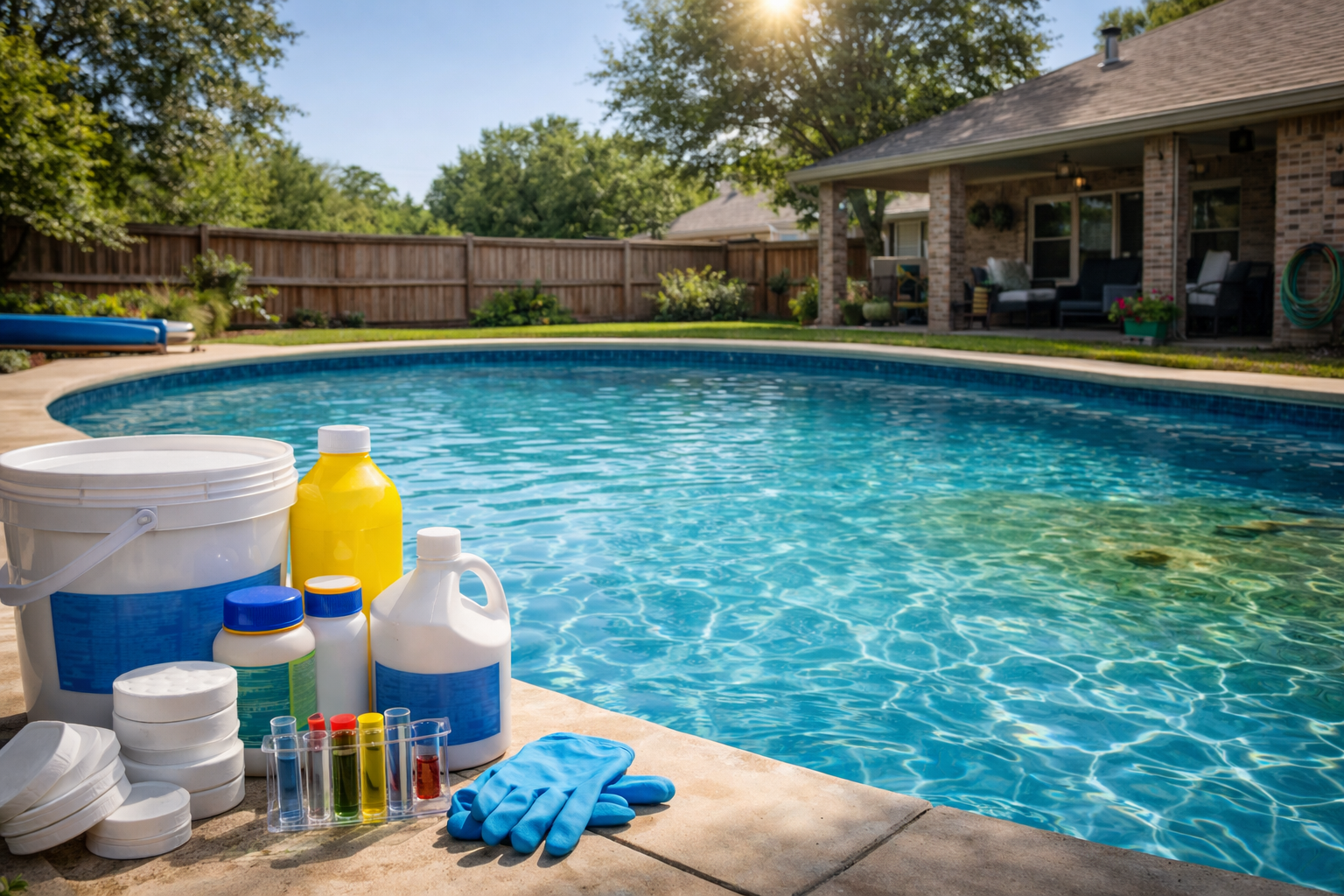
Neglected pools subtract value. A pool in poor condition doesn’t just fail to add value. It actively works against you at resale. Green water, cracked surfaces, and aging equipment give buyers negotiating leverage to push prices down. In Texas summers, a pool that looks fine on Monday can show visible algae growth by Friday if the water chemistry is off. We see this pattern regularly, and it’s one of the strongest arguments for consistent professional pool maintenance.
Frequently Asked Questions
Do above-ground pools add home value in Texas?
No. Above-ground pools add essentially no appraised value and can actually deter buyers. Only inground pools are treated as permanent improvements by Texas appraisers.
Does pool condition affect resale value?
Yes, significantly. A well-maintained pool with recent resurfacing and functioning equipment signals lower repair risk to buyers. A neglected pool with visible wear becomes a negotiating point that reduces the offer price rather than raising it.
Should I install a pool before selling my home?
Probably not, unless you’re in a high-end neighborhood where pools are expected. With a Texas ROI of 30% to 60%, most homeowners take a net financial loss on the installation itself. If a pool already exists and is in good condition, it’s an asset. Installing one specifically to sell is rarely a sound financial move.
How much does a pool add to home value in San Antonio?
With a median home price of approximately $265,750 as of late 2024, a 7% to 10% pool premium would add roughly $18,600 to $26,575 in San Antonio, consistent with what industry appraisers report for Central Texas.
How much does a pool add to home value in Austin?
Austin is one of the strongest pool markets in the country. Redfin’s metro-level analysis ranked Austin second nationally, with pools adding approximately $52,000 to a typical home’s value.
The Bottom Line
Texas pools add more value than in most states, driven by climate, a long swim season, and outdoor-living culture that makes a pool a neighborhood expectation rather than a novelty. Austin leads the state with roughly a $52,000 average premium. Houston, DFW, and San Antonio all show meaningful value-adds depending on neighborhood tier.
But the return on installation is partial. A $70,000 pool may add $21,000 to $42,000 at resale (30% to 60% ROI), meaning homeowners should expect a net financial loss before accounting for years of maintenance, insurance, and property tax increases. That math improves considerably for homeowners who plan to enjoy the pool for five or more years; at that point, the financial gap converts into real lifestyle return. In higher-end neighborhoods where pools are expected, skipping one can actually suppress a home’s competitive position.
The principle that emerges from the data: invest in quality construction, keep the pool meticulously maintained, and choose a design that leaves usable yard space. If you already own a pool, consistent upkeep is the highest-return move you can make.
Bluewater Pools serves homeowners across Austin and San Antonio with weekly maintenance, equipment repairs, and green pool recovery. Our technicians hold CPO, CMS, CPI, RAIL, and OSHA certifications, and we’re a proud member of the Pool & Hot Tub Alliance. If you want to keep your pool in the kind of condition that holds its resale value, reach out to our team to get started.