Pool Opening Costs in Texas: What Homeowners Pay in 2026
Opening a pool in Texas typically costs between $150 and $300, which sits at or slightly below the national average of $300. That advantage comes directly from Texas’s mild winters, which spare most pools the kind of freeze damage that makes spring reopening far more involved in northern states.
At Bluewater Pools, we service pools across the Austin and San Antonio metro areas, and we see firsthand how much the state’s climate shapes these costs. Texas has approximately 801,000 residential swimming pools, making it the third-largest pool state in the country. Many of those owners never formally close their pools at all, which means the spring reopening is less intensive, and less expensive, than it would be elsewhere.
Texas Pool Opening Costs vs. the National Average
Professional pool opening services nationally range from $150 to $500. The table below compiles estimates from major cost-tracking platforms:
Source | Average | Typical Range | Notes |
$300 | $175–$400 | Inground $250–$400; above-ground $175–$250 | |
~$300 | $150–$400 | Inground $250–$400; above-ground $150–$250 | |
$300 | $250–$350 | Low end $175; high end $500 | |
~$440 | $375–$500 | Skews higher; includes spring cleaning | |
~$225 | $150–$300 | Houston one-time service at $118–$126 | |
~$225 | $85–$350 | Widest range reported | |
~$250 | $200–$300 | Combined opening/closing reference | |
N/A | $150–$300 | Spring opening estimate for Texas pools |
Texas-specific costs land consistently at the lower end of national ranges. The main reason: Texas winters are mild enough that most pools don’t require the intensive restoration work common in colder climates.
For context, closing a pool nationally runs $200 to $500, and the combined annual cost of opening plus closing ranges from $450 to $650 according to Fixr. Many Texas homeowners skip that cycle entirely by maintaining reduced winter service rather than formally shutting down their pools.
What’s Included in a Professional Pool Opening
A standard professional pool opening restores a pool from its dormant or reduced-maintenance state back to swim-ready condition. According to Angi, HomeGuide, and Bob Vila, a complete service typically includes:
- Removing, cleaning, and storing the pool cover (including pumping off standing water for solid covers)
- Pulling winterization plugs from return jets, skimmer lines, and plumbing
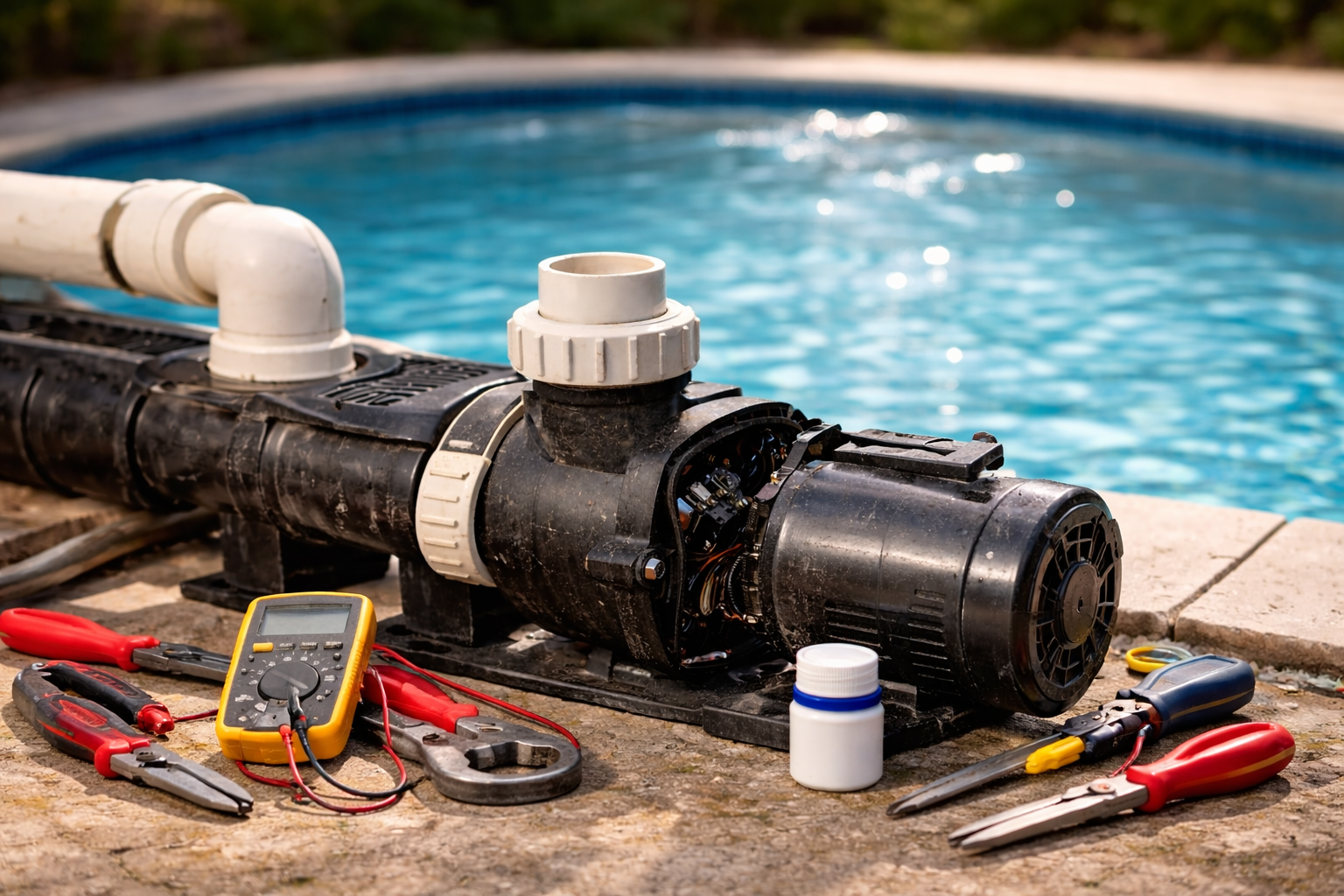
- Reconnecting and starting the pump, filter, heater, chlorinator, lights, ladders, and handrails
- Topping off the water level to the correct skimmer line
- Cleaning or backwashing the filter
- Brushing, vacuuming, and clearing debris from walls and floor
- Testing and balancing water chemistry (pH, chlorine, alkalinity, calcium hardness, cyanuric acid)
- Shock treatment to eliminate bacteria and algae (Angi recommends waiting 1–2 days after shocking before swimming)
Not every opening package covers all of this. HomeGuide reports that some companies charge an extra $40 to $150 for add-ons like vacuuming or chemical balancing that others include in the base price. Always confirm exactly what’s covered before booking.
At Bluewater Pools, every pool cleaning service visit includes specialized underwater vacuuming, surface skimming, skimmer basket cleaning, complete water chemistry testing, and equipment servicing based on your filtration system. You receive before-and-after photos and a detailed report showing every chemical added and your water balance levels.
Individual Service Costs When Extras Apply
When a base opening package doesn’t cover everything, or when a pool needs extra attention after a tough winter, individual service costs add up quickly:
Service | Cost Range | Source |
Chemical treatment and balancing | $40–$150 | HomeGuide |
Pool shock treatment | $25–$50 | Bob Vila |
Equipment inspection (standalone) | $75–$350 | Thumbtack |
Filter cleaning | $60–$65 | Bob Vila, Fixr |
Vacuuming | $80–$360 | Bob Vila |
Pool cover removal and cleaning | ~$125 | HomeGuide |
Acid wash (if needed) | $350–$550 | Bob Vila |
Drain and clean (full) | $500–$700 | Bob Vila |
Hot tub opening (add-on) | $50–$75 | Fixr |
Water feature setup | $50–$100 | Fixr |
Pool service professionals charge $50 to $100 per hour according to HomeGuide, with some markets seeing $70 to $98 per hour per LawnStarter data.
Chemical Costs for Texas Pools
Texas’s intense UV exposure breaks down chlorine faster than in most other states, making stabilizer (cyanuric acid) a critical part of any opening. Individual pool opening chemicals typically cost:
Chemical | Cost |
Chlorine | $15–$80 |
Pool shock | $25–$50 |
Algaecide | $14–$60 |
pH balancer | $15–$40 |
Stabilizer (cyanuric acid) | $20–$30 |
Clarifier | $20–$30 |
Scale/stain remover | $15–$40 |
Most professional opening services include chemicals in their quoted price. DIY chemical kits run $21 to $61 according to HomeGuide, though a full DIY chemical startup typically runs closer to $115 per LawnStarter.
Our weekly residential pool maintenance service in Austin and San Antonio runs $45 to $60 per week, inclusive of all standard chemicals.
Five Factors That Affect Your Pool Opening Cost
1. Pool type
Pool type is the single biggest cost variable. Inground pools cost $250 to $400 to open compared to $150 to $250 for above-ground pools, according to HomeGuide. Angi explains why: inground pools are larger, with bigger pumps and filters that take longer to clean and reinstall.
2. Surface material
Concrete and gunite pools cost $300 to $400 to open because their rough, porous surfaces trap algae and require more labor-intensive cleaning. Fiberglass and vinyl pools cost $250 to $350 thanks to smoother surfaces. The gap widens over time: annual concrete pool maintenance runs $450 to $1,200 versus $300 to $550 for fiberglass per Bob Vila.
3. Pool condition heading into spring
A pool that sat without any winter maintenance may need a full restoration rather than a standard opening. Fixr estimates that unmaintained pools cost at least $500 to reopen. We offer a dedicated green pool cleaning service for these situations. Depending on the severity of algae growth, green pool recovery typically takes one to three service visits.
4. Cover type
Mesh covers allow debris to accumulate throughout winter, which means more vacuuming at opening. Fixr reports mesh-covered pool openings run $300 to $450, compared to $250 to $400 for solid covers.
5. Filter type and added features
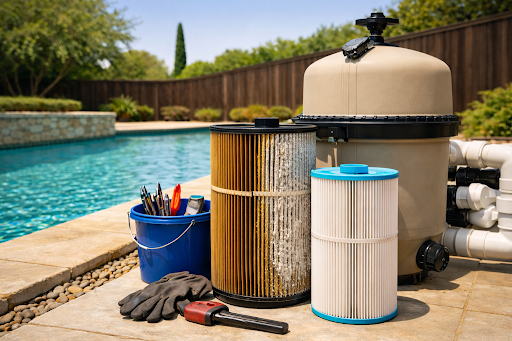
Diatomaceous earth (DE) filters require more involved cleaning and safety equipment compared to sand or cartridge filters, per Angi. Saltwater pools add $20 to $30 for salt cell installation and salinity testing. Each additional feature like water features, specialty lighting, or diving boards adds $30 to $100.
Why Texas Pool Owners Pay Less to Open Their Pools
Texas’s climate fundamentally changes the math on seasonal pool costs. Most homeowners in northern states pay $400 to $600 for full winterization, then a similar amount again for spring reopening. Many Texas owners skip that cycle entirely by reducing service frequency in cooler months rather than formally closing their pools.
The Texas pool season runs roughly 8 to 10 months, compared to just 3 to 5 months in northern states. Regional variation within Texas matters:
- North Texas (Dallas-Fort Worth): Occasional freezes; pool season mid-March through late October. Most DFW owners install freeze guards as a far less expensive alternative to full winterization.
- Central Texas (Austin, San Antonio): Pool season typically mid-March through early November.
- South Texas and the Rio Grande Valley: Near year-round swimming; water temperatures rarely drop below 60°F.
The 2021 Winter Storm Uri is worth noting here. The storm caused widespread equipment damage and pipe bursts across Texas, reinforcing the value of freeze protection systems even in the state’s typically mild climate.
Texas’s heat also creates unique maintenance demands once the season is underway. High temperatures and strong sun cause rapid water loss and chemical imbalance. Summer maintenance costs can increase 20 to 30 percent due to extreme heat, heavy usage, and accelerated chemical consumption. This is why weekly year-round service makes sense for Texas pools: water left unattended in Texas heat can turn green within days.
Ongoing Maintenance Costs After Opening
The one-time opening fee is only part of the picture. Monthly maintenance represents the largest ongoing pool expense, and it varies by pool type and usage.
Expense | Monthly Cost | Annual Cost |
Weekly cleaning visits | $120–$300 | $1,440–$3,600 |
Pool chemicals | $50–$100 | $600–$1,200 |
Electricity (pump, heater) | $30–$150 | $360–$1,800 |
Equipment repairs | N/A | $200–$1,000 |
Total | $200–$550 | $2,600–$7,600 |
Surface material has an outsized effect on long-term costs. Over a 10-year horizon, gunite pools can cost $20,000 or more in maintenance, including acid washing every 3 to 5 years and resurfacing every 10 years (which alone can run $10,000 or more). Fiberglass pools cost substantially less. Vinyl pools fall in between but require liner replacement every 7 to 10 years at $4,000 to $7,000.
DIY vs. Professional Pool Opening
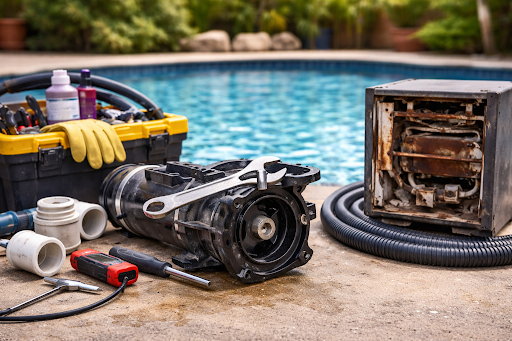
For homeowners weighing whether to open the pool themselves, the math is relatively clear. A professional opening costs $175 to $400 and saves 2 to 6 hours of work. Angi notes that DIY mistakes can flood equipment, cause pump failure, and damage pipes, leading to repairs that quickly outweigh any savings. HomeGuide estimates DIY maintenance saves approximately $1,200 per year over professional service, but that figure doesn’t account for the risk of errors or the value of expert monitoring.
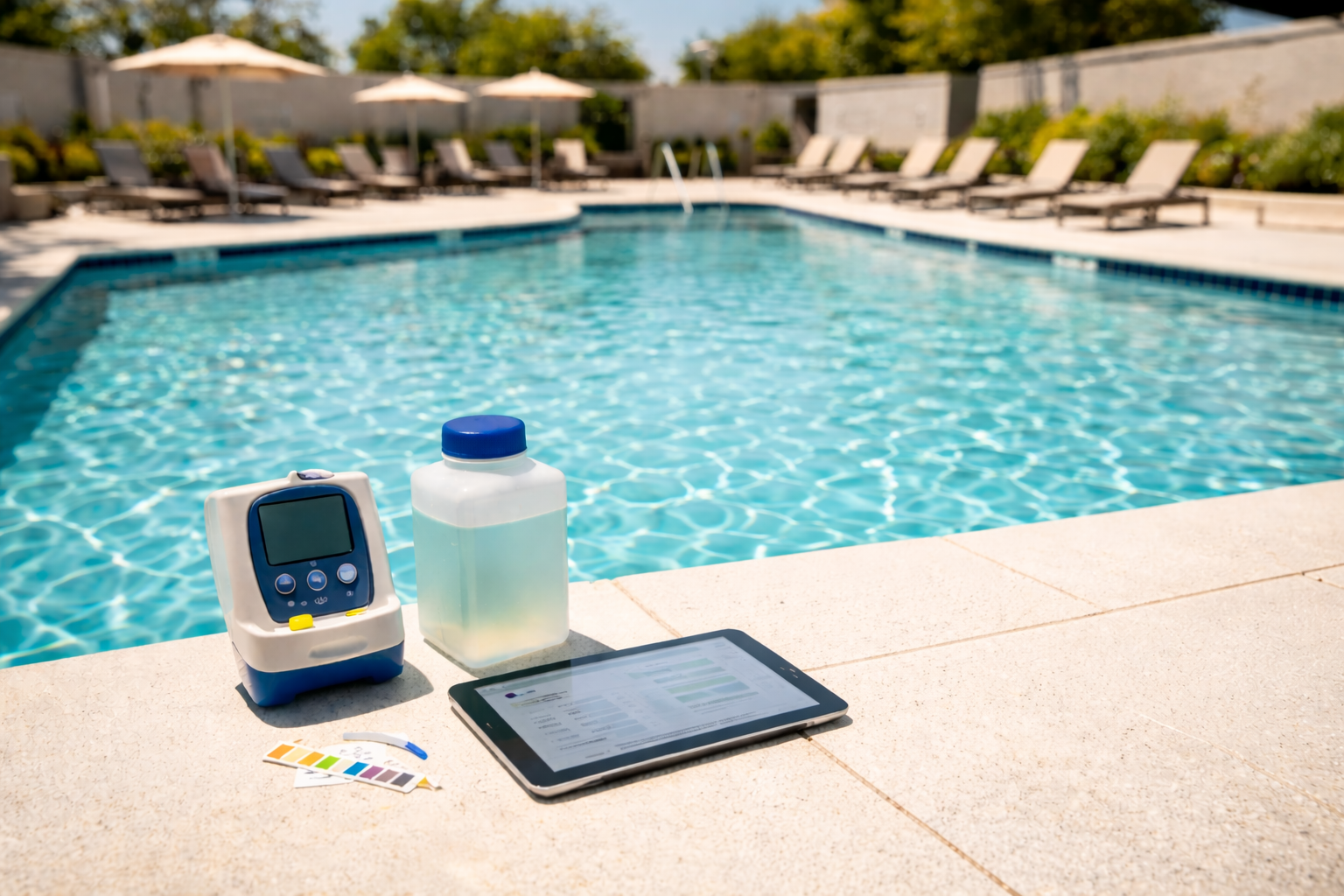
Proper water chemistry requires accurate volume calculations, knowledge of how different chemicals interact, and the right testing equipment. Electronic water analyzers, for example, test for a broader range of parameters than basic test strips, which only check pH and chlorine.
Common Questions About Pool Opening Costs in Texas
How much does it cost to open an inground pool in Texas?
Inground pool openings in Texas typically run $250 to $400 for a standard service, depending on pool size, surface material, and condition. Pools that were properly maintained or covered over winter tend to fall at the lower end of that range.
Do Texas pools need to be closed for winter?
Most Texas pools don’t require full winterization. Many homeowners simply reduce service frequency during cooler months. However, North Texas owners near Dallas-Fort Worth should consider freeze guards to protect equipment during occasional hard freezes.
What makes a pool opening cost more than expected?
The most common cost drivers are a neglected pool condition requiring extra cleaning or chemical treatment, pool covers that allowed debris to accumulate, DE filter systems that require more involved servicing, and add-on features like water features or specialty lighting.
Does pool opening include chemicals?
Most professional opening packages include standard chemicals in the quoted price, but not all do. Some companies charge separately for chemical balancing, shock treatment, or algaecide. Confirm what’s included before booking.
Ready to Get Your Pool Ready for the Season?
If your Austin or San Antonio pool needs a seasonal startup, equipment checkup, or a full green-to-clean restoration, our team is ready to help. Bluewater Pools technicians hold CPO, CMS, CPI, RAIL, and OSHA certifications, and we back every service with before-and-after photo documentation and a detailed chemical report.
Contact us at 512-886-7665 or reach out online to schedule your spring pool opening.