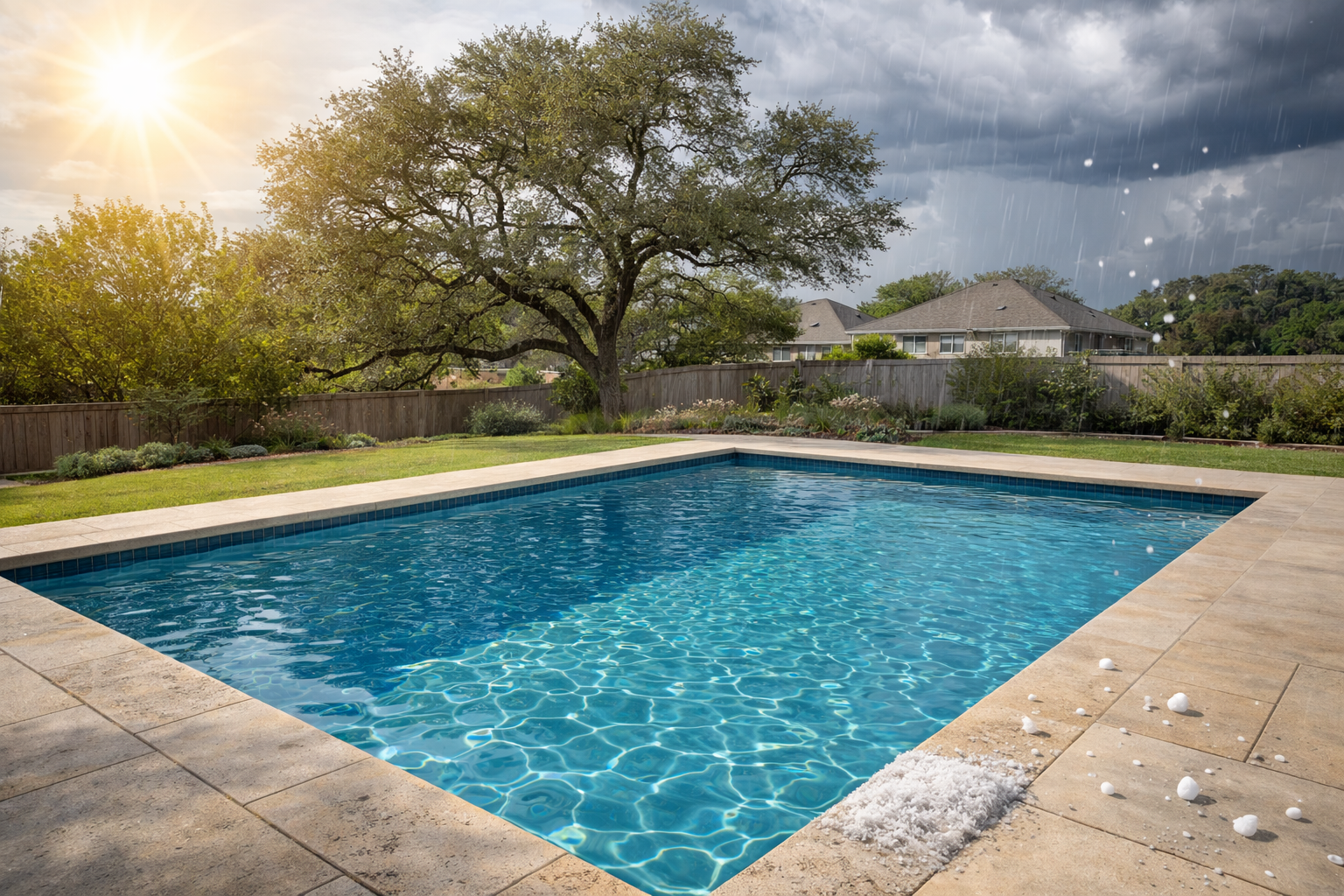
How Extreme Texas Weather Can Affect Your Swimming Pool
Texas is home to roughly 801,000 residential swimming pools, and no state puts those pools through more punishment. Between summer heat that can destroy 90% of your chlorine in two hours, droughts that may make it illegal to refill your pool, freezes that crack plumbing overnight, and hailstorms more frequent than anywhere else in the country, Texas pool ownership demands a level of year-round attention that most other states simply don’t require.
At Bluewater Pool Service, we maintain pools across San Antonio and Austin, and we see the effects of this climate up close every week. The damage isn’t random. Each type of weather event attacks your pool in a specific, predictable way. Understanding those patterns is the first step to staying ahead of them.
Summer Heat: Chlorine Burns Off Fast and Algae Moves In Quickly
Texas summers are defined by sustained, extreme heat. Dallas averages a July high of 96.6°F. San Antonio set a record in 2023 with 75 days above 100°F, shattering the previous record of 59 days set in 2009.
That heat attacks your pool on two fronts simultaneously: it destroys chlorine, and it accelerates algae growth.
How UV Burns Through Your Chlorine
The UV index across Texas regularly reaches 10 to 11 (the “Extreme” category) from May through August, per EPA guidance on the UV Index scale. Under those conditions, unstabilized chlorine has a half-life of just 20 to 45 minutes in direct sunlight. Research published in the Journal of Environmental Engineering and Science found quantum yields near 1.0 for UV photolysis of hypochlorous acid, meaning nearly every UV photon absorbed destroys a chlorine molecule. Without a stabilizer like cyanuric acid, up to 90% of your chlorine can be gone within two to three hours on a clear summer day.
The most common issue we see with new pool owners in Texas is not realizing how quickly the heat can turn a clean pool into a green one. A pool that looks fine on Monday can have visible algae growth by Friday if the chemistry is off.
Why Algae Takes Over So Fast
Algae thrive between 77°F and 86°F, temperatures Texas pools sustain for five months or more. Research published in PMC confirms that cyanobacteria gain a competitive advantage at elevated temperatures, and when chlorine drops below 1 ppm, algae can colonize a pool within hours. If your pool turns green, you’re looking at a full chemical treatment, often requiring multiple shock doses and brushing over several days before the water clears.
Physical Damage to Pool Structure and Equipment
The heat doesn’t just affect water chemistry. Concrete and gunite pool shells undergo thermal expansion at approximately 0.66 inches per 100 feet for every 100°F temperature swing, per National Precast Concrete Association data. Repeated expansion and contraction cycles cause microcracks, spalling, and surface degradation. Pool plaster fades and chalks under sustained UV exposure.
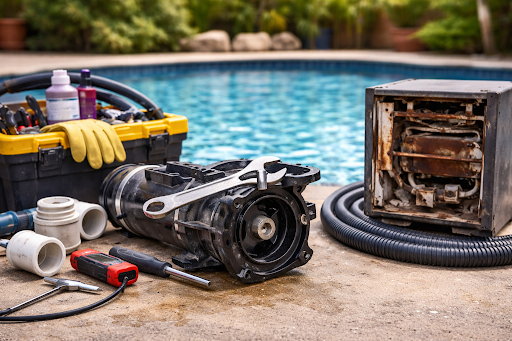
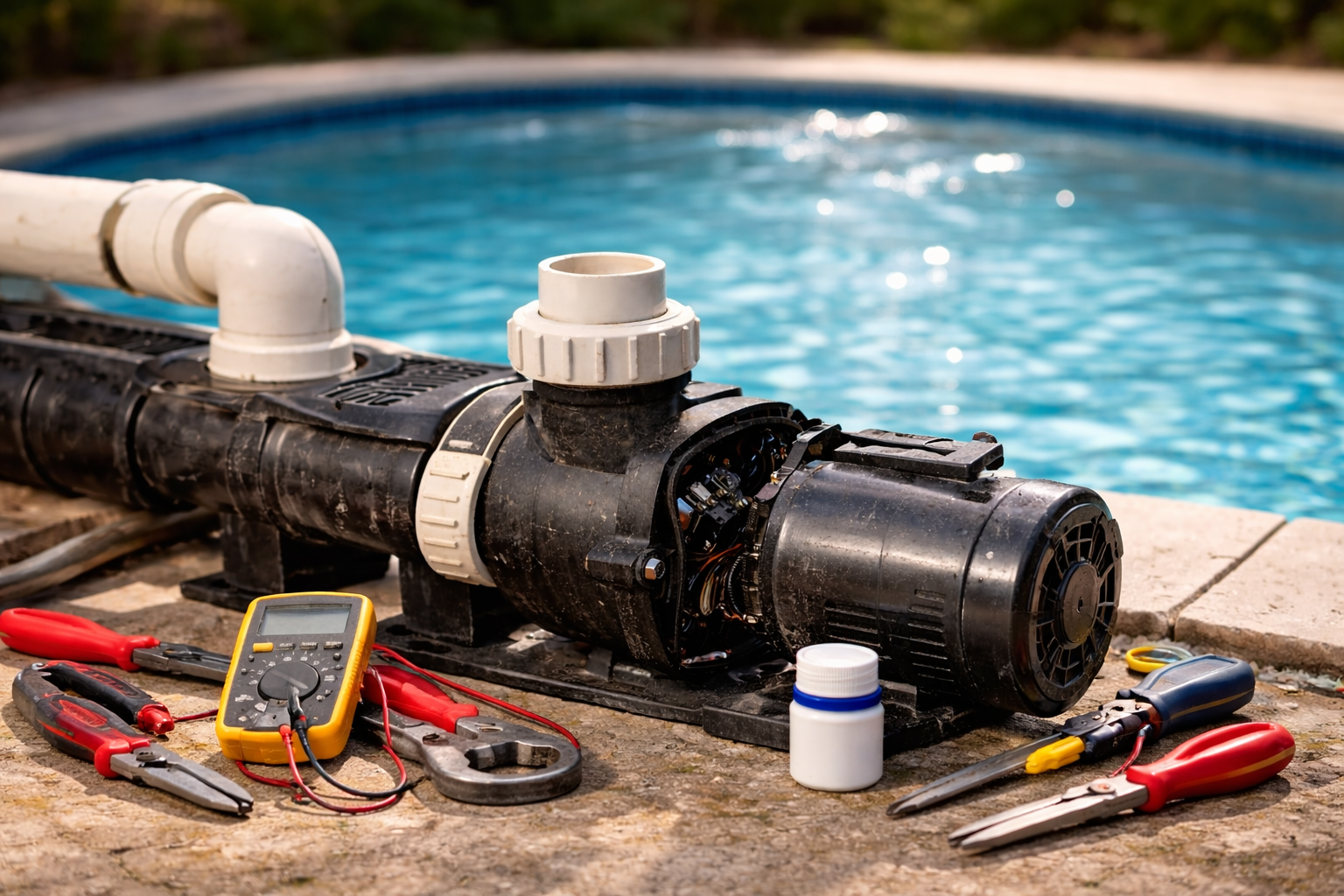
Equipment takes a hit too. Pumps that lose prime due to heat-accelerated evaporation can warp housings, melt shaft seals, and damage PVC fittings. This is one of the more expensive and preventable outcomes of summer maintenance neglect.
Summer Heat Risk | What Happens | Preventive Measure |
UV exposure | Up to 90% chlorine loss in 2-3 hours | Add stabilizer (cyanuric acid) to protect chlorine |
Water temps above 77°F | Algae colonization within hours if chlorine drops | Maintain 2-4 ppm free chlorine |
Evaporation | 900+ gallons lost per week for a standard pool | Monitor water level; check for drought restrictions before refilling |
Thermal expansion | Microcracks in concrete/gunite over time | Schedule annual structural inspections |
Pump overheating | Warped housings, damaged seals | Keep pump area shaded; check for prime weekly |
Drought: When Topping Off the Pool Becomes Complicated
Texas has experienced persistent drought conditions throughout most years since 2000. During those periods, pool owners face a double problem: evaporation accelerates while water supplies shrink.
A typical residential pool loses approximately half an inch of water per day during summer, according to municipal utility data cited by the Town of Flower Mound, Texas. That translates to roughly 909 gallons per week, or about 3,636 gallons per month for a standard 32×13-foot pool.
Water Restrictions Vary Significantly by City
The rules around pool refilling during drought conditions are not uniform across Texas, and the penalties for violations can be steep.
City | Pool Filling Rules During Drought | Max Fine |
San Antonio | Allowed, but triggers surcharge above 12,000 gal/mo at Stage 4; pools must follow watering schedule | $137 per violation |
Austin | Unrestricted through Stage 3; banned at Stage 4 | Up to $1,000/violation |
Dallas | Not prohibited even during drought stages | Varies by stage |
Houston | Restricted to designated watering days at Stage 2 | Up to $2,000/occurrence |
Wichita Falls | Full ban during severe drought (2010-2015) | $500 |
San Antonio’s SAWS drought stage system is tied directly to Edwards Aquifer levels. At Stage 4, a surcharge of $10.37 per 1,000 gallons applies for residential use above 12,000 gallons per month. SAWS has explicitly warned that refilling pools can trigger those surcharges.
If your pool is losing water during a drought restriction period, the answer isn’t always to top it off. Fixing the underlying issue, whether it’s evaporation, a leak, or a splash loss problem, is the smarter move.
Winter Freezes: The Most Expensive Event Most Texas Pools Aren’t Ready For
February 2021’s Winter Storm Uri was a turning point for Texas pool ownership. Every one of Texas’s 254 counties was simultaneously under a winter storm warning for the first time in recorded history, per NOAA’s National Centers for Environmental Information. Dallas-Fort Worth hit -2°F, the coldest reading in 72 years. Waco endured 205 consecutive hours below freezing.
The damage to swimming pools was unlike anything the state had seen. Residential and commercial pool owners watched waterlines burst, pumps freeze, filters shatter, and ice form on water surfaces.
Why Texas Pools Are Especially Vulnerable
The fundamental problem is that Texas pools are almost never winterized because the climate historically doesn’t require it. When 69% of Texas households lost power during Uri, pool pumps stopped circulating and freeze protection systems went dark.
Water expands by approximately 9% when it freezes, generating pressures far beyond what domestic pipes are designed to handle. Pool pumps, heaters, filters, salt chlorine generators, and PVC plumbing lines all contain water that, once static, becomes a destructive force.
The Texas Department of Insurance reported 500,196 total insurance claims from Uri, with estimated total insured losses of $10.346 billion. Many pool owners discovered after the fact that their coverage was incomplete. Progressive Insurance notes plainly that failure to properly winterize a pool in freeze-prone areas means cracks and leaks may not typically be covered.
The Key Rule During a Texas Freeze
Keep the water moving. If your pump is running, the circulating water is much harder to freeze. If you lose power, the priority shifts to manually draining your pump, filter, and heater to prevent cracking.
Winter Storm Elliott in December 2022 tested those lessons, but because the Texas grid held and power stayed on, freeze protection systems functioned and pool damage was far less severe than in 2021. That difference illustrates exactly how much a functioning pump matters.
Hail and Storms: Physical Damage from Above
Texas leads the nation in hail. The state recorded 1,123 major hail events (stones 1 inch or larger) in 2023 alone, per the Insurance Institute for Business and Home Safety using NOAA Storm Prediction Center data. NOAA’s NCEI reports the state averages $338.6 million in annual hail property damage, the highest of any state.
Hailstones above 2 inches can shatter pool tile and coping, pit plaster finishes, puncture pool covers, and crush pump housings and filter tanks. A potentially record-breaking 7.25-inch hailstone was found near Vigo Park, Texas, on June 2, 2024, pending verification by the Texas State Climatologist.
Wind, Tornadoes, and Lightning
Texas averages over 150 tornadoes per year, more than any other state. Straight-line thunderstorm winds of 60 to 100+ mph can rip safety covers from anchors, topple pool fencing, and send patio furniture airborne.
Lightning is a significant threat to equipment. Texas leads the country in total lightning strikes. A nearby strike can destroy pump motors, control panels, salt chlorine generators, and underwater lighting systems through power surges, even if the strike doesn’t hit your property directly.
Heavy Rain: The Chemistry Problem You Might Not Expect
While drought starves pools of water, heavy Texas rain events flood them with the wrong kind.
Rainwater is naturally acidic at pH 5.0 to 5.5. A significant storm dilutes your chlorine, drops your pH, and washes fertilizers, pesticides, animal waste, and organic debris directly into the water. The resulting phosphate spike, combined with diluted sanitizer and warm temperatures, creates near-ideal conditions for an algae bloom.
Pool overflow during intense storms can also flood equipment pads, damage pump motors, and erode decking.
NOAA Atlas 14 updated Texas rainfall frequency estimates dramatically in 2018: in Houston, the 100-year storm rainfall estimate increased from 13 inches to 18 inches in 24 hours. What was previously classified as a 100-year event around Houston is now considered a 25-year event. That shift matters for anyone with a pool in a low-lying area.
What to Do After a Heavy Rainstorm
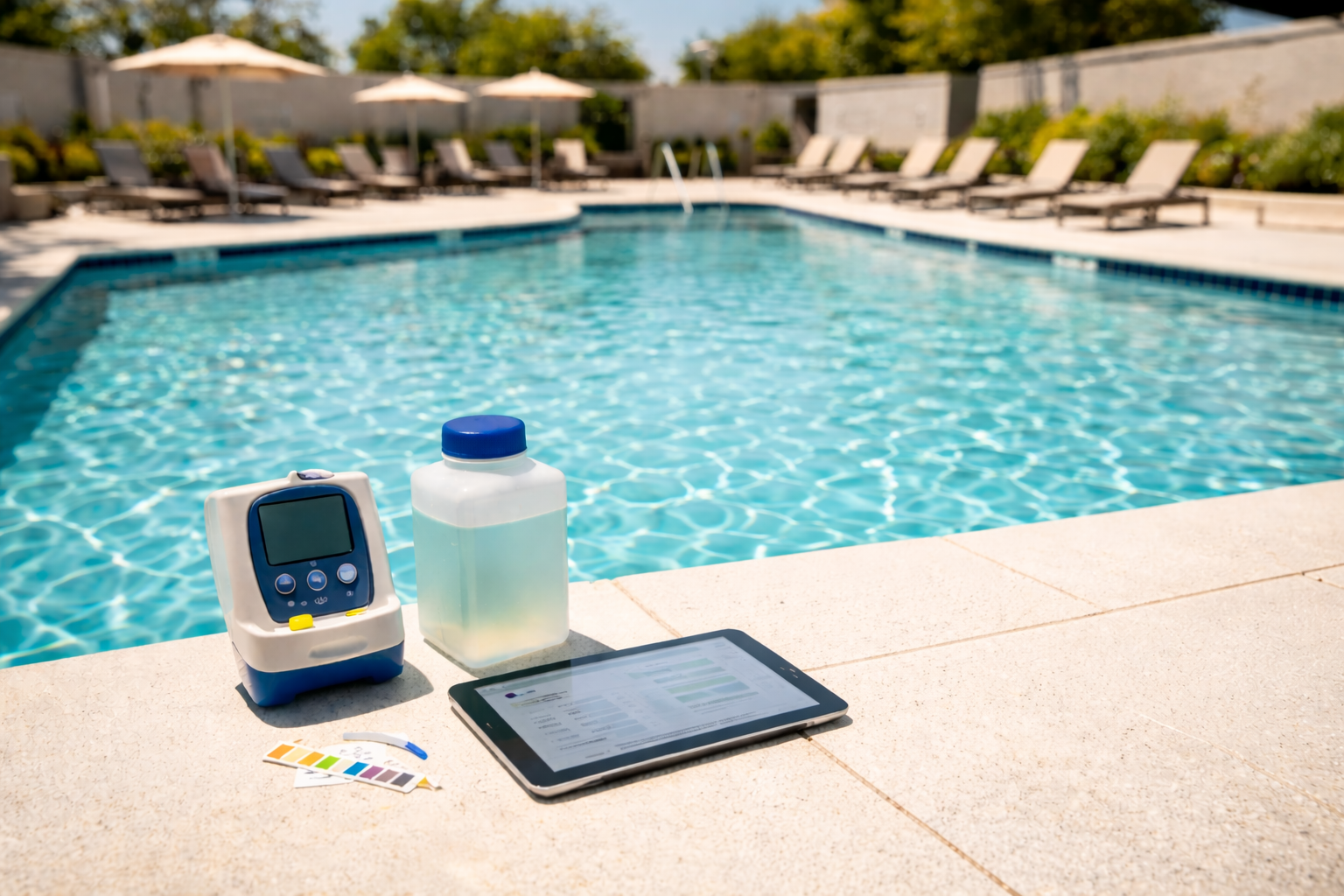
- Test water chemistry within 24 hours of a significant storm
- Shock the pool if chlorine has dropped below 1 ppm
- Brush pool surfaces to disrupt any early algae formation
- Check and clean skimmer and pump baskets
- Inspect equipment pads and surrounding drainage
Hurricane and Flooding Risk: The Structural Threat
Hurricane Harvey in 2017 demonstrated the most severe flooding scenario Texas pools can face. Harvey dumped a U.S.-record 60.58 inches of rain near Nederland, Texas, and more than 136,000 structures flooded in Harris County alone.
Floodwater introduced raw sewage, E. coli, heavy metals, pesticides, and industrial contaminants into pools across the Houston metro area. Research published in Environmental Science and Technology found that Harvey’s floodwaters transported an estimated 1,000 kg of chromium and 650 kg of nickel into Galveston Bay from industrial sites. Post-flood pool water isn’t just dirty. It’s chemically and biologically hazardous in a way that standard treatment can’t quickly overcome.
The most dramatic structural threat from flooding is hydrostatic pressure. When groundwater rises around a drained or partially empty pool, the shell can literally float out of the ground. Houston’s expansive clay soil retains water long after surface flooding recedes, maintaining elevated pressure around pool structures for weeks. The Florida Swimming Pool Association puts it plainly: don’t drain your pool during a flood event. The weight of the water is what keeps the shell anchored.
The Real Cost of Getting It Wrong
Between 1980 and 2024, Texas experienced 190 confirmed billion-dollar weather disasters, with total estimated costs of approximately $436 billion (CPI-adjusted), per NOAA NCEI. Pool investment in Texas ranges from $35,000 to over $100,000. The pool and spa industry contributes more than $2.3 billion and 39,000 jobs to the Texas economy.
The pattern across every weather threat is the same: reactive maintenance fails in Texas conditions. Waiting until something goes wrong, whether it’s an algae bloom, cracked equipment, or a flooded pump pad, costs significantly more than consistent, proactive care.
Protecting Your Pool Year-Round
Texas weather doesn’t follow a seasonal script. Summer UV is destroying chlorine before you finish your morning coffee. Drought restrictions can make topping off the pool a compliance issue. A winter storm can crack your equipment in under 15 minutes if the power goes out. And after any significant rain, your water chemistry is starting from scratch.
At Bluewater Pool Service, our technicians hold CPO (Certified Pool Operator), CMS (Certified Maintenance Specialist), CPI (Certified Pool Inspector), RAIL, and OSHA certifications, the full range of credentials needed to handle every weather scenario Texas throws at a pool. If you’re in the San Antonio or Austin area and want a pool maintenance plan built around the specific demands of this climate, we’d be glad to talk through what that looks like for your pool.
Call us at 512-886-7665 or visit blue pool water to get started.