The Top 5 Reasons Your Pool Chemicals Aren’t Working in Texas
Texas pool owners spend more on chemicals yet deal with worse water quality problems than homeowners in almost any other state. The frustrating part is that the chemicals themselves usually aren’t the problem. The problem is that Texas conditions, extreme UV radiation, very hard water, heavy bather loads, aggressive algae growth, and common application mistakes, create a compounding set of forces that degrade chemical performance far faster than standard pool care guides account for.
At Bluewater Pool Service, we work with pool owners across San Antonio and Austin every day, and these five issues come up constantly. Understanding why your chemicals aren’t doing their job is the first step to fixing it.
1. Texas Sunlight Destroys Unprotected Chlorine in Under Two Hours
The single biggest reason pool chemicals appear to “stop working” is ultraviolet photolysis: the process by which sunlight breaks apart the active sanitizing form of chlorine.
Hypochlorous acid (HOCl) is the molecule that actually kills pathogens. It absorbs UV radiation in the 290–350 nm wavelength range, and when it does, the reaction is permanent: HOCl + UV → HCl + O. The chlorine is destroyed, not temporarily suppressed.
Without a UV stabilizer (cyanuric acid), the half-life of free chlorine in direct midday sunlight is approximately 35 minutes. Within two hours, up to 90% of free chlorine can be gone. This degradation rate is documented in the PHTA Certified Pool Operator program, drawing from foundational photodecomposition research by J.A. Wojtowicz published in the Journal of the Swimming Pool and Spa Industry (Vol. 1, No. 1, 1996).
Texas makes this dramatically worse. Major Texas cities regularly hit UV index values of 9–11 during summer months, classified as “Extreme” by the EPA UV Index Scale. San Antonio averages roughly 300 sunny days per year, compared to the national average of approximately 205. According to the National Renewable Energy Laboratory, Central Texas receives approximately 5.5–6.0 kWh/m²/day of solar radiation during summer, among the highest in the continental United States.
Austin and San Antonio also average 20–30 days annually with temperatures exceeding 100°F. When pool water climbs into the low 90s°F, the Van’t Hoff principle applies: chemical reaction rates approximately double for every 10°C (18°F) temperature increase. Every chemical process in your pool speeds up, including the ones working against you.
The Cyanuric Acid Paradox
Cyanuric acid (CYA) is the solution to UV destruction, and it can also become its own problem.
CYA acts as a UV shield by forming a temporary, reversible bond with HOCl that absorbs UV radiation before it can destroy the chlorine. The industry-standard recommended range is 30–50 ppm, with Texas-specific guidance for professional operators targeting 50–60 ppm during summer.
The issue is that CYA accumulates. The most common chlorine product, trichloroisocyanuric acid tablets (3-inch pucks), is approximately 50% cyanuric acid by weight, adding roughly 0.6 ppm of CYA for every 1 ppm of chlorine delivered. CYA doesn’t degrade, evaporate, or break down through any normal chemical process. It only leaves the pool through physical water removal.
As CYA rises, it holds progressively more chlorine in a protected but inactive state. Water chemistry experts recommend maintaining free chlorine at a minimum of 7.5% of the CYA level to sustain adequate sanitation. Here’s what that looks like in practice:
CYA Level (ppm) | Minimum Free Chlorine Needed (ppm) | Approximate % Active HOCl | Practical Impact |
0 (no stabilizer) | 1.0 | ~97% at pH 7.2 | Maximum killing power; destroyed by UV in under 2 hours |
30 | 2.3 | ~3–5% | Good balance of UV protection and sanitation |
50 | 3.8 | ~2–3% | Ideal for Texas summer conditions |
80 | 6.0 | ~1.5–2% | Upper acceptable limit; noticeably slower kill times |
100 | 7.5 | ~1% | "Chlorine lock" threshold, harsh on swimmers, hard to maintain |
150 | 11.3 | ~0.5–0.7% | Effectively unmanageable |
200+ | 15+ | Less than 0.5% | Pool essentially unsanitized at normal FC levels |
The CDC’s Model Aquatic Health Code (MAHC), 5th Edition, now mandates immediate remediation when CYA reaches 300 ppm or higher, recognizing that excessive stabilizer renders chlorine sanitization ineffective.
The only remedy for high CYA is a partial drain and refill, which is complicated in Texas by drought restrictions that can prohibit pool draining during Stage 2 or higher water conservation measures. This is why our CPO-certified technicians use liquid chlorine (sodium hypochlorite) as the primary sanitizer for Texas pools: it delivers chlorine with zero CYA added.
2. Texas Tap Water Fights Your Chemicals From the Start
The geology beneath Texas fundamentally shapes pool water chemistry before you add a single chemical.
The Edwards Aquifer, which supplies water to much of Central Texas, passes through massive Cretaceous-age limestone and dolomite formations. The dissolution reaction loads the water with calcium (hardness) and bicarbonate (alkalinity) simultaneously.
The USGS classifies water above 180 mg/L as CaCO₃ as “very hard.” Much of Central Texas exceeds this threshold significantly:
City | Primary Water Source | Typical Hardness (mg/L CaCO₃) | USGS Classification |
San Antonio | Edwards Aquifer | 250–380 | Very hard |
Austin | Colorado River / Edwards and Trinity Aquifers | 180–300 | Very hard |
Dallas | Surface reservoirs | 50–110 | Soft to moderately hard |
Houston | Surface + groundwater blend | 60–150 | Moderately hard to hard |
Source: Municipal Consumer Confidence Reports and USGS Water Science School
Why pH Is the Most Important Factor Most Pool Owners Ignore
Chlorine’s killing power depends entirely on pH. The equilibrium between hypochlorous acid (HOCl, the powerful germicide) and the hypochlorite ion (OCl⁻, approximately 80–100 times less effective as a disinfectant) is governed by pH.
pH | % Active Chlorine (HOCl) | Effective Disinfection Power |
7.0 | ~76% | Excellent |
7.2 | ~66% | Good (ideal lower bound) |
7.5 | ~50% | Adequate |
7.8 | ~33% | Declining |
8.0 | ~24% | Poor, ~64% loss vs. pH 7.2 |
8.5 | ~9% | Severely compromised |
Source: White’s Handbook of Chlorination and Alternative Disinfectants, 5th Edition, Wiley, 2010
Texas municipal water is typically delivered at pH 7.5–9.5, raised deliberately for corrosion control under the EPA’s Lead and Copper Rule, with total alkalinity of 150–350 ppm. That’s far above the ideal pool range of 80–120 ppm. From the moment tap water enters your pool, the chemistry is working against effective chlorination.
At pH 8.0, a pool testing 2 ppm free chlorine effectively has only ~0.48 ppm of germicidal chlorine, compared to ~1.32 ppm at pH 7.2. Your test kit shows an adequate reading, but the chlorine isn’t killing pathogens at the rate you need.
Why Pool pH Keeps Drifting Up in Texas
High-alkalinity source water creates a buffering system that resists downward pH correction. When acid is added to lower pH, it converts bicarbonate to carbonic acid, which decomposes to CO₂ and escapes the water surface. As CO₂ leaves, equilibrium shifts and pH climbs back toward 7.8–8.0 within 24–48 hours.
Water features (waterfalls, spillovers), high water temperatures, and saltwater chlorine generators all accelerate this drift. Texas pool owners often need to add acid weekly or more. High calcium hardness also drives scale formation on equipment, tile, and plaster. Scale on salt chlorinator cells alone can reduce chlorine generation efficiency by 30–60%.
3. Swimmers Consume More Chlorine Than You Think
Every swimmer introduces a mixture of nitrogen-containing organic compounds that react with and consume free chlorine. Research by Dr. Ernest R. “Chip” Blatchley III at Purdue University found that urea, the dominant nitrogen compound in sweat and urine, requires approximately 8 moles of chlorine per mole of urea for complete oxidation, making it the single largest chlorine consumer from bather waste (Environmental Science and Technology, 44(22), 8529–8534, 2010).
Research from Delft University of Technology quantified what a typical swimmer brings into a pool per session:
- Sweat: 200–1,000 mL per hour (higher in hot environments)
- Urine: ~50–80 mL per swim session
- Sunscreen, cosmetics, body oils: 0.1–1.5 grams combined
- Total organic carbon release: 100–1,500 mg per bather
The PHTA CPO Handbook estimates a single bather can consume 0.5 to 1.0 ppm of free chlorine per hour in a typical residential pool. A pool party with four to six swimmers on a 100°F Texas afternoon can deplete chlorine from 3.0 ppm to near zero within hours.
Texas amplifies this further. The American College of Sports Medicine confirms sweat rates of 0.5–1.5 liters per hour during moderate activity in temperatures above 90°F. More swimmers, more sweat, more sunscreen, over a season that runs 7–12 months depending on where you are in Texas, means more chemical demand than in any northern state.
Why Your Pool “Smells Like Chlorine” But Isn’t Sanitized
When free chlorine reacts with nitrogen compounds from sweat and urine, it forms chloramines (combined chlorine). These compounds are approximately 25–100 times less effective as disinfectants than free chlorine, according to the WHO’s Guidelines for Safe Recreational Water Environments.
The CDC addresses a widespread misconception here: a strong chemical smell around a pool is not caused by too much chlorine. It’s caused by chloramines, which form when there isn’t enough free chlorine to oxidize contaminants fully. Chloramines also cause the red, stinging eyes swimmers blame on “too much chlorine.”
To destroy chloramines, you need to achieve breakpoint chlorination, adding approximately 10 parts free chlorine for every 1 part combined chlorine measured. Below this threshold, added chlorine partially reacts with existing chloramines without fully destroying them, which actually lowers total chlorine readings. This is what creates the frustrating experience of adding chlorine but seeing levels that won’t come up.
4. Warm Water and Phosphates Create Ideal Conditions for Algae
Algae impose chlorine demand by consuming free chlorine as it oxidizes algal cell walls and proteins, creating a feedback loop where declining chlorine accelerates algae growth, which depletes chlorine further.
Most freshwater algae species reach optimal growth rates between 77°F and 95°F. Texas pool water routinely sits at 85–95°F from June through September, squarely in that optimal zone. Green algae can double in as little as 3–6 hours under these conditions. Cyanobacteria, the organisms behind black algae, can thrive at temperatures up to 104°F.
Mustard algae is particularly problematic in Texas. This chlorine-resistant strain appears as yellowish-brown dust on shady pool surfaces and can survive outside the water on pool toys, swimsuits, and cleaning equipment, leading to constant reinfection. Treating it requires sustained free chlorine levels of 30+ ppm for 48 hours, combined with sanitizing all pool equipment at the same time.
Why Texas Pools Have So Many Phosphates
Phosphates are the primary limiting nutrient for algae growth in freshwater systems, a finding established in landmark research by Dr. David Schindler (Science, 195(4275), 260–262, 1977). Professional pool operators in Central Texas target phosphate levels below 100 ppb in summer and 200 ppb in winter.
Texas pools face an unusually heavy phosphate burden from several sources at once:
- Fertilizer runoff: Bermuda, St. Augustine, and Zoysia grasses all require regular phosphorus-containing fertilization. Rain events wash that fertilizer into pools via deck runoff.
- Municipal tap water: Many Texas water systems add orthophosphate or polyphosphate-based corrosion inhibitors, delivering phosphates at concentrations of 500–3,000 ppb in fill water.
- Pollen: Texas’s extended pollen seasons (cedar December–February, oak February–May, grass April–October) deposit massive organic loads that decompose and release phosphates and nitrogen. Oak catkins and cedar pollen are waxy and hydrophobic, floating on the surface and creating sludge that blinds filter media while stripping chlorine through oxidant demand.
A single storm event can spike phosphate levels above 1,000 ppb. When that happens, algae can overwhelm even pools that had adequate chlorine because the nutrient load outpaces the sanitizer’s capacity. Texas pool water can turn green in as little as 3–5 days without proper chemical balance. This is why weekly pool maintenance matters so much more here than in most other states.
5. When and How You Add Chemicals Matters as Much as What You Add
Even with a solid understanding of water chemistry, the timing and sequence of chemical application determines whether treatments actually work.
Shocking During the Day Wastes the Treatment
Adding unstabilized chlorine (calcium hypochlorite or sodium hypochlorite) during midday Texas sun exposes the treatment to immediate UV photolysis, losing 50%+ of the added chlorine within the first two hours. The optimal time to shock is after sunset, when 8–10 hours of darkness allow elevated chlorine to work on contaminants without UV degradation. The PHTA CPO Handbook explicitly recommends evening application for shock treatments.
pH Has to Be Corrected Before Adding Sanitizer
Adding chlorine to water at pH 8.0 means only ~24% of that chlorine will be in the active germicidal form, compared to ~66% at pH 7.2. A shock treatment added to high-pH water wastes roughly two-thirds of its sanitizing potential before it contacts a single pathogen.
The correct order of operations, per PHTA CPO training:
- Total alkalinity (adjust first, it’s the pH buffer foundation)
- pH (adjust second, determines chlorine efficacy)
- Calcium hardness (adjust third, affects scaling and surface protection)
- Cyanuric acid (adjust fourth, determines chlorine longevity)
- Free chlorine (adjust last, now it can work at full effectiveness)
Not Brushing Before Shocking Leaves the Problem Intact
Algae and bacteria form protective biofilm layers on pool surfaces. Weekly brushing of walls, steps, and floors disrupts this biofilm, exposing organisms to the sanitizer. Without brushing first, a shock treatment only addresses free-floating organisms while surface-dwelling colonies survive and rapidly recolonize.
Consumer Test Strips Miss Important Detail
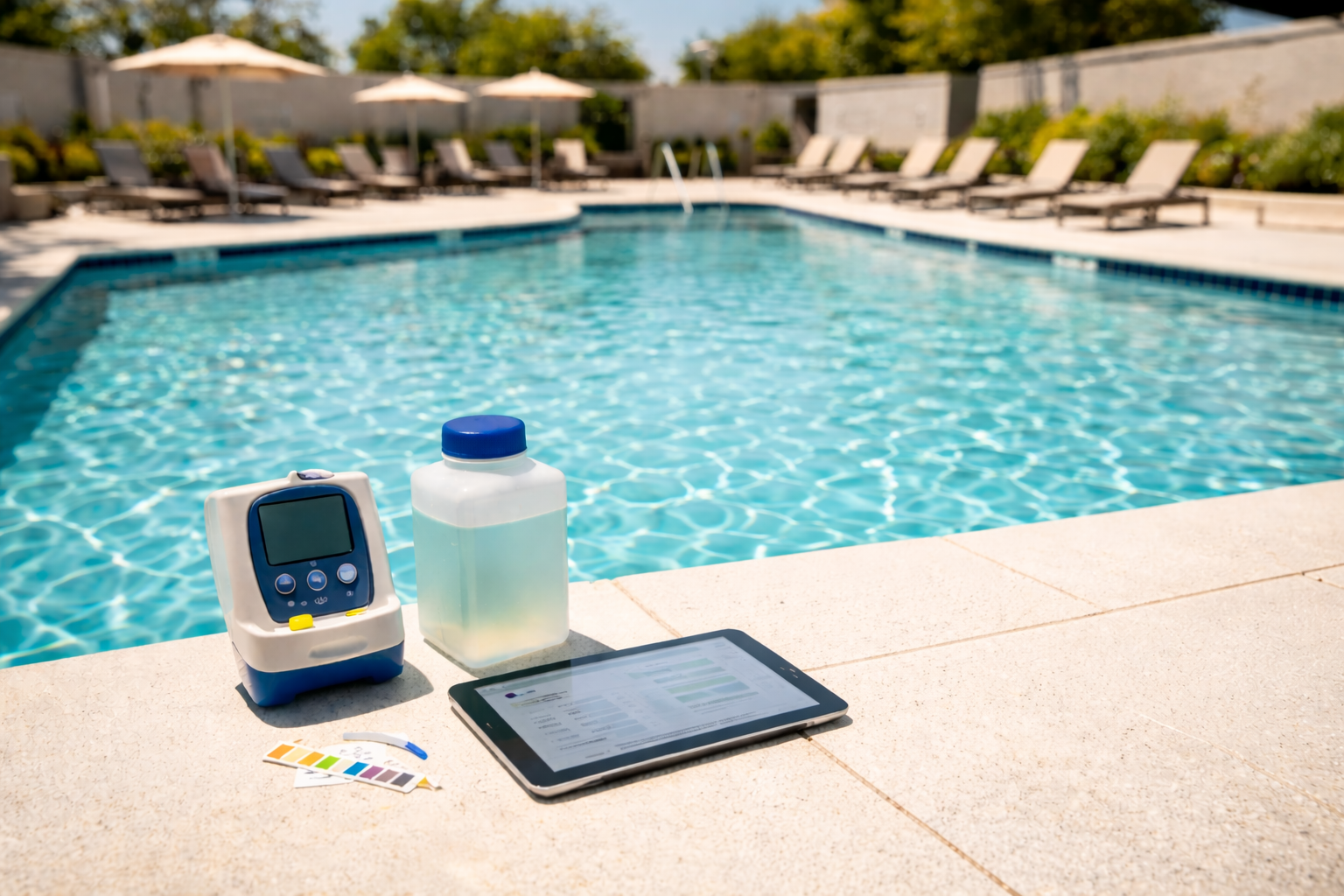
Consumer test strips carry a margin of error of approximately ±0.4 pH units, enough to read pH 7.6 when the actual value is 8.0. That’s the difference between scale-forming and corrosive water. Professional testing with photometric analyzers tests 10+ parameters simultaneously with far greater precision, which is what our CPO-certified technicians use on every visit.
How These 5 Problems Compound Into Bigger Water Quality Issues
These five factors don’t operate independently. High pH reduces HOCl availability while UV simultaneously destroys it. CYA accumulation from stabilized chlorine use (driven by extreme UV loss) further reduces the active fraction. Heavy bather loads and algae consume what little effective chlorine is left. Improper timing and application waste the replacement chemicals.
The result is a pool that tests “adequate” on a consumer test strip but is actually under-sanitized. The chemicals aren’t absent; they’re just not in the right form to work.
For Texas conditions specifically, adjusted chemistry targets make a real difference:
- Free chlorine: 4–6 ppm (standard national guidelines target 1–3 ppm, which is insufficient for Texas)
- pH: 7.2–7.4 (lower than many guides recommend, to compensate for hard, alkaline source water)
- Total alkalinity: 70–90 ppm (lower than standard guidance to reduce pH bounce)
- CYA: below 60 ppm (managed carefully to avoid chlorine lock)
These adjustments reflect the specific conditions of Texas pool water: extreme UV, limestone-derived hardness and alkalinity, and a pool season that can run 7–12 months depending on the region.
Frequently Asked Questions
Why does my pool turn green so fast in Texas?
Texas pool water can turn green in as little as 3–5 days when chlorine drops. Warm water temperatures (85–95°F in summer), high phosphate loads from fertilizer runoff and municipal water, and intense UV degradation all work together to accelerate algae growth beyond what a weakened sanitizer can control.
Why does my pool smell like chlorine but still look cloudy?
That smell is chloramines, not free chlorine. Chloramines form when free chlorine reacts with nitrogen compounds from sweat, sunscreen, and other organic matter. They’re far less effective as disinfectants than free chlorine and signal that your chlorine is being consumed faster than it’s being replaced. The fix is breakpoint chlorination: adding approximately 10 parts free chlorine for every 1 part combined chlorine.
How often should I check pool chemistry in Texas?
Weekly testing at minimum during the swim season. Given Texas’s UV intensity, extreme heat, and hard water, chemistry can shift significantly between visits. Quarterly testing with professional-grade equipment is also worth scheduling to catch CYA accumulation and other parameters that basic test strips can’t measure accurately.
What is the right cyanuric acid level for a Texas pool?
50–60 ppm is generally recommended for Texas during summer, slightly higher than the standard 30–50 ppm guidance to compensate for extreme UV intensity. Above 80 ppm, kill times slow noticeably. Above 100 ppm, maintaining safe chlorine levels becomes very difficult. If CYA is already high, the only remedy is a partial drain and refill.
Is liquid chlorine better than tablets for Texas pools?
For managing CYA levels, yes. Trichlor tablets (3-inch pucks) add roughly 0.6 ppm of CYA for every 1 ppm of chlorine delivered. Liquid chlorine (sodium hypochlorite) adds zero CYA. Using liquid chlorine as your primary sanitizer gives you much better control over CYA accumulation, which is especially important across a long Texas swim season.
Get Your Texas Pool Chemistry Right
Understanding these five factors is the foundation of reliable pool water quality in Texas. Standard national guidelines weren’t written for conditions where UV indexes hit 11, tap water arrives at pH 8.5 with 300 ppm hardness, and pools spend six months above 85°F.
If you’re tired of battling your pool’s water chemistry, Bluewater Pool Service provides professional pool cleaning across San Antonio and Austin with CPO, CMS, CPI, RAIL, and OSHA-certified technicians, computerized water analysis, and quarterly advanced testing. We’re a BBB A-rated member of the Pool & Hot Tub Alliance. Give us a call at 512-886-7665 or contact us here.