Commercial Pool Service Costs in Texas (2026 Pricing Guide)
Commercial pool service in Texas typically costs $400 to $2,000+ per month, depending on the facility’s size, type, and service frequency. Large facilities with high bather loads can expect total annual operating costs well above $100,000 when you factor in chemicals, equipment, repairs, and compliance requirements.
Texas commercial pool maintenance costs run measurably higher than the national average. The state’s year-round swimming season, extreme UV exposure, and strict health regulations under 25 Texas Administrative Code Chapter 265 create a cost profile that facilities in cooler, seasonal states simply don’t face. At Bluewater Pools, we service commercial facilities across San Antonio and Austin, and we see firsthand how those climate and compliance factors stack up.
This guide breaks down what commercial pool service actually costs in Texas, what’s driving those costs, and what state law requires of operators.
What Commercial Pool Service Costs in Texas
Monthly service rates vary widely based on pool size and facility type:
Facility Type | Estimated Monthly Cost |
Small community pool | $400–$800/month |
Medium commercial pool | $800–$1,200/month |
Large commercial facility | $1,000–$2,000+/month |
Hotel or resort (daily service) | $1,500–$3,000+/month |
For annual maintenance costs, Angi breaks out estimates by pool volume:
Pool Size | Estimated Annual Maintenance |
Small (under 10,000 gallons) | $800–$1,200 |
Medium (10,000–20,000 gallons) | $1,200–$1,800 |
Large (20,000+ gallons) | $1,800–$3,000 |
Commercial (50,000+ gallons) | $10,000–$20,000+ |
Per-visit labor rates range from $75 to $150 per hour (Angi), with HomeAdvisor reporting a similar range of $75 to $100 per hour. The bigger cost driver at the commercial level is frequency: most commercial pools require two to five service visits per week, compared to once weekly for residential pools. That gap in service frequency is the single largest reason commercial contracts cost so much more.
For total annual operating costs at large facilities, an aquatics operations analysis published on LinkedIn by consultant Gal Moyal estimated a large commercial pool at roughly $107,609 per year, broken down as gas heating ($41,209), electricity ($16,400), water and backwash ($22,500), chemicals ($5,000), and additional operating costs.
How Commercial Contracts Differ from Residential Service
The cost difference between commercial and residential pool service goes beyond price per visit. Commercial contracts are structurally different in almost every way:
Feature | Residential | Commercial |
Contract durationMonth-to-month or annual | Month-to-month or annual | 12–36 months, often with auto-renewal |
Service frequency | Once per week | 2–5x per week; daily for hotels |
Chemical testing | Weekly | Every 2 hours (Class A/B) or 3x daily (Class C with staff) |
Compliance burden | Minimal | Health department inspections, VGB Act, CPO certification |
Record-keeping | Minimal | Written logs retained 2+ years |
Cancellation notice | Flexible | 60–90 days are typically required |
Insurance | Basic | Proof of commercial liability insurance often required |
At Bluewater Pools, our commercial pool service covers daily, weekly, and seasonal maintenance plans that include cleaning, equipment upkeep, inspections, and compliance support. We work with hotels, apartment complexes, community centers, and government facilities, including the Special Warfare Aquatic Training Pools at Lackland Air Force Base.
Six Factors That Drive Commercial Pool Pricing in Texas
1. Pool Volume and Surface Area
A 50,000-gallon community pool holds roughly five times more water than a standard 10,000-gallon residential pool. Chemical dosing scales with water volume, which is why larger pools see steeper monthly invoices. HomeGuide puts annual commercial chemical costs at $5,000–$15,000+.
2. Facility Type and Service Frequency
Hotels and resorts typically require daily service with high aesthetic standards. Apartment complexes and HOAs average two to three visits per week. Municipal and community pools face the strictest regulations and the highest bather loads. Water parks have the highest operating costs of any category.
3. Bather Load
High traffic burns through sanitizer fast. Texas’s 25 TAC §265 sets maximum-occupancy formulas based on pool surface area, and facilities near those limits incur chemical costs of $200–$300 per month, compared to $50–$75 for lightly used pools.
4. Equipment Complexity
Facilities with automatic chemical feed systems, variable-speed commercial pumps, and electronic water chemistry controllers face significantly higher purchase and maintenance costs than those using residential-grade equipment. These systems are standard at high-bather-load facilities but add substantially to the service budget.
5. Texas Climate
Summer maintenance costs run an estimated 20–30% above base costs due to accelerated chemical consumption, heavy usage, and evaporation. The state’s extended pool season, 8–10 months in Central and North Texas and year-round in South Texas for most commercial facilities, means operators cannot offset summer costs with a true off-season.
6. Regulatory Compliance
Permits, annual inspections, certified operator staffing, and equipment upgrades for code compliance all add both direct and indirect costs. These are covered in detail in the section below.
Texas Regulations That Affect Commercial Pool Costs
Texas commercial pools are governed by 25 TAC Chapter 265, Subchapter L, administered by the Texas Department of State Health Services (DSHS). The current version became effective April 26, 2024, incorporating the 2021 International Swimming Pool and Spa Code.
Pool Classifications
Texas classifies commercial pools into three categories:
- Class A: Competitive aquatic events
- Class B: Open to the general public
- Class C: Hotels, apartments, condos, private clubs, HOAs, schools
Each classification carries different staffing, testing, and safety requirements under 25 TAC §265.182.
Water Testing Requirements
Testing frequency is one of the most cost-impactful regulations:
- Class A and B pools: Disinfectant and pH tested every 2 hours when open
- Class C pools with on-site staff: Tested 3 times per day
- Class C pools without on-site staff: Tested once per day
Required Chemical Ranges
Texas mandates specific chemical ranges that must be maintained at all times:
| Parameter | Minimum | Maximum |
|---|---|---|
| Free chlorine | 1.0 ppm | 8.0 ppm |
| Bromine | 3.0 ppm | 10 ppm |
| pH | 7.0 | 7.8 |
| Combined chlorine | — | 0.4 ppm max |
| Cyanuric acid (outdoor only) | — | 100 ppm max |
Cyanuric acid is prohibited in indoor pools and spas. Records must be maintained on-site for a minimum of two years.
CPO Certification Requirement
Every public pool and spa must be maintained under the supervision of a certified pool operator (CPO through the Pool & Hot Tub Alliance) or an Aquatic Facility Operator (AFO through NRPA). Class B pools require a minimum of two lifeguards at all times, each holding current lifeguard, first aid, and CPR certifications.
Federal VGB Act Compliance
All public pool drain covers must meet ANSI/APSP/ICC-16 2017 anti-entrapment standards. Single-drain pools require secondary anti-entrapment systems (Safety Vacuum Release Systems), which cost $1,000–$3,000+. VGB-compliant drain covers cost $50–$500+ each.
Non-compliance penalties range from $10–$200 per violation per day for a first offense, escalating to $10–$1,000 per day plus up to 30 days in jail for repeat offenders. Counties and municipalities can order immediate pool closure.
Inspection Costs by City
Texas requires annual inspections of all commercial pools conducted by DSHS or local regulatory authorities. Several major cities add their own requirements and fees:
City/County | Annual Permit Fee | Inspection Frequency | Re-Inspection Fee | Notable Requirements |
Houston | Required | Annual, unannounced | $196.18 | Working flowmeters enforced since Feb 2024 |
Dallas | $20/pool + $20 each additional | Annual | Citation for non-permit | City-specific "Manager of Operations" cert |
San Antonio | $229.69 (up to 2 pools); $75.19 each additional | Annual + complaint-based | — | Aligned with 25 TAC Chapter 265 updates |
Austin | Annual (fee schedule effective Oct 2025) | Annual | — | Pre-opening inspection for new/remodeled facilities |
Tarrant County | — | 2 inspections/year | — | Covers 34 cities + DFW Airport; scores posted publicly |
Cities like Dallas require their own Manager of Operations certification in addition to the state CPO requirement, adding another layer of compliance costs.
Individual Service and Equipment Costs
Chemical Treatments and Cleaning
| Service | Cost Range |
|---|---|
| Chemical balancing per visit | $15-$35 |
| Pool shock treatment | $25-$50 |
| Algae removal/shock treatment | $150-$400 |
| Acid wash | $250-$550 |
| Drain and clean | $500-$700 |
| Annual chemical costs (commercial) | $5,000-$15,000+ |
ServiceResidential RangeCommercial-Grade RangePump repair$250–$800Higher for commercial HP unitsPump replacement$300–$1,600$1,800–$6,500+ (3–7.5 HP)Filter replacement (with labor)$250–$1,700$1,500–$2,600+Commercial gas heater (200K–500K BTU)N/A$3,500–$22,000Commercial heat pumpN/A$9,400–$10,000Salt chlorine generator (commercial)N/A$2,800–$16,300Chemical controller systemN/A$2,500–$5,200Pool resurfacing (commercial)—$15,000+ for large pools
Neglected pumps and heaters commonly cost $500 to $2,000 to replace. Improper pH management alone can destroy a heater’s heat exchanger at a replacement cost of $1,500 or more. Most of those failures are preventable with consistent weekly service and proper water chemistry management.
How Texas Heat and Weather Inflate Costs
Intense UV radiation can destroy up to 90% of a pool’s free chlorine in a two-hour window without proper cyanuric acid stabilization. When water temperatures exceed 90°F, which is common throughout a Texas summer, chemical reaction rates roughly double. Chlorine is consumed faster, pH drifts more quickly, and algae can establish in hours rather than days.
Evaporation adds a continuous cost. Texas pools can lose more than two inches of water per week in summer, requiring regular refilling that dilutes chemical concentrations and adds to water bills. Central Texas pools face an additional challenge: water from the Edwards Aquifer contains high levels of calcium carbonate, requiring precise management to prevent scaling or corrosion.
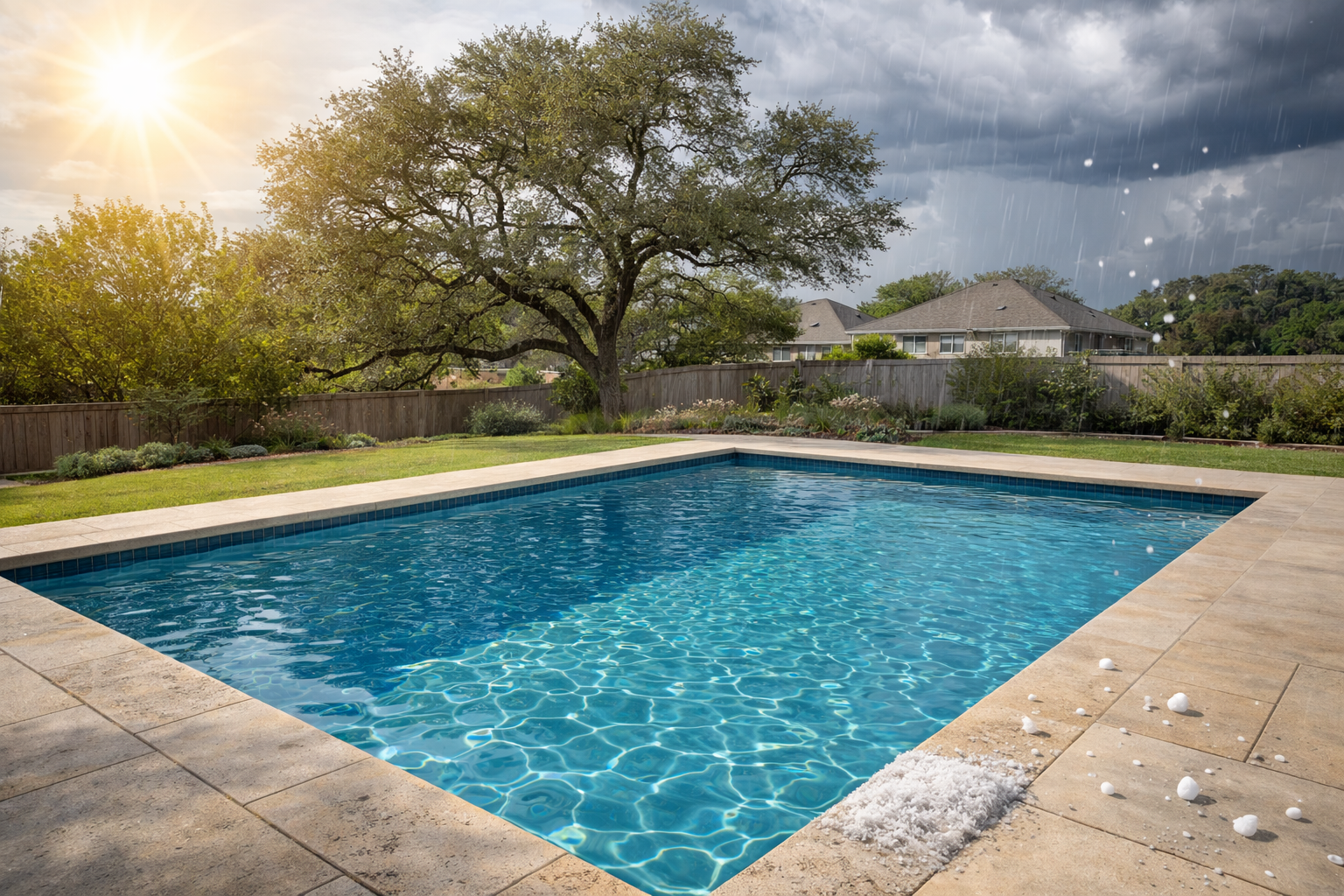
Severe weather events create acute cost spikes. The February 2021 Winter Storm Uri caused catastrophic damage to pool equipment statewide through frozen pipes and cracked equipment. Even in normal years, the Dallas–Fort Worth area averages 29 days below freezing annually (NOAA/NWS data). Heavy spring thunderstorms introduce debris and contaminants, dilute pool chemistry, and can trigger algae blooms requiring immediate rebalancing at $40–$60 per extra visit.
Drought restrictions add operational complexity. Austin has enforced permanent year-round conservation watering restrictions since 2016. Pools are generally permitted during drought stages to maintain equipment integrity. Still, pool covers may be required when not in use, and some municipalities prohibit filling new pools during high-restriction stages.
Texas vs. National Average Costs
| Cost Category | Texas | National Average |
|---|---|---|
| Monthly residential pool service | $100–$300/month | $80–$150/month |
| Annual residential maintenance | ~$1,400 average | $960–$1,800 |
| Pool season length | 8–12 months | 3–5 months (North) |
| Summer chemical cost premium | +20–30% above base | Varies by region |
| Year-round service months (commercial) | 12 months | 5–8 months (seasonal states) |
The most significant cost differential is structural. A facility paying $1,500/month in Texas accumulates $18,000 in annual savings. The same facility in a state with a six-month season pays $9,000. That 100% premium is driven almost entirely by climate.
Frequently Asked Questions
Q: How much does commercial pool service cost per month in Texas?
A: Most commercial facilities in Texas pay $400–$2,000+ per month. Hotels and high-traffic facilities at the higher end of that range typically require daily service.
Q: Is a CPO required for commercial pools in Texas?
A: Yes. Every public pool and spa in Texas must be maintained under the supervision of a certified pool operator (CPO) or an Aquatic Facility Operator (AFO), per 25 TAC §265.194.
Q: How often do commercial pools in Texas need to be inspected?
A: Texas requires annual inspections of all commercial pools by DSHS or local regulatory authorities. Some cities, including Houston and Tarrant County, conduct two inspections per year.
Q: Why is pool maintenance more expensive in Texas than in other states?
A: The primary driver is the extended season. Texas commercial facilities pay for 12 months of professional service, where comparable facilities in seasonal-climate states pay for 5–8 months. UV-driven chlorine loss, summer evaporation, and high bather loads compound those baseline costs.
Q: What is the Virginia Graeme Baker Act, and how does it affect pool costs?
A: The VGB Act requires all public pool drain covers to meet ANSI/APSP/ICC-16 2017 anti-entrapment standards. Single-drain pools also require Safety Vacuum Release Systems, which cost $1,000–$3,000+. Non-compliant facilities face inspection failures and fines.
Work with a CPO-Certified Commercial Pool Service in Texas
Managing a commercial pool in Texas means balancing strict regulatory requirements, extreme weather, and high bather loads simultaneously. The cost of getting it wrong adds up fast, whether that’s penalty fines, premature equipment failures, or a compliance lapse that forces a temporary closure.
At Bluewater Pools, our technicians hold CPO, CMS, CPI, RAIL, and OSHA certifications. We’re active members of the Pool & Hot Tub Alliance and hold a BBB A-rating. We serve commercial pool clients across San Antonio and Austin, including apartment complexes, community pools, and government facilities.
Contact us or call 512-886-7665 to talk through your facility’s needs.