Pool Equipment Repair Costs in San Antonio: What to Expect in 2026
San Antonio homeowners should budget between $150 and $4,000 for most pool equipment repairs in 2026, with costs running 5–15% higher than two years ago due to tariffs, rising labor rates, and new federal energy regulations. The most common repairs – pump work, filter service, and heater fixes – typically fall between $150 and $1,200. Full equipment replacements can reach $4,000–$7,500 for premium systems.
At Bluewater Pools, we’ve worked with hundreds of pool owners across the San Antonio and Austin metros since 2020, and we see these cost realities play out every week. This guide breaks down what specific repairs cost, what’s driving up prices in 2026, and how to make smarter decisions about when to repair versus replace.
What San Antonio’s Climate Does to Pool Equipment
San Antonio’s heat doesn’t just make pools more appealing – it makes them harder to maintain. The city logged a record 162 days at or above 90°F in 2025, and the swimming season stretches roughly 4.5 months, with average summer highs of 95–96°F in July and August.
That kind of sustained heat puts serious stress on equipment. Pumps run longer hours. Heaters cycle more aggressively during the spring and fall shoulder seasons. And San Antonio’s hard water from the Edwards Aquifer accelerates calcium buildup on filters, salt cells, and heating elements – shortening the lifespan of equipment that might last longer in a milder climate.
The Pool & Hot Tub Alliance (PHTA) characterizes the Texas market as having a distinct “June–August emergency repair peak as extreme heat stresses equipment.” That tracks with what we see in the field – summer is when equipment that was already struggling tends to fail completely.
Texas has approximately 801,000 residential pools, the third most in the country behind Florida and California. The San Antonio metro has grown by roughly 205,000 residents since April 2020, and new pool construction actually fell 17% in 2025 to just 622 permits. The takeaway: more pools, less new construction, and an aging installed base. Repairs and maintenance are increasingly where the market lives.
Pool Equipment Repair Costs in 2026: A Full Breakdown
The table below compiles current cost data from Angi, HomeAdvisor, HomeGuide, and Thumbtack, alongside Texas-specific ranges where available. We’ve cross-referenced these against what we’re seeing in the San Antonio market.
Equipment | Repair Cost Range | Replacement Cost Range | Texas-Specific Range |
Pool pump | $150–$700 | $700–$4,000 | $250–$800 (repair); $600–$1,200 (replace) |
Pool motor | $50–$300 | $250–$800 | $200–$650 |
Sand filter | $50–$350 | $250–$1,000 installed | $150–$600 |
Cartridge filter | $50–$200 | $250–$1,200 installed | $75–$200 |
DE filter | $200–$500 | $550–$1,300 installed | $200–$800 |
Gas heater | $150–$750 | $1,500–$5,500 installed | $300–$1,200 |
Heat pump heater | $200–$1,200 | $2,500–$7,500 installed | $300–$1,200 |
Salt cell | N/A | $200–$1,000 (cell only) | $300–$1,000+ |
Pool light | $65–$150 | $450–$1,700 per light | $65–$1,700 |
Automation system | Varies | $2,500–$7,500 installed | - |
Leak detection | $100–$1,000 | N/A | - |
Leak repair | $350–$2,700 | N/A | - |
Service call / diagnostic | $45–$150/hour | N/A | - |
Pool pump repair and replacement
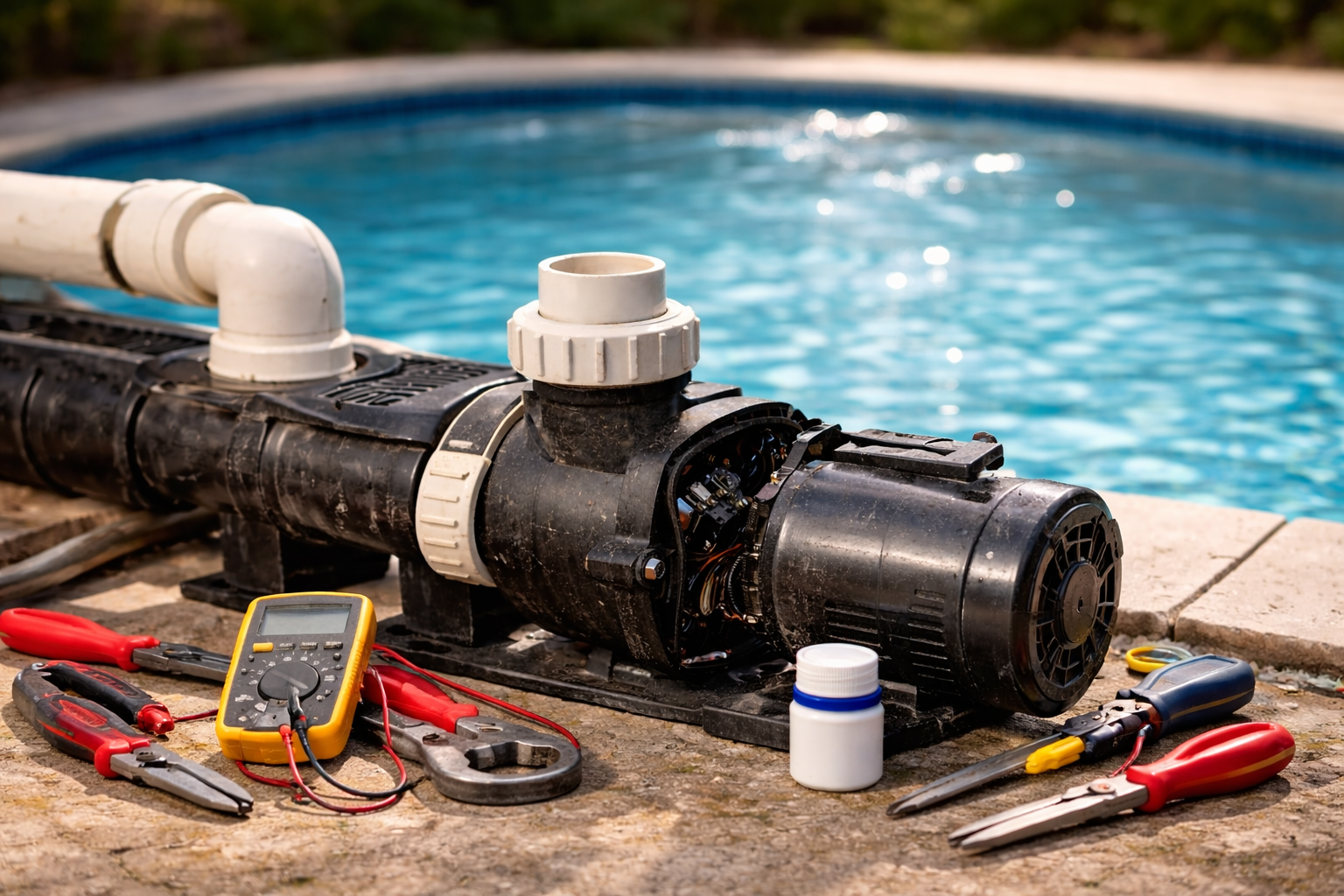
The pump is the most common repair call we handle at Bluewater’s San Antonio service area. According to Angi, the average pool pump repair runs $350, with most falling between $150 and $500. Full replacements average $1,300 nationally, though most homeowners spend between $700 and $4,000 depending on the pump type and installation complexity.
Pool heater repair
Heater repairs average $478 nationally, according to Angi. HomeAdvisor breaks this down by type: electric heat pumps run $200–$1,200 to repair, natural gas heaters cost $150–$750, and solar heaters run $50–$400. In San Antonio, gas heaters – the most common type here – typically land in the $300–$1,200 range.
Pool filter service
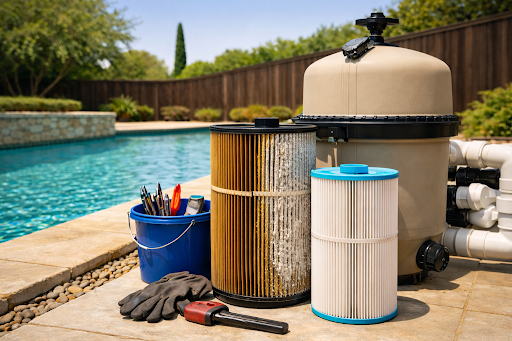
Filter costs vary significantly by type. Cartridge filters are the most affordable to service ($75–$200 in Texas), while DE filters sit at the high end ($200–$800). Sand filters fall in the middle at $150–$600. These are also services where timing matters – filters serviced during the off-season typically come with faster turnaround.
Salt cell replacement
Salt cells need replacement every 3–7 years. HomeGuide puts the replacement cost at $600–$1,000 for the cell alone, with Texas homeowners typically spending $300–$1,000+ depending on the system. This is a predictable expense that we recommend building into any long-term pool budget.
Pool lights
Pool light costs surprise a lot of homeowners. Angi reports the average replacement runs $625 per light, with a range of $450–$1,700. LED upgrades sit at the higher end ($600–$1,500) but last significantly longer than incandescent alternatives – often 25,000–50,000 hours versus 1,000–5,000 for older bulbs.
Why Pool Repair Costs Are Rising in 2026
Three forces are converging to push repair costs higher, and San Antonio homeowners face all of them at once.
Tariffs on imported parts
The most immediate pressure is trade policy. Broad tariffs on Chinese imports took effect in 2025, and ProValet reported in March 2025 that these tariffs led to a nearly 10% increase in pool service material costs. A critical detail: while most pool pumps are manufactured domestically, most of the motors inside those pumps come from China. That pass-through cost affects nearly every repair involving pump work.
The PHTA’s tariff policy tracker documents a complex and evolving structure, with U.S.-China tariffs at various points capped at 30% under a temporary truce. The practical impact: parts costs that were already climbing are climbing faster.
Labor now makes up 60% of your bill
According to Bankrate’s 2025 cost analysis, home repair costs have risen approximately 4% in the past year and about 61% over the past decade. Labor now accounts for roughly 60% of the total cost of repair projects. Pool repair labor charged to customers typically runs $75–$150 per hour, according to Angi, on top of parts and service call fees.
Federal energy regulations are changing what you can buy
The Department of Energy’s Dedicated-Purpose Pool Pump (DPPP) rule, in effect since 2021, requires most new in-ground pool pumps to use variable-speed technology. A September 2025 expansion closed what the industry called the “replacement motor loophole” – as of that date, replacement motors of 1.15 THP or greater must also be variable-speed.
Variable-speed pumps cost more upfront, but the DOE estimates average life-cycle savings of $2,140, with a payback period of under one year. The International Energy Agency has found that variable-speed pumps can reduce residential pool energy consumption by 60–80%. When a single-speed pump fails, the mandatory upgrade to variable-speed technology is worth the premium.
Repair vs. Replace: How to Make the Right Call
The industry standard rule is simple: if a repair costs more than 50% of the cost of replacement, replace the equipment. One pool industry source frames it clearly: “If the repair bill exceeds 50% of the pool pump replacement cost, it’s almost always better to replace.”
Here’s how that applies to common equipment:
Equipment | Avg Lifespan | Replace When... |
Pool pump (in-ground) | 8–12 years | Repair exceeds ~$650 (50% of avg replacement) |
Pool pump (above-ground) | 5–10 years | Multiple component failures or motor burnout |
Gas pool heater | 5–10 years | Repair exceeds ~$1,500 |
Electric heat pump | 10–15 years | Compressor failure or refrigerant leak |
Pool filter housing | 10+ years | Structural cracks or warping |
Salt chlorine generator cell | 3–7 years | The cell no longer produces adequate chlorine |
Pool automation system | 5–7 years | Multiple relay failures or obsolete software |
Beyond the 50% rule, energy efficiency matters. A failing single-speed pump is an opportunity: replacing it with a variable-speed model – now required by federal regulations for most in-ground pool pumps – can save $500–$600 per year on electricity. At that rate, even a premium variable-speed pump, installed for $1,500–$2,500, pays for itself within two to four years.
When to Schedule Repairs (Timing Affects Cost and Availability)
San Antonio’s repair costs aren’t constant throughout the year. Spring and early summer are peak demand – homeowners rush to get pools operational, and equipment that struggled through winter tends to fail completely once heavy use resumes.
Homeowners who can schedule non-emergency repairs during the October–February window typically find better availability and potentially lower prices. This is especially true for filter cleaning, light replacement, and automation upgrades – work that doesn’t need to happen during swim season.
Our pool maintenance services include proactive assessments during the fall and winter that can catch failing equipment before it becomes an emergency repair in June. The cost difference between a planned off-season repair and an emergency summer call can be meaningful.
What to Look for in a San Antonio Pool Repair Company
Texas has specific licensing requirements that many homeowners don’t know about. Any pool service work involving electrical components – including pump, motor, heater, light, or automation system replacement – requires a Residential Appliance Installer License (RAIL) from the Texas Department of Licensing and Regulation (TDLR). The exam has a pass rate of approximately 28%, and unlicensed work carries fines starting at $2,000 per occurrence.
Before hiring any repair company, verify:
- RAIL license – check via the TDLR website
- PHTA certifications – look for CPO (Certified Pool & Spa Operator), CMS (Certified Maintenance Specialist), or CST (Certified Service Technician)
- Liability insurance and workers’ compensation – request certificates
- Written estimates – scope, parts, labor, timeline, and warranty terms
- Manufacturer authorization – particularly if your equipment is from Pentair, Hayward, or Jandy, as unauthorized work can void warranties
- Payment structure – no more than 25% deposit upfront, with final payment only after completed work
The BBB also recommends choosing companies that have been in business for at least a few years and have verifiable local references. BBB spokesperson Carl Bates put it plainly in a February 2026 interview: “So many times we find people get references from their supposed contractor and they never call those references and check them out.”
Our technicians at Bluewater hold CPO, CMS, CPI, and OSHA certifications, a RAIL license, and an active Pool & Hot Tub Alliance membership – and we’re a Jandy Preferred Warranty Service Station, which means authorized repairs for Jandy equipment that preserve your manufacturer’s warranty. We also carry authorization for Hayward and Pentair equipment. You can learn more about our pool repair services or check our BBB A-rating, which we’ve maintained since March 2021.
The Bottom Line
For most San Antonio pool owners in 2026, the realistic repair budget looks like this:
- Minor repairs (filter cartridge, light fixture, minor pump work): $75–$500
- Mid-range repairs (pump repair, heater repair, salt cell): $300–$1,200
- Major repairs or replacements (full pump replacement, heater replacement, automation system): $1,000–$7,500
Three things are bending costs upward: tariffs adding roughly 10% or more to imported parts, labor that now represents 60% of your total bill, and DOE mandates requiring variable-speed technology for most pump replacements.
The strategies that save money are fairly consistent: schedule non-urgent repairs in fall or winter, apply the 50% rule before authorizing expensive repairs on aging equipment, and when a single-speed pump fails, invest in the variable-speed upgrade – the energy savings make it a sound decision.
Ready to get your pool equipment assessed before the summer rush? Contact Bluewater Pools to schedule a service call in San Antonio. We’ll give you an honest evaluation of your equipment’s condition and clear pricing before any work begins.