
How to Choose the Best Pool Service in Austin, TX (2026)
Choosing a pool service in Austin is not the same as choosing one in Dallas, Denver, or Phoenix. Austin’s specific combination of extreme UV, hard alkaline municipal water, year-round swim season, and seasonal pollen events creates maintenance demands that a generic pool company with minimal training is poorly equipped to handle. Choose the wrong service and you’re looking at thousands in equipment damage, recurring algae problems, and water that’s unsafe to swim in.
We’ve helped dozens of Austin pool owners get their water dialed in at Bluewater Pool Service, and the issues we inherit from previous providers tend to follow predictable patterns. This guide will walk you through what actually matters when evaluating a pool service in Austin, not just the obvious stuff, but the local-specific factors that most comparison guides miss.
Why Austin Pools Require More Than Basic Maintenance
Before you can evaluate a pool service, it helps to understand what they’re up against.
According to the National Weather Service, Austin’s normal daily highs reach 90°F by late May and hold there through late September. KUT Radio reports the city now averages roughly 37 triple-digit days per year, up from about 11 in the early 1900s. When water temperatures exceed 90°F, chemical reaction rates roughly double for every 18°F increase, which means chlorine burns off dramatically faster and algae can establish in hours rather than days.
Then there’s the UV problem. Austin’s UV index peaks at 10-12 (Extreme) from April through August. Research into outdoor pool chemistry shows that UV radiation breaks down free chlorine by roughly one-third per hour when cyanuric acid levels are insufficient. Without proper stabilizer management, an Austin pool can lose up to 90% of its chlorine in just a few hours of peak sunlight.
Austin’s water supply adds another layer of complexity. Austin Water’s annual quality reports show the municipal supply draws from the Colorado River through the Highland Lakes system. The water registers a hardness of approximately 184 parts per million, right at the threshold between “hard” and “very hard” on the USGS scale. The naturally high pH (approximately 8.82) requires frequent chemical adjustment to keep pool water in the ideal 7.2-7.6 range.
Austin Climate Factor | Data | Impact on Pools |
Days above 90°F per year | 123 (NWS 1991-2020 normals) | Accelerated chlorine consumption, algae risk |
Peak UV index | 12 (Extreme), April-August | Rapid chlorine degradation without stabilizer |
Water hardness | ~184 ppm (hard to very hard) | Calcium scale on tile, equipment, plumbing |
Swim season length | 6+ months (April-October) | Extended maintenance obligation |
Annual rainfall | ~35.5 inches, heaviest in May/October | Post-storm chemical dilution, debris influx |
Any pool service worth hiring understands these dynamics and accounts for them. A company that treats Austin pools like northern pools with a six-month season is going to miss the mark consistently.
What Licenses Actually Matter in Texas
Texas licensing for pool companies is nuanced, and the gaps are where unqualified operators hide.
The state does not require a license for basic cleaning (skimming, vacuuming, and chemical balancing). However, any work involving electrical equipment (pumps, motors, underwater lights, heaters, timeclocks, salt chlorine generators) legally requires a Residential Appliance Installer License (RAIL) from the Texas Department of Licensing and Regulation (TDLR). The business itself must hold a Residential Appliance Installation Contractor (RAIC) license, which requires minimum insurance of $300,000 per occurrence and $600,000 aggregate.
The RAIL exam has an approximately 28% pass rate. TDLR fines for unlicensed work start at $2,000 per occurrence, and unlicensed work can expose you as the homeowner to liability.
You can verify any company’s license status at tdlr.texas.gov/LicenseSearch. Do this before signing anything.
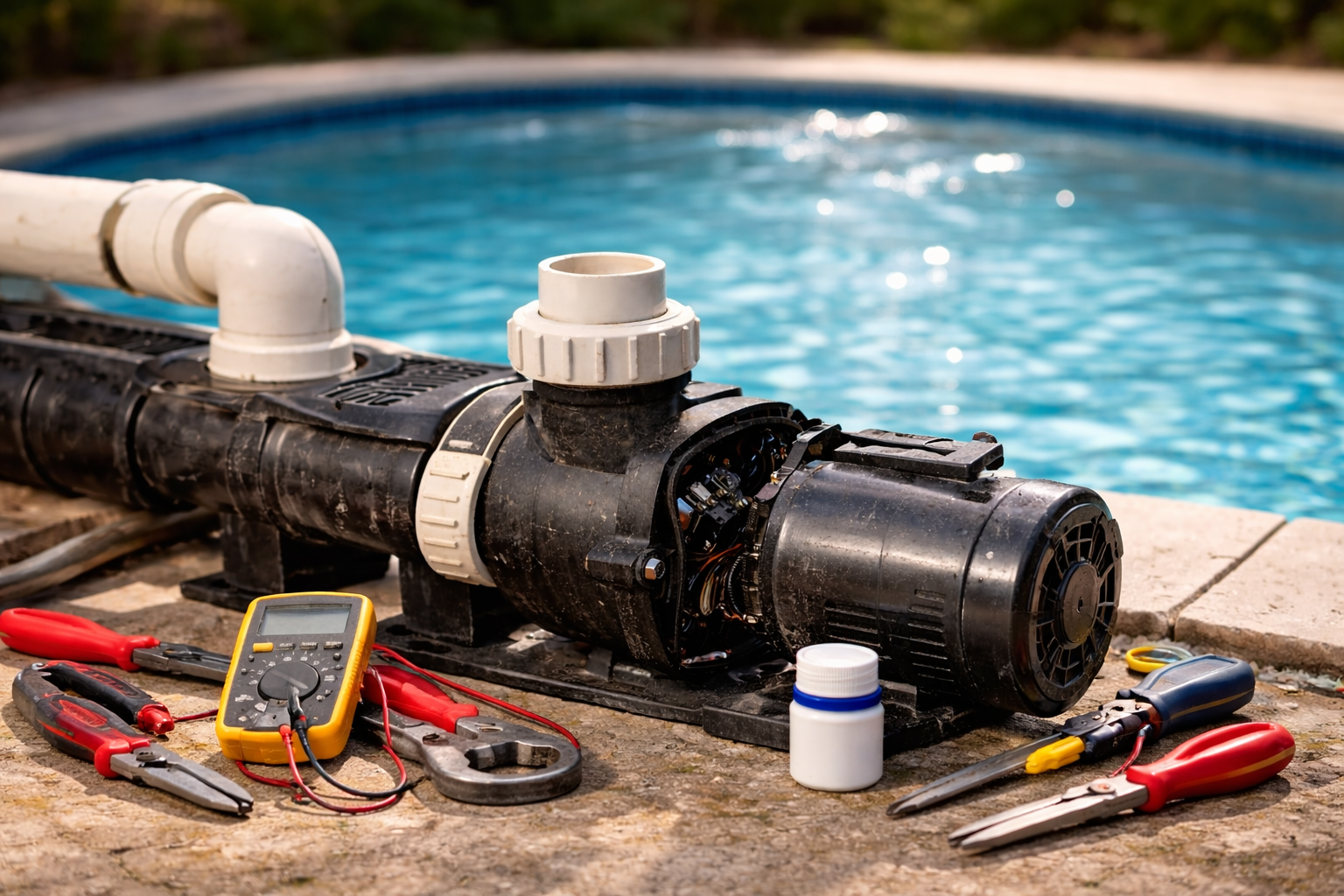
At Bluewater Pool Service, all our technicians hold RAIL licensing, which means we’re legally authorized to diagnose and repair pumps, motors, and electrical pool equipment. This matters because a service that can only clean your pool but can’t legally touch the equipment leaves you calling a second company every time something goes wrong.
Certifications: What They Mean and What to Look For
Beyond licensing, professional certifications tell you whether a technician actually understands water chemistry. The Pool & Hot Tub Alliance (PHTA) administers the industry’s most recognized credentials.
Certification | Issuing Body | What It Signals |
CPO (Certified Pool & Spa Operator) | PHTA | Foundation water chemistry and operations knowledge |
CMS (Certified Maintenance Specialist) | PHTA | Entry-level maintenance competency |
CST (Certified Service Technician) | PHTA | Intermediate troubleshooting, hydraulics, electrical (2 yrs exp. required) |
CSP (Certified Service Professional) | PHTA | Highest service credential in the industry (5 yrs + CST required) |
RAIL (Residential Appliance Installer) | TDLR (Texas) | Legally required for pool electrical equipment work |
The CPO is the baseline. More than 700,000 students have trained through the CPO program since 1973. Any company doing pool maintenance at a professional level should have CPO-certified technicians at minimum.
Our technicians at Bluewater carry CPO, CMS, CPI (Certified Pool Inspector), and OSHA certifications in addition to RAIL licensing. We’re also active members of the Pool & Hot Tub Alliance, which keeps us connected to ongoing training and industry standards. If a company can’t tell you which specific certifications their technicians hold, that’s worth taking seriously.
Austin’s Hard Water Problem (and Why Your Pool Service Needs to Know About It)
Most homeowners don’t think about water chemistry beyond “is the chlorine level okay.” In Austin, that’s not enough.
Austin’s water, drawn from ancient limestone bedrock, contains total dissolved solids of approximately 172-248 ppm and sulfate levels around 58 mg/L. This produces persistent calcium scale deposits on tile lines, inside heaters, on filter elements, and inside salt chlorine generators. Scale buildup reduces equipment efficiency, shortens component lifespan, and creates rough surfaces that harbor algae.
The elevated natural pH of Austin’s tap water also means pool owners must add acid more frequently to maintain balance. Left unchecked, high-pH water combined with high calcium hardness creates conditions for calcium carbonate precipitation, the chalky white deposits that are a common headache for local pool owners.
Professional technicians address this through regular acid washing, sequestrant treatments to keep minerals in solution, and monitoring the Langelier Saturation Index (LSI), a calculation that factors pH, temperature, calcium hardness, alkalinity, and total dissolved solids to predict whether water will scale or corrode. Austin’s water chemistry baseline requires more expertise and attention to maintain proper LSI balance than in cities with softer water.
When interviewing a pool service, ask specifically how they handle Austin’s hard water. If they don’t know what LSI is, keep looking.
What Pool Service Costs in Austin
Austin pool service costs run slightly above the national average, driven by the extended swim season and summer chemical demands. According to HomeYou Austin pool data, a typical full-service visit runs $105-$112. Monthly maintenance plans for weekly service range from approximately $125 to $300 per month in Central Texas.
For comparison, national averages from major consumer platforms run lower: HomeGuide cites $80-$150/month nationally, while Thumbtack reports roughly $86/month for weekly service across all markets. The Austin premium reflects the reality that pools here require service for a longer season with more aggressive chemical demands.
Beyond routine maintenance, budget for these common expenses:
- One-time deep clean or green pool recovery: $150-$350 (HomeGuide)
- Pump replacement: $700-$1,300 (HomeAdvisor)
- Filter replacement: $1,500-$2,000
- Salt cell replacement: $400-$700 every 3-7 years (accelerated in Austin due to hard water scale)
- Total annual ownership costs (maintenance, repairs, electricity, water, insurance): $3,000-$6,000/year (HomeGuide)
Full winterization services are largely unnecessary in Austin, where pools typically stay operational year-round. However, freeze protection inspections before cold snaps are important. The approximately 12 sub-freezing days per year at Camp Mabry can cause serious damage to pipes and equipment if freeze guards aren’t functioning.
Austin’s Four Seasons, Each With Different Demands
One thing that catches new Austin pool owners off guard: the off-season doesn’t really exist here, and each season brings its own specific maintenance challenges.
Spring brings heavy oak pollen that coats every outdoor surface, particularly from late March through early April. May is Austin’s wettest month, with pools facing constant debris influx and chemical dilution from storms.
Summer is the most demanding period. With water temperatures regularly exceeding 90°F and UV peaking at 12 (Extreme), weekly shock treatments become essential rather than optional, and twice-weekly water testing is recommended during peak heat. Algae, including stubborn black algae, can establish within hours in poorly balanced water.
Fall brings relief from heat but introduces oak and pecan leaf drop that overwhelms skimmer baskets. Ragweed pollen peaks from late September through October, adding organic matter that feeds algae and clogs filters. October is Austin’s second-wettest month, averaging 3.9 inches of rain.
Winter is perhaps the most counterintuitive season. Mountain cedar (Ashe juniper) releases pollen from December through February that local meteorologists have described as resembling “yellow smoke.” This massive pollen output clogs filters, deposits organic matter into pool water, and introduces phosphates that promote algae growth, all during a season when many owners assume their pool needs minimal attention.
A pool service that doesn’t understand these seasonal dynamics will be caught off guard repeatedly throughout the year.
What Good Service Looks Like Operationally
Beyond certifications and licensing, the operational practices of a pool company tell you a lot about their reliability.
Look for these specifics:
- Dedicated technician assignment. The same person should service your pool each visit so they develop familiarity with your specific equipment and water chemistry patterns.
- Post-visit service reports. Reputable companies send before-and-after photos and water chemistry readings after each visit. This creates accountability and a record you can reference if problems develop.
- Advance communication. Text notifications before arrival aren’t just courteous, they’re a sign of an organized operation.
- Proper water testing equipment. Basic test strips aren’t sufficient for Austin’s complex water chemistry. Companies should use electronic testing devices that measure a full panel of chemistry levels, not just pH and chlorine.
At Bluewater, we use computerized electronic testing for comprehensive water analysis, send before-and-after photos via email report after every visit, and assign each customer to a dedicated technician. The BBB advises that if a contractor is too slow to communicate during the sales process, that pattern typically continues after they have your business.
Red Flags to Watch Out For
The Texas Attorney General’s Consumer Protection Division and the BBB identify several warning signs that should end the conversation.
- No proof of TDLR licensing. Any company performing equipment work without a RAIL license is operating illegally. Some unlicensed operators falsely claim licensing “doesn’t apply” to their work. It does, and TDLR fines start at $2,000 per violation.
- Large upfront payments. Payment should be milestone-based or billed after service.
- No written estimates or contracts. Verbal agreements don’t protect you.
- Prices significantly below market. The BBB warns that scammers frequently lure customers with prices they don’t want to pass up.
- Cash only, no physical address. These are hallmarks of transient operators.
- No verifiable online reviews or references. Any established company should have a track record you can check.
Texas consumers have meaningful recourse if things go wrong. The Texas Deceptive Trade Practices Act allows consumers who prove knowing deception to recover up to three times their actual damages. Complaints can also be filed with TDLR for licensing violations.
Ten Questions to Ask Before You Hire
Before signing any service agreement, get clear answers to these questions. Evasiveness on any of them is a warning sign.
- How long have you been operating in Austin specifically?
- Can you provide your TDLR RAIL/RAIC license number for verification?
- Do you carry at minimum $300,000 per occurrence in general liability coverage? Can I see the certificate?
- Which PHTA certifications do your technicians hold (CPO, CMS, CST, CSP)?
- Will the same technician service my pool each visit?
- What’s included in the quoted price, and what triggers an additional charge?
- Are chemicals included or billed separately?
- How do you handle post-storm chemical recovery after heavy rain?
- How do you manage cedar and oak pollen season?
- Do you provide freeze protection inspections before winter cold fronts?
How to Compare Pool Services Side by Side
When you’ve narrowed your list to two or three companies, use this framework to compare them:
Factor | What to Look For |
Licensing | TDLR RAIL and RAIC verified at tdlr.texas.gov |
Insurance | Minimum $300,000/occurrence general liability + workers' comp |
Certifications | CPO minimum; CMS, CST, or CSP preferred |
Hard water knowledge | Can explain LSI, sequestrant treatments, and calcium scale management |
Seasonal experience | Familiar with Austin pollen seasons, flash flood recovery, cedar season |
Service reporting | Before/after photos and chemistry data after each visit |
Technician continuity | Same technician assigned to your pool |
Contract terms | Clear cancellation policy, no large upfront payments |
Reviews | Verified Google or BBB reviews from local Austin customers |
Response time | Returns calls and emails within 24 hours |
A company that passes most of these criteria will be qualified to handle what Austin’s environment throws at a pool. One that struggles to answer basic questions about licensing or certifications should be crossed off the list regardless of price.
What We’ve Learned Servicing Austin Pools
We’ve been operating in Austin since 2020, and the issues that show up most often in pools we take over from other services are almost always the same: scale buildup from unmanaged hard water, recurring algae from inconsistent chemical balancing, and equipment that’s been neglected because the previous technician either couldn’t legally touch it or didn’t know how.
Austin’s environment doesn’t forgive inconsistency. A pool that’s properly balanced in June can turn green by August if chemistry isn’t actively managed through the heat. Cedar season can clog a filter in a week if no one’s paying attention. These aren’t rare edge cases. They’re the normal operating environment for any pool in this city.
The pool services that do well here are the ones that understand Austin specifically, not just pools in general.
Ready to Talk About Your Pool?
If you’re evaluating pool service companies in Austin and want to talk through what your specific pool needs, contact Bluewater Pool Service at 512-886-7665 or info@bluepoolwater.com. We’re happy to walk through your current setup and answer any questions before you make a decision.