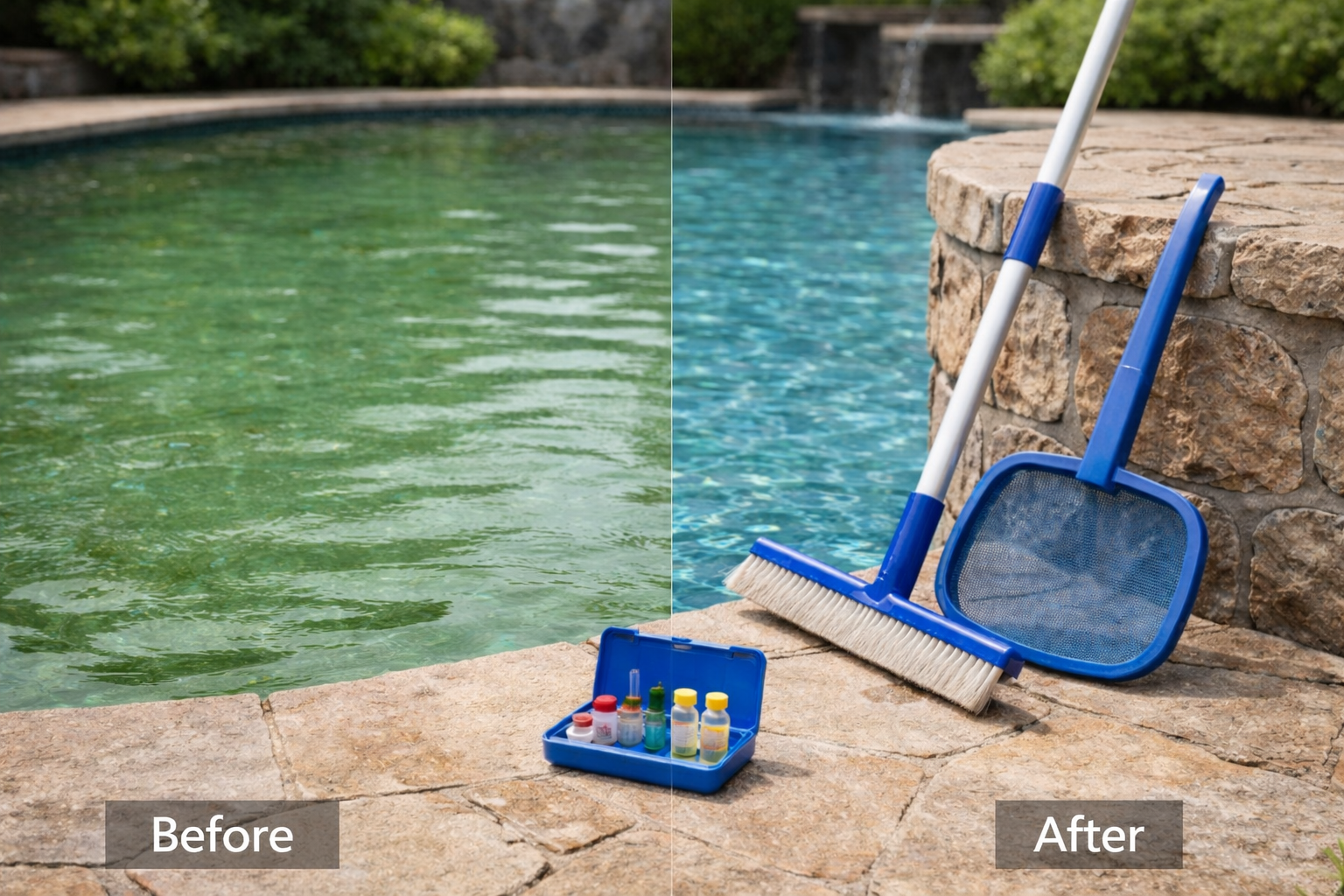
Pool Maintenance Cost in Texas: What to Expect in 2026
Pool maintenance in Texas typically costs between $150 and $300 per month for professional service, with most homeowners spending around $2,400 annually. This covers weekly cleaning visits, chemicals, and routine equipment maintenance. Your exact cost depends on pool size, equipment type, and service frequency. At Bluewater Pools, we’ve helped hundreds of homeowners across San Antonio and Austin avoid the $700 to $2,500 pump replacements and costly algae treatments that result from skipping regular maintenance.
Average Pool Maintenance Costs in Texas
Texas pool owners face higher costs than the national average. While the national average hovers around $140 per month, the statewide average in Texas is approximately $198 per month. Texas pool owners pay a 41% premium over the national baseline, reflecting the operational intensity required to maintain a pool in the state’s climate.
Regional pricing varies across the state’s major metros:
Metro Area | Average Monthly Cost | Key Cost Drivers |
Austin | $218 | Traffic congestion, affluent market, limestone dust |
Dallas-Fort Worth | $208 | Deciduous trees, freeze risk, and competitive market |
Houston | $200-$250 | High humidity, algae management, geographic sprawl |
San Antonio | $120-$180 | More value-oriented market, softer labor costs |
El Paso | $168 | Arid climate, evaporation, and TDS management |
Here’s what you’ll typically spend annually:
Service/Expense | Monthly Cost | Annual Cost |
Weekly cleaning visits | $150-$300 | $1,800-$3,600 |
Pool chemicals | $50-$125 | $600-$1,500 |
Electricity (pump, heater) | $30-$150 | $360-$1,800 |
Equipment repairs | N/A | $200-$1,000 |
Total Average | $230-$575 | $2,960-$7,900 |
Regular professional maintenance prevents the most costly emergency repairs and equipment failures.
Understanding Service Tiers in 2026
The Texas pool service market has evolved beyond the traditional one-size-fits-all model. Most companies now offer distinct service tiers:
Chemical-Only / Partial Service ($80-$150/month): Popular in price-sensitive markets, this tier includes water chemistry analysis, chemical application, and skimmer basket evacuation. You handle physical debris removal yourself or use an automated cleaner. The lower end of this range is becoming rare, limited to owner-operator routes or high-density neighborhoods.
Full Service ($150-$300/month): The standard professional package includes weekly netting, brushing, vacuuming, and complete chemical balancing. In major metros like Dallas and Austin, the floor for this service has risen to $150, with many established firms charging upwards of $200 for standard pools.
Premium / Concierge Service ($300-$550+/month): A rapidly growing segment catering to the luxury market. This tier includes filter cleaning, salt cell acid washing, storm recovery visits, and specialty enzymes and phosphate removers, all included in the base rate. It often prioritizes dispatch for repairs, serving as an insurance policy for your pool’s operational uptime.
What’s Included in Professional Pool Maintenance
When you hire a professional pool service in Texas, you’re getting more than someone to scoop leaves. Quality pool maintenance service includes:
Weekly cleaning and care:
- Specialized underwater vacuuming
- Surface skimming and debris removal
- Skimmer basket cleaning
- Wall and tile brushing
Water chemistry management:
- Complete water testing (pH, chlorine, alkalinity, calcium hardness)
- Chemical balancing and additions
- Quarterly advanced testing with computerized equipment
Equipment servicing:
- Pump and filter inspection
- Sand filter backwashing
- Cartridge filter cleaning (monthly or quarterly)
- Minor repairs and adjustments
This comprehensive approach keeps your pool swimmable and your equipment running efficiently. The Texas heat and sun create unique challenges that weekly attention addresses before they become problems.
Factors That Affect Pool Maintenance Costs in Texas
Pool Size and Type
Larger pools need more chemicals and labor time. A 15,000-gallon pool requires significantly more chlorine and pH balancers than a 10,000-gallon pool. Similarly, in-ground pools typically cost more to maintain than above-ground options due to their size and more complex equipment.
Pool type also matters. Saltwater pools usually have lower monthly chemical costs since the salt system generates chlorine automatically. Traditional chlorine pools require regular chemical purchases, but avoid the upfront cost of salt system equipment.
Texas Climate and Weather
Texas weather significantly impacts maintenance costs. The extended swim season, which effectively runs from March to November in many southern counties, combined with high average temperatures, creates conditions that demand aggressive chemical management.
The state’s extreme heat and UV exposure cause rapid chlorine depletion. Without an adequate stabilizer, a pool can lose its entire free chlorine residual within hours. This necessitates the aggressive “shock and awe” strategies that impact operational budgets.
Texas has also experienced significant “weather whiplash” in recent years. The state has experienced rapid oscillations between prolonged drought and intense precipitation. These extreme weather patterns create unique challenges:
During droughts: Soil desiccation causes ground movement, leading to structural cracks and plumbing issues that drive up repair costs.
During heavy rains: Sudden precipitation introduces massive organic loads into pools, instantly depleting chlorine residuals and requiring labor-intensive recovery.
This is why we recommend weekly service in Texas. Pool water left unattended in Texas heat can turn green within days. It’s not because we want to upsell, but because the science of water chemistry demands it.
Equipment and Pool Features
Your filtration system type affects both service needs and costs:
- Sand filters require regular backwashing but are straightforward to maintain
- Cartridge filters need a monthly or quarterly breakdown and cleaning
- DE (diatomaceous earth) filters offer superior filtration but require more specialized care
- Glass media filters are rapidly replacing sand in retrofits, filtering down to 5-10 microns and requiring less water to backwash
Older equipment also increases costs. Aging pumps and heaters work less efficiently and fail more often. Proactive equipment monitoring can prevent unexpected replacement costs of $500-$2,500.
2026 Equipment Replacement Costs
As pools built during the 2020-2022 pandemic boom mature, homeowners face significant capital expenditures as warranties expire. Here’s what equipment replacements cost in 2026:
Component | Standard Cost | Premium/High-Efficiency Cost |
Variable Speed Pump (VSP) | $700-$1,200 (unit only) | $1,500-$2,500 (installed with automation) |
Filter System | $500-$800 (cartridge/sand) | $1,500+ (large capacity/glass media) |
Heater | $2,000-$3,500 (gas/propane) | $4,200-$12,000 (heat pump/chiller) |
Salt Chlorinator | $400-$800 (cell replacement) | $1,500-$3,000 (complete system) |
Automation System | $1,500 (basic controls) | $3,500+ (full smart home integration) |
Leak detection has become a critical service in Texas due to shifting clay soils. A standard leak detection service commands $300 to $500 for diagnostics, with repairs ranging from $500 for minor epoxy work to over $2,000 for underground plumbing excavation.
Monthly Pool Maintenance Cost Breakdown
Understanding where your money goes helps you budget accurately:
Service visits make up the bulk of monthly costs. Weekly visits at $37.50 to $75 each total $150 to $300 monthly. This covers labor, expertise, and the convenience of not having to spend your weekends cleaning your pool.
Chemicals run $50 to $125 monthly for most pools. Chemical prices have stabilized after supply chain disruptions but remain at a structurally higher plateau than pre-2020 levels. This includes chlorine, pH adjusters, alkalinity increasers, and algaecides.
Utilities add $30 to $150 monthly, depending on your pump efficiency, heater usage, and local electricity rates. Variable-speed pumps cost more upfront but significantly reduce monthly power bills.
Seasonal services like pool opening or winterizing add additional costs. While Texas’s mild winters often make full winterization optional, many homeowners choose to reduce service frequency or temporarily close their pools, costing $150 to $400 per event.
DIY vs. Professional Pool Maintenance
Some homeowners choose to maintain their own pools to save money. The math seems simple: buy chemicals and equipment instead of paying for weekly service.
The reality is more complex. Professional pool maintenance offers consistency and expertise that prevents costly breakdowns. According to industry data, professional services greatly decrease unexpected breakdown or replacement costs.
At Bluewater Pools, our technicians are all Certified Pool Operators (CPO), Certified Maintenance Specialists (CMS), Certified Pool Inspectors (CPI), and hold RAIL (Residential Appliance Installer License) and OSHA licenses. These certifications mean they understand the science behind water chemistry. They know how to read water balance levels, identify equipment problems before they cause failures, and maintain optimal swimming conditions.
The rise of AI-powered robotic cleaners has created a hybrid option. Modern robots from brands like Beatbot and Polaris can handle physical cleaning, but they can’t manage chemistry. This has driven growth in the “chemical-only” service tier, where professionals handle water chemistry while homeowners let robots handle debris removal.
DIY maintenance can work if you have time and knowledge. But most homeowners who try it eventually return to professional service after discovering how much work proper pool care requires, or after dealing with a green pool or equipment failure.
How to Budget for Pool Maintenance
Plan for these expenses when budgeting:
Regular monthly costs: Budget $200 to $300 monthly for full-service maintenance if you want weekly professional care. This covers cleaning visits, chemicals (which we provide), and routine equipment servicing.
Annual equipment maintenance: Set aside $200 to $1,000 annually for repairs or replacements. Even well-maintained equipment eventually needs new parts.
Seasonal adjustments: If you reduce service frequency in winter, factor in spring opening costs of $150-$300.
Emergency fund: Set aside a reserve for unexpected expenses. Pool repairs, such as pump replacements or leak fixes, can run several hundred to several thousand dollars.
The key is viewing maintenance as investment protection. Your pool represents a significant financial investment. Regular care preserves that investment and prevents expensive emergency repairs.
Why Quality Matters More Than Price
Quality pool service requires proper training, professional equipment, and attention to detail. Our technicians use computerized testing equipment for comprehensive water analysis beyond basic pH and chlorine checks. They understand how Texas weather affects water chemistry and equipment performance.
Professional certifications matter. CPO certification means technicians have studied water chemistry science and passed rigorous testing. This knowledge prevents problems before they start, not just after your pool turns green.
You’ll also get better communication and service. At Bluewater Pools, we send text notifications when we’re 30 minutes away, provide before-and-after photos, and email detailed reports showing exactly what we did and what chemicals we added. This transparency builds trust and lets you see the value you’re receiving.
Consider this: one emergency pump replacement costs $700 to $2,500. One severe algae treatment for a neglected pool can run several hundred dollars. These single incidents often exceed the cost of a year’s premium service. Quality maintenance prevents these expensive surprises.
Keep Your Pool Crystal Clear Without the Stress
Pool ownership in Texas comes with unique challenges, but professional maintenance makes it manageable. While costs range from $150 to $300 per month, the investment protects your pool, preserves your equipment, and gives you more time to enjoy swimming rather than scrubbing.
At Bluewater Pools, we handle everything: cleaning, chemical balancing, and equipment care, so you don’t have to think about it. Our CPO-certified technicians bring professional expertise and a scientific approach to every visit. We serve homeowners throughout San Antonio and Austin, building relationships with customers who appreciate quality service.
Ready to stop worrying about pool maintenance? Contact us today for a free quote. We’ll assess your pool, explain our process, and show you how professional service protects your investment while keeping your water crystal clear year-round.