Pool Closing Costs: What to Expect in 2026
Professional pool closing costs between $150 and $650, with most homeowners paying $250–$350 for a standard in-ground pool. The exact price depends on your pool’s size, additional features, your region, and how much prep work the pool needs before winterization can begin.
At Bluewater Pool Service, a BBB A-rated company serving Austin and San Antonio, we handle seasonal pool preparation for homeowners throughout Central Texas. The question we hear most often is whether professional closing is worth the cost. The short answer: a $300 closing can prevent freeze damage that routinely runs $5,000–$20,000, and homeowners insurance almost never covers that kind of loss.
This guide breaks down what pool closing actually costs, what the service includes, and what Texas pool owners specifically need to know.
How Much Does Pool Closing Cost?
Here’s how national pricing breaks down across major consumer cost platforms for 2025:
Source | Average Cost | Typical Range | Year |
$350 | $200–$500 | 2025 | |
$250 | $175–$300 | 2025 | |
$250 | $200–$300 | 2025 | |
— | $250–$500 (in-ground) | 2026 |
In-ground pools cost more to close than above-ground pools because of more complex plumbing, heavier equipment, and larger covers. Here’s a general breakdown by pool type:
- In-ground pools: $200–$500 (average around $300)
- Above-ground pools: $150–$300 (average around $175)
Labor typically runs $50–$125 per hour depending on the region, and a standard closing takes about two hours.
What Affects Pool Closing Costs?
The spread from $150 to $650+ comes down to a combination of factors that compound on each other.
Pool size and type are the primary variables. Larger or irregularly shaped pools require more chemicals, more labor, and heavier covers. Concrete and gunite pools may need extra attention at the tile line.
Additional features each add to the total:
- Water features (waterfall, fountain, deck jet): $50–$100 per feature
- Attached spa or hot tub: $40–$150
- Saltwater pool (salt cell cleaning and chlorine generator protection): $75–$150
- Solar heater: additional antifreeze work required
Pool condition at closing is often underestimated as a cost driver. A neglected pool may need multiple shock treatments and extensive algae removal before winterization can even start, adding hours to the job. Pools maintained consistently throughout the season are almost always cheaper and faster to close.
Region and climate dictate how much work is actually required. Northern states like Minnesota and Wisconsin command $400–$600 for in-ground closings because the process is intensive: full line blowing with commercial compressors, antifreeze in the plumbing, and heavy-duty covers rated for snow and ice loads. Southern regions generally cost less because the process is less involved.
Timing affects pricing too. Booking early in fall avoids late-season surcharges, and demand spikes as temperatures drop. Most industry professionals recommend scheduling when temperatures consistently stay below 65°F.
Cover type represents one of the widest cost ranges in the entire process:
Cover Type | Cost Range |
Basic winter cover | $75–$250 |
Above-ground cover | $30–$500 |
In-ground solid cover | $650–$1,200 |
In-ground mesh cover | $1,500–$3,000 |
Manual safety cover | $1,000–$3,600 |
Automatic retractable cover | $8,000–$20,000 |
What a Professional Pool Closing Includes
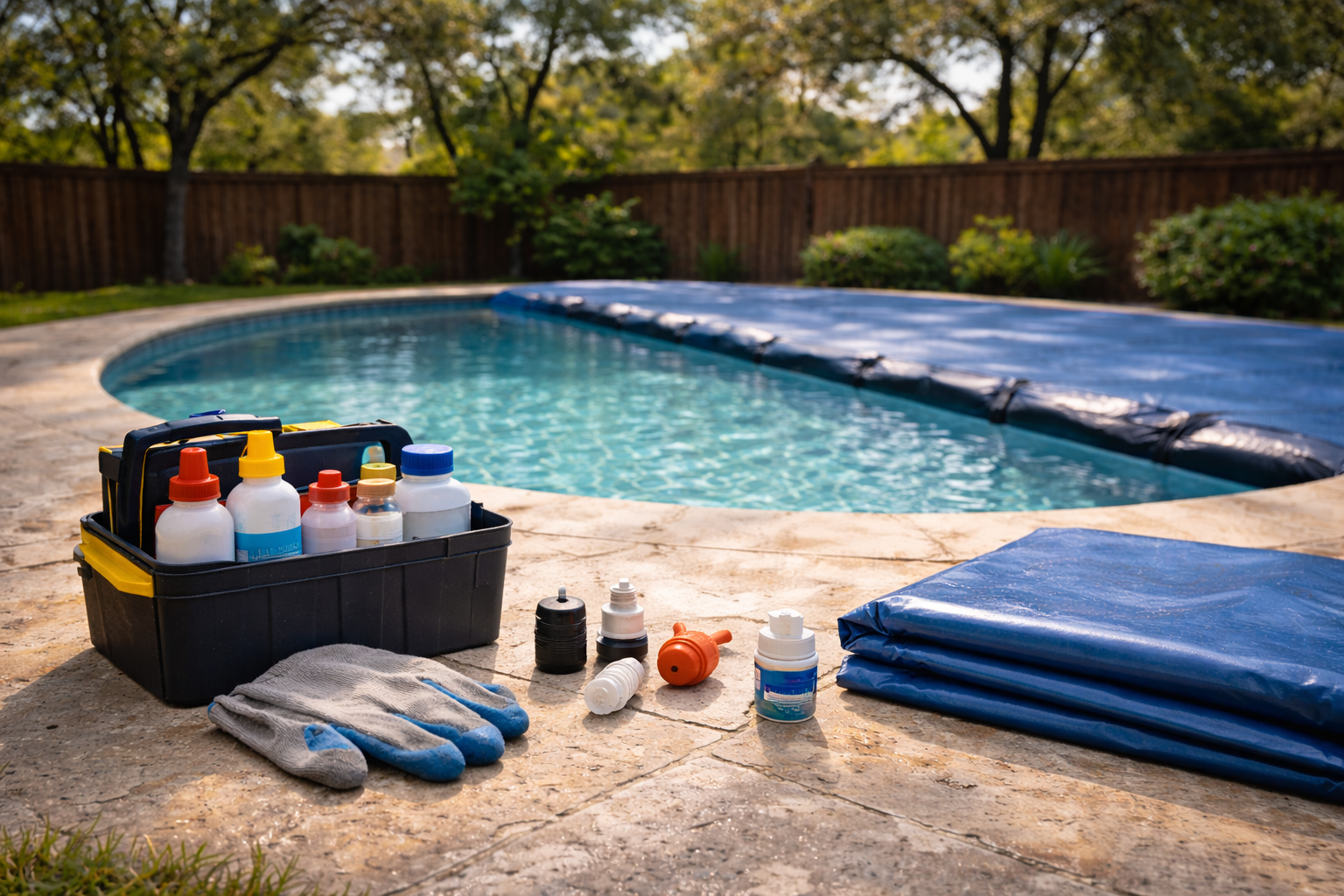
A proper pool closing follows a systematic, multi-step process. Most companies complete the work in one to two visits. Here’s what’s typically covered:
- Accessory removal — skimmer baskets, ladders, steps, cleaners, and wall fittings are removed, rinsed, dried, and stored
- Deep cleaning — debris is skimmed, the bottom is vacuumed, and walls, floor, and tile are brushed. A cleaner pool at closing means a cleaner pool at opening and significantly lower algae risk
- Water chemistry balancing — technicians test and adjust pH (7.2–7.6), alkalinity (80–150 ppm), calcium hardness (200–400 ppm), and chlorine (1–3 ppm), then shock the pool at roughly one pound of shock per 10,000 gallons
- Winterizing chemicals — algaecide, stain and scale preventer, metal sequestrant, and optionally a slow-release winter pill ($15–$25) that disperses chemicals throughout the off-season
- Water level adjustment — lowered 4–6 inches below the skimmer (mesh covers require about 12 inches). Pools should never be drained completely, as ground pressure can damage the structure or pop a vinyl liner
- Plumbing winterization — all water is blown out of suction lines, return lines, and skimmer lines using a commercial air compressor, then each line is sealed with winter expansion plugs. This is the most critical step and the one most likely to go wrong in a DIY closing
- Equipment winterization — pump, filter, heater, and auxiliary equipment are all drained. Drain plugs are removed and stored. O-rings are lubricated. Salt cells are removed for saltwater pools
- Cover installation — the winter cover is secured with anchors, water bags, cables, or weights
What’s typically not included (and may add cost): heavy cleaning of neglected pools, filter cartridge deep cleaning ($40–$70), water feature winterization (roughly $50 per feature), cover purchase, and any existing equipment repairs.
Pool Closing Costs in Texas: A Different Calculation
Texas operates differently from most of the country. Because hard freezes are uncommon, the majority of Texas pools run year-round without formal winterization. Most rely on freeze-guard switches that automatically circulate water when temperatures approach freezing, protecting equipment during typical cold snaps.
When Texas pool owners do opt for seasonal closing, the process is generally less intensive than in the North — often limited to pulling drain plugs, lowering water below the tile line, and ensuring equipment is protected for brief cold periods. That service typically runs $150–$400.
The problem is what happens during an atypical Texas winter.
The 2021 Winter Storm Uri exposed the weakness of relying entirely on freeze-guard switches. When power failed across the state, those switches stopped working, and pool equipment froze without protection. Mikael Rem, President of Moonlight Pool and Spa, described the damage to KWTX News at the time: “Pipes were bursting, pumps were breaking, heaters were breaking. People are paying one hundred dollars in repairs all the way up to $15,000 to $20,000 worth of equipment.” Three months after the storm, pool companies were still booked solid.
That’s the Texas paradox: because full winterization is uncommon, freeze-guard switches are the primary line of defense — and they fail during exactly the kind of extended power outage that accompanies a severe winter storm.
For our customers in the Austin and San Antonio areas, we recommend at minimum having equipment inspected before winter and knowing your options before a cold front arrives. Our pool maintenance services include seasonal preparation, and our team is also available for pool repairs when freeze damage does occur.
DIY Pool Closing vs. Hiring a Professional
The savings from closing your own pool look appealing on paper. Here’s the full picture:
DIY | Professional | |
Above-ground pool | $50–$150 | $150–$300 |
In-ground pool | $100–$200 | $200–$500 |
Time required | 4–8 hours | ~2 hours |
Typical savings | $75–$200 | — |
Risk of costly error | Moderate to high | Very low |
Potential repair costs from mistakes | $350–$5,800+ | N/A |
The problem with DIY isn’t the chemicals. It’s the line blowing. Fixr notes that most freeze damage to pipes and pool equipment comes from improper winterization attempts by homeowners. A single plumbing line that isn’t fully cleared can crack and burst during a freeze. Draining too much water can cause walls to cave in or liners to tear.
Adam Graham, a construction industry analyst at Fixr.com, frames the economics clearly: “The repair costs for burst pipes, damaged filter systems, and cracked tiles are often more expensive than closing your pool. This preventative measure saves money in the long run.”
DIY may be a reasonable choice if you have a simple above-ground pool, own or can rent an air compressor, are comfortable with pool chemistry, and have closed a pool successfully before. For in-ground pools — especially those with attached spas, water features, saltwater systems, or expensive equipment — professional service is consistently the safer bet.
A middle-ground option: handle the basic prep yourself (removing accessories, surface cleaning) and hire a pro for the technical steps.
The Real Cost of Skipping Winterization
When water freezes, it expands by approximately 9%, putting enormous pressure on every component it contacts. Equipment can freeze in less than an hour when temperatures drop below 32°F and circulation stops.
Here’s what repair bills typically look like:
Damage Type | Repair Cost Range |
Minor freeze damage | $200–$350 |
Pool pump replacement | $1,000–$3,000+ |
Pool heater replacement | $1,800–$4,200 |
Vinyl liner replacement | $1,242–$3,871 |
Pool replastering | $6,000–$8,000 |
Full pool resurfacing | $6,000–$15,000 |
Major equipment overhaul | $10,000–$20,000 |
Sources: HomeAdvisor, Angi, HomeGuide
What makes this worse is that homeowners insurance rarely covers pool freeze damage. NJM Insurance states directly that pool freeze damage is excluded from homeowners coverage and that proper winterization is the homeowner’s responsibility. Goosehead, Insurify, Lemonade, and Travelers all carry similar exclusions.
The math is straightforward: spending $250–$350 on a professional closing to protect against $5,000–$20,000 in uninsured damage is not a close call.
Frequently Asked Questions
How much does it cost to close an in-ground pool?
Most homeowners pay $200–$500 to professionally close an in-ground pool, with a national average around $300. The final cost depends on pool size, additional features (attached spas, water features, saltwater systems), and how much cleaning and balancing work is needed before winterization can begin.
How much does it cost to close an above-ground pool?
Above-ground pool closings typically cost $150–$300, averaging around $175. The process is simpler than in-ground closings, with less complex plumbing and lighter equipment to manage, which is reflected in the lower price.
When should you close your pool for winter?
Most pool professionals recommend closing when temperatures consistently stay below 65°F. Closing too early in warmer conditions increases algae risk because the water is still warm enough for growth. Booking in advance is smart, as availability fills quickly when temperatures start dropping.
Do Texas pools need to be winterized?
Traditional winterization is uncommon in Texas because the climate is mild and most pools run year-round. Freeze-guard switches that circulate water during cold snaps provide standard protection for brief freezes. However, extended power outages during severe winter events can disable those switches completely, leaving equipment exposed. Texas pool owners should at minimum have equipment inspected before winter and know what options are available if a hard freeze is forecast.
What chemicals are used to close a pool?
A standard winterization chemical treatment includes shock (about one pound per 10,000 gallons), algaecide, stain and scale preventer, and metal sequestrant. Many pool owners also add a winter pill — a slow-dissolving tablet that disperses chemicals gradually during the off-season. Materials typically cost $21–$80 depending on pool size and products used.
Ready to Schedule Your Pool Closing?
Bluewater Pool Service serves homeowners across the Austin and San Antonio metro areas. Our technicians hold CPO (Certified Pool Operator), CMS (Certified Maintenance Specialist), CPI (Certified Pool Inspector), RAIL, and OSHA certifications, and every service comes with a satisfaction guarantee. Call us at 512-886-7665 or email info@bluepoolwater.com to get on the schedule before the cold weather hits