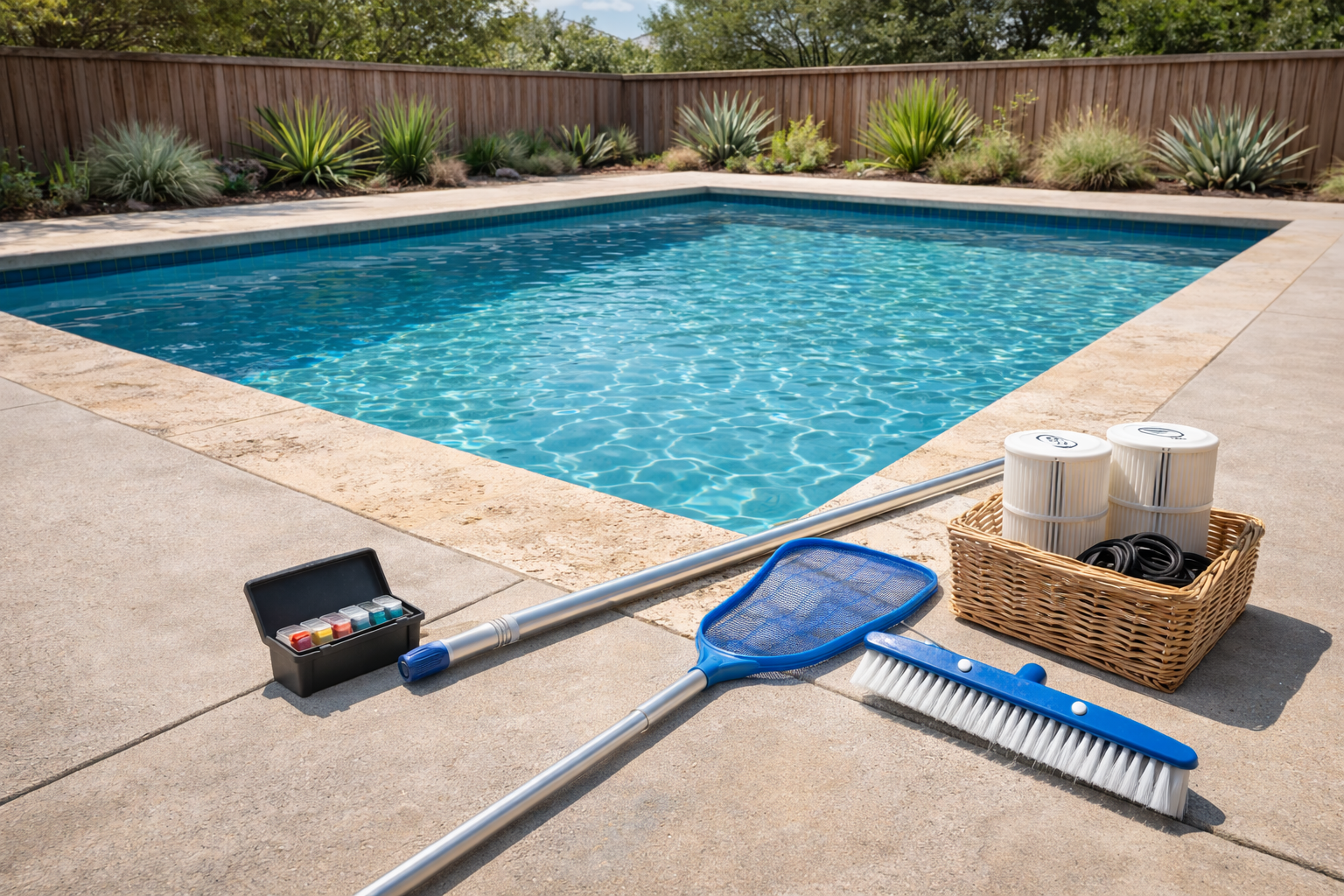
San Antonio Pool Maintenance Guide: Climate, Chemistry, and Conservation
Maintaining a pool in San Antonio is a different challenge than almost anywhere else in the country. The combination of extreme heat, limestone-sourced hard water, and recurring drought restrictions creates conditions that generic pool care guides simply don’t account for. At Bluewater Pools, green pool recovery is the most common emergency call we handle in the San Antonio metro, and it almost always traces back to the same regional factors: intense UV, aggressive evaporation, and water that starts the season already pushing the limits of recommended chemistry ranges. This guide covers what actually matters for local pool owners, backed by data from SAWS, the CDC, and federal climate agencies.
Why San Antonio Pool Maintenance Is Different
Three overlapping forces define pool ownership in this city: heat and UV exposure that consume chemicals at an accelerated rate, hard tap water that concentrates minerals as evaporation removes volume, and a drought cycle that restricts the water needed to address both problems.
According to NWS 1991-2020 Climate Normals, San Antonio averages 122 days per year at or above 90°F and 18 days at or above 100°F. Summer pool water temperatures routinely exceed 85°F, the threshold at which algae and bacterial growth accelerate dramatically. The EPA classifies San Antonio’s UV index as “Extreme” (11-12) from April through August, with “Very High” readings in March and September.
That UV intensity has a direct, measurable impact on chlorine: 1 ppm of free chlorine can be depleted in as little as 45 minutes under full Texas sun without cyanuric acid (CYA) stabilizer. Pool owners in northern climates face a fraction of this demand.
Then there’s the water. San Antonio draws primarily from the Edwards Aquifer, which delivers tap water with calcium hardness of 257-342 ppm. That’s already close to the upper end of the 150-400 ppm recommended range, before any evaporation has occurred. Every gallon of water that leaves your pool through evaporation leaves those minerals behind.
San Antonio’s Hard Water and What It Does to Your Pool
SAWS water quality data shows that San Antonio tap water carries 15-20 grains per gallon of calcium and magnesium, sourced naturally from the Edwards and Trinity Aquifers passing through limestone. That puts San Antonio’s tap water in the “very hard” category before it ever reaches your pool. An uncovered residential pool in San Antonio typically loses 15,000-25,000+ gallons annually to evaporation. As that water disappears, calcium and other dissolved minerals stay behind and concentrate.
The table below compares recommended pool chemistry ranges with what San Antonio tap water delivers at fill:
Parameter | Recommended Range | San Antonio Tap Water | Challenge Level |
Free Chlorine (with CYA) | 2.0-4.0 ppm | 1.41 ppm avg (SAWS treated) | Moderate: needs supplemental chlorine |
pH | 7.2-7.6 ideal | 7.0-7.8 | Low: already within range |
Total Alkalinity | 60-180 ppm (TX DSHS) | Moderate-high (limestone source) | Moderate: tends to run high |
Calcium Hardness | 150-400 ppm (TX DSHS) | 257-342 ppm at fill | High: concentrates with evaporation |
Cyanuric Acid (CYA) | 30-50 ppm ideal; max 100 ppm | 0 ppm (not present in tap) | Moderate: must add stabilizer for UV protection |
Total Dissolved Solids | Under 1,500 ppm | Under 500 mg/L at fill | Moderate: concentrates over time |
Sources: CDC Healthy Swimming; Texas DSHS Administrative Code 265.206; SAWS water quality data
Understanding the Langelier Saturation Index
The LSI is the most important number most San Antonio pool owners have never heard of. It measures whether pool water is balanced, scaling, or corrosive. An LSI above +0.3 means the water is prone to depositing scale on surfaces, tile lines, and equipment. An LSI below -0.3 means the water is corrosive and will attack plaster, grout, and metal fittings.
In San Antonio’s climate, the LSI trends toward the scaling side because evaporation continuously concentrates calcium. Scale buildup in pool heaters is particularly damaging: the calcium layer acts as insulation that can force internal temperatures high enough to crystallize and crack internal components, damage typically excluded from manufacturer warranties.
Managing LSI in San Antonio means tracking more than just chlorine and pH. We use a WaterLink Spin Touch photometer that tests 10+ water parameters simultaneously, which eliminates the guesswork of manual color-matching kits. A pH reading off by even 0.2 can push water from balanced into scaling or corrosive territory.
Industry guidance suggests partially draining and refilling pool water approximately every two years to manage mineral accumulation. In practice, drought restrictions (covered below) can complicate the timing of that maintenance.
Seasonal Maintenance in San Antonio
San Antonio pools run year-round. The city averages 300+ sunny days annually, and winter months average highs in the 60s°F, which means pool equipment never fully rests and chemical maintenance continues even in January. What changes is the intensity of demand.
During summer specifically, pools can lose a quarter to a half inch of water per day through evaporation alone. That’s roughly 1.75-3.5 inches per week, or thousands of gallons per month before accounting for splash-out and backwashing.
Season | Avg High (°F) | Key Tasks | Why It Matters in San Antonio |
Winter (Dec-Feb) | 63-68 | Monitor freeze forecasts; run pump during freezes; insulate exposed pipes; clean cedar pollen from water daily; test chemistry weekly | Roughly 14 freeze nights per year; cedar pollen can reach 20,000-32,000 grains per cubic meter |
Spring (Mar-May) | 74-87 | Increase chlorine dosing as temps rise; clean oak catkins daily; check filters weekly; begin CYA stabilizer management | Rapid temperature increases; heavy oak pollen; UV climbing to "Extreme" levels by April |
Summer (Jun-Aug) | 92-96 | Test water chemistry 2-3 times weekly; maintain CYA at 30-50 ppm; monitor water level daily; clean filters biweekly; check for algae daily | Peak algae risk with water above 85°F; highest chemical demand; quarter to half inch daily evaporation |
Fall (Sep-Nov) | 72-90 | Reduce chemical dosing gradually; clean ragweed pollen; inspect equipment before freeze season; prepare freeze protection plan | Algae risk continues through October; first freeze possible by late November |
Source: NWS 1991-2020 Climate Normals
Algae: The Dominant Warm-Season Problem
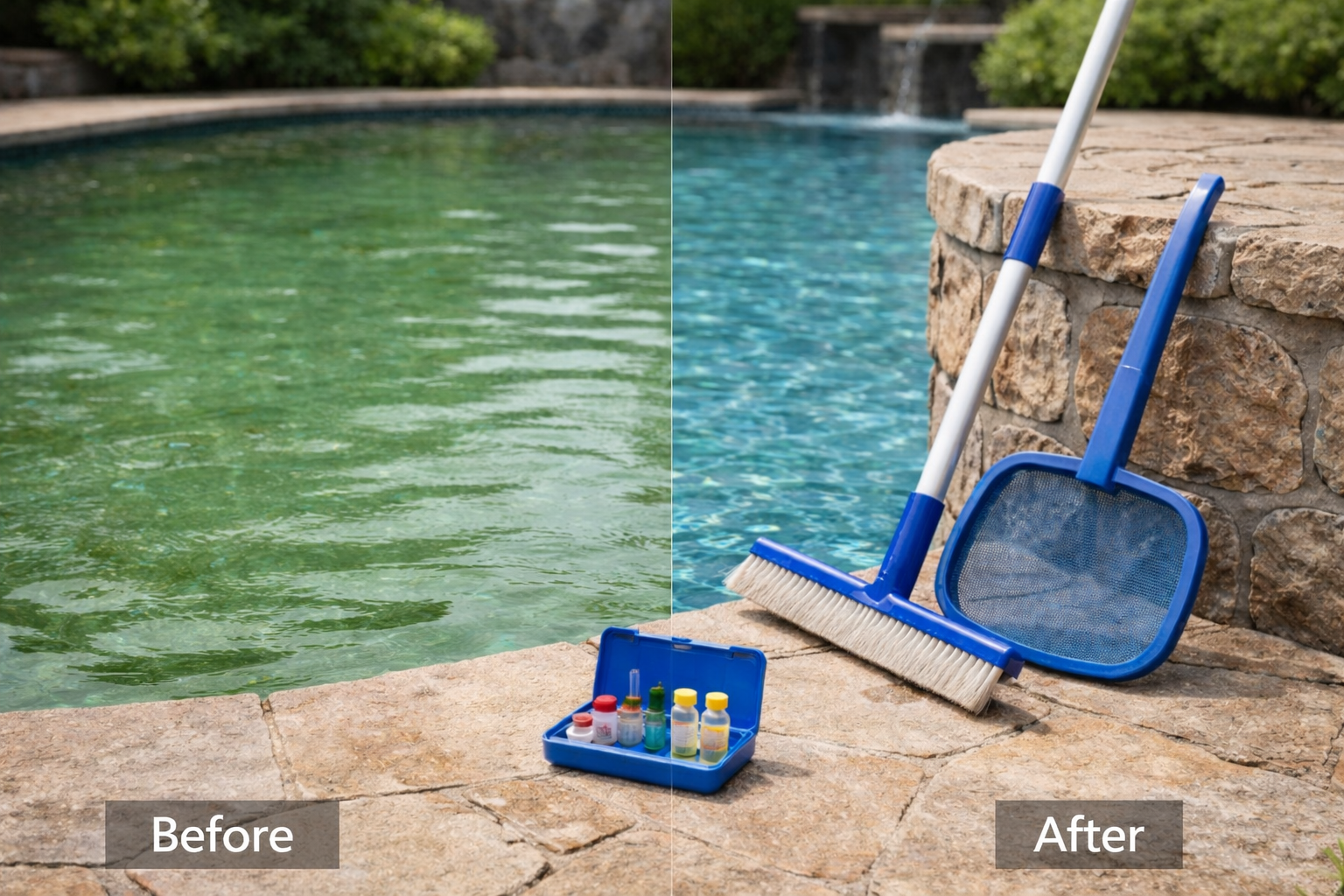
Green pool recovery is the most-requested emergency service we handle in San Antonio. The conditions that drive algae growth, including water temperatures above 85°F, free chlorine below minimum levels, pH above 7.8, and accumulated organic debris from pollen and dust, describe a typical San Antonio summer day with particular accuracy.
Higher water temperatures accelerate chemical reactions, meaning the same chlorine dose is consumed faster at 95°F than at 78°F. This is why we recommend weekly pool cleaning service during San Antonio summers rather than biweekly intervals. Two-week gaps leave pools exposed to rapid chemical shifts that can turn water green within days.
Pollen: Four Overlapping Seasons
San Antonio pool owners contend with four distinct pollen seasons that deposit organic material into pool water, clog filters, and drive up chlorine demand:
- Mountain cedar (December through mid-February): Texas A&M AgriLife documents pollen counts reaching 20,000-32,000 grains per cubic meter. Cold fronts sweep this pollen directly from the Hill Country into San Antonio.
- Live oak (March through early May): Oak catkins create heavy debris loads that overwhelm skimmers and clog filters quickly.
- Grass pollen (May through October): Overlaps directly with peak swimming season.
- Ragweed (August through November): Extends into fall swimming months.
These overlapping seasons mean San Antonio pools face meaningful organic debris loading for roughly 10 months of the year.
Water Conservation Rules Every Pool Owner Needs to Know
San Antonio’s dependence on the Edwards Aquifer makes water conservation a legal obligation for pool owners. SAWS declared Stage 3 water restrictions in 2024, the first time in the utility’s 30-year history.
This is not a temporary situation. San Antonio spent 48 out of 60 months under Stage 2 restrictions during the 2011-2015 drought. The current drought cycle began in 2022, and SAWS data tracks closely to the 1950s Drought of Record, which lasted seven years.
Here is how SAWS drought stages affect pool owners specifically:
Stage | Aquifer Trigger (J-17 Well) | Pool Rules | Penalties |
Year-Round | Above 660 ft MSL | General water waste is prohibited; no specific pool rules | None specific |
Stage 1 | 660 ft or below (10-day avg) | No specific pool cover requirement | $137 first violation |
Stage 2 | 650 ft or below (10-day avg) | All non-public pools must have at least 25% of the surface covered with evaporation screens when not in use | $137 first violation; higher for repeat violations |
Stage 3 | 640 ft or below (10-day avg) | 25% cover requirement continues; drought surcharge of $10.37 per 1,000 gallons above 20,000 gal/month | Surcharge plus violation fees |
Stage 4 | City Manager discretion | 25% cover requirement continues; surcharge threshold drops to 12,000 gal/month | Surcharge plus violation fees |
Source: SAWS Drought Restrictions
Under Edwards Aquifer Authority Stage 3 and 4 rules, refilling empty pools and filling new pools is prohibited without a waiver. In October 2024, SAWS announced that variances will not be granted for pool refilling to avoid surcharges. For any pool owner planning to drain for maintenance, chemical reset, or repair work during a drought year, timing matters.
Topping off existing pools to maintain operational water levels remains permitted at all stages, though the surcharge structure adds meaningful cost for high-usage households.
The Case for a Pool Cover
The EPA WaterSense program estimates that solid pool covers reduce evaporation by more than 90%, while solar and bubble covers achieve 50-95% reduction depending on coverage. For a typical San Antonio residential pool, this translates to cutting annual water loss from 15,000-25,000+ gallons down to roughly 1,500-2,500 gallons — more than 20,000 gallons saved per year from a single piece of equipment.
According to the U.S. Department of Energy, covers also reduce pool chemical consumption by 35-60% and cut heating costs by 50-70% for heated pools. Fewer chemicals evaporate, less organic matter enters the water, and calcium has less opportunity to concentrate.
Pool cover adoption remains low nationally despite these savings — a significant missed opportunity for San Antonio pool owners who face some of the highest evaporation rates in the country.
Freeze Protection: Rare, But the Consequences Are Severe
San Antonio averages just 14 freeze nights per year, with all-day hard freezes occurring roughly twice per decade. Under normal conditions, a freeze is brief and manageable with basic precautions. Winter Storm Uri in February 2021 was not normal.
San Antonio International Airport recorded a low of 9°F on February 15, 2021, with temperatures remaining below freezing continuously for multiple days. Power outages prevented pool pumps from circulating water, causing plumbing lines, pumps, filters, and heaters to crack and burst across the region. Pool equipment repair calls surged dramatically in the weeks after the thaw. San Antonio’s Community Pipe Repair Fund excluded pool plumbing from coverage, leaving pool owners to absorb those costs independently.
The practical takeaway for San Antonio pool owners: full winterization is not necessary, but an active freeze protection plan is essential. During any forecast below 34°F, run the pump continuously to keep water moving through equipment. Insulate exposed pipes and valves. If power is lost during a multi-day freeze, contact a service provider as quickly as possible since the window to prevent equipment damage is short.
Our pool repair team handles freeze damage and post-storm equipment repairs. Every technician holds CPO (Certified Pool Operator), CMS (Certified Maintenance Specialist), CPI (Certified Pool Inspector), RAIL, and OSHA certifications, including the TDLR electrical licensing required for the equipment repairs that spiked after Uri.
Health, Safety, and Permit Requirements
Minimum Water Quality Standards
The CDC’s Healthy Swimming program establishes that properly maintained pool water requires at least 1 ppm free chlorine (at least 2 ppm when using CYA stabilizer), with pH maintained at 7.0-7.8. The CDC recommends testing at least twice daily during heavy use.
CDC surveillance data from 2015-2019 documented 208 outbreaks associated with treated recreational water, resulting in 3,646 illnesses, 286 hospitalizations, and 13 deaths. Cryptosporidium, the leading pathogen, requires 10.6 days at 1 ppm free chlorine to inactivate. Consistent, properly dosed chemical maintenance is the only reliable defense.
Drowning Prevention in Texas
According to Texas DFPS, Texas leads the nation in childhood drownings, with 103 children drowning statewide in 2024. The CPSC reports that 81% of fatal drownings in children under 15 occur in residential settings, and 75% of child pool and spa drowning victims are younger than five. Drowning is the leading cause of death for children ages 1-4 nationally.
San Antonio’s barrier requirements for residential pools include:
- Fence height: Minimum 48 inches
- Openings: Cannot allow passage of a 4-inch sphere
- Gates: Must open outward, be self-closing and self-latching, with release mechanisms at least 54 inches from the ground
- Drain safety: Pools constructed or renovated after January 1, 2021 must have dual or multiple suction outlets at least 3 feet apart
Pools constructed or renovated before 2021 with single-drain configurations must install Safety Vacuum Release Systems.
How Often Should a San Antonio Pool Be Serviced?
For most San Antonio pools, weekly pool maintenance service is the appropriate standard during summer. The combination of extreme UV, water temperatures routinely above 85°F, and rapid chemical depletion from heat makes biweekly intervals insufficient for maintaining safe, balanced water during peak season.
Winter service frequency can be reduced depending on usage and exposure, but chemical testing and equipment monitoring should continue year-round. San Antonio’s mild winters mean pools rarely stop operating entirely, and the freeze risk, however brief, requires active management rather than seasonal shutdown.
For hotels, apartment complexes, and community facilities, higher bather loads push the requirement toward more frequent attention. Details on our commercial pool service are available for facilities with more complex maintenance requirements.
Ready for a Local Expert to Take This Over?
San Antonio pools require more precise chemistry management, more frequent attention, and more deliberate water conservation planning than pools in most American cities. If you’d rather leave the weekly testing, chemical balancing, and equipment monitoring to someone who works in Edwards Aquifer water every day, Bluewater Pool Service serves the San Antonio metro with technicians holding CPO, CMS, CPI, RAIL, and OSHA certifications. Call us at 512-886-7665 or email info@bluepoolwater.com to get started.