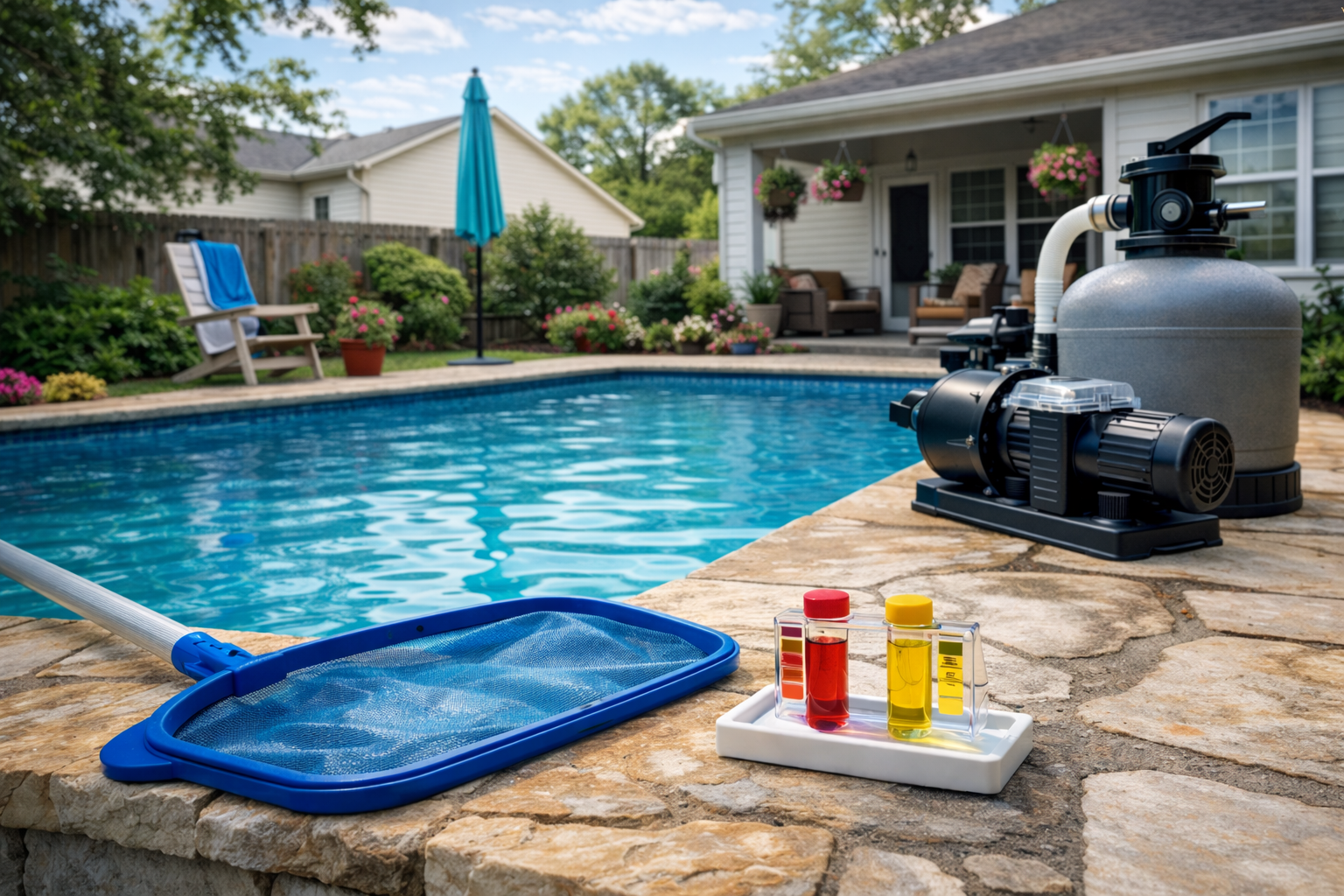
A Beginner’s Guide to Pool Maintenance in Texas
Owning a pool in Texas is one of the best ways to survive our summers. But if you’re new to it, the maintenance side can feel overwhelming. Between water chemistry, equipment upkeep, and the unique challenges of the Texas climate, there’s a lot to stay on top of.
At Bluewater Pools, our Certified Pool Operators (CPO) maintain hundreds of residential and commercial pools across San Antonio and Austin. The most common issue we see with new pool owners? They don’t realize how quickly Texas heat can turn a clean pool into a green one. A pool that looks fine on Monday can have visible algae growth by Friday if the chemistry is off.
This guide covers what every new Texas pool owner needs to know: the fundamentals of circulation, cleaning, and chemistry, plus the seasonal adjustments that are specific to our climate.
The Three Fundamentals: Circulation, Cleaning, and Chemistry
Pool maintenance comes down to three things: keeping the water moving, keeping surfaces clean, and keeping the chemistry balanced. In the industry, these are called the “Three Cs,” and every maintenance task falls into one of these categories.
In Texas, all three require more attention than they would in cooler climates. Higher temperatures accelerate algae growth, increase chemical consumption, and put more stress on equipment. Weekly service is the standard recommendation here for good reason.
How Your Pool’s Circulation System Works
Think of your pool’s circulation system as the engine that keeps everything running. Water gets pulled through the skimmers (which catch floating debris) and the main drain, pushed through the filter, and returned to the pool.
When circulation stops or slows down, you get stagnant water. Stagnant water means uneven chemical distribution, which means algae. In Texas, where ambient temperatures regularly exceed 100°F for weeks at a time, even a few days of poor circulation can cause problems.
Keeping Your Water Level Right
This is one of the first things that catches new Texas pool owners off guard. Evaporation rates in Texas can lower your water level by more than two inches per week during the summer. If the water drops below the halfway point of your skimmer opening, your pump starts pulling air instead of water. That leads to loss of prime and can burn out your motor.
Check your water level weekly and top it off as needed. A pool cover can reduce evaporation by up to 90%.
Pump Types and What They Cost to Run
Your pump is the single most important piece of equipment in your pool system. If you’re building new or replacing an old pump, the type you choose has a significant impact on your monthly electricity bill.
Pump Type | How It Works | Monthly Electricity Cost | Best For |
Single-Speed | Runs at one fixed speed (3,450 RPM) | $26 - $29 | Lowest upfront cost |
Two-Speed | Toggles between high and low | $15 - $20 | Moderate savings |
Variable-Speed | Adjustable from 600 to 3,450 RPM | $9 - $11 | Best long-term value |
Variable-speed pumps cost more upfront but use 60-70% less electricity. They can also run at lower speeds for longer periods, which actually improves filtration and is better for freeze protection in winter.
Pool Cleaning Basics
Cleaning is the most visible part of pool maintenance. It includes skimming debris off the surface, vacuuming the pool floor, brushing the walls, and maintaining your filter.
Skimming and vacuuming should happen at least once a week. In the fall, when live oak leaves start dropping, you may need to skim more often. Those small leaves sink fast and will stain plaster if they sit on the bottom too long.
Brushing the walls and floor prevents algae from getting a foothold. Algae spores attach to surfaces before they bloom, so regular brushing disrupts that process before it becomes visible.
Emptying skimmer baskets is a simple task that makes a big difference. A full basket restricts water flow, which reduces filtration efficiency and puts extra strain on your pump.
Know Your Filter Type
Your filter removes physical contaminants from the water. The type of filter you have determines how you maintain it.
Sand filters trap particles in the 20-40 micron range. Maintenance involves “backwashing,” which reverses the water flow to flush out trapped debris. The downside is that backwashing uses a significant amount of water, which matters during Texas drought restrictions.
Cartridge filters use pleated polyester elements and filter down to 10-15 microns. They don’t require backwashing, making them the more water-efficient option. You’ll need to remove and clean the cartridges every 3 to 6 months.
DE (Diatomaceous Earth) filters provide the finest filtration at 2-5 microns. They require both backwashing and periodic manual teardowns to inspect the internal grids.
At Bluewater Pools, our technicians handle all filter maintenance as part of our weekly pool cleaning service, including sand filter backwashing and scheduled cartridge breakdowns.
Water Chemistry for Texas Pools
This is the part that intimidates most new pool owners. But the basics are straightforward once you understand what you’re measuring and why.
The Texas climate makes water chemistry more demanding than in most states. Intense UV radiation can destroy up to 90% of your pool’s free chlorine in a single two-hour window if it isn’t properly stabilized. Our tap water tends to run hard (high in calcium), and the heat accelerates every chemical reaction in the pool.
Here are the ranges you want to maintain:
Parameter | Ideal Range | Why It Matters in Texas |
Free Chlorine | 1.0 - 3.0 ppm | UV burns through chlorine fast; summer requires frequent supplementation |
pH | 7.2 - 7.6 | Texas source water is naturally alkaline, pushing pH upward |
Total Alkalinity | 80 - 150 ppm | Buffers pH; adjust this before trying to correct pH |
Calcium Hardness | 200 - 400 ppm | Texas tap water is often already high; evaporation concentrates it further |
Cyanuric Acid (CYA) | 30 - 80 ppm | Acts as sunscreen for chlorine; levels above 100 ppm cause "chlorine lock" |
Why pH Matters More Than You Think
pH isn’t just about swimmer comfort. It directly affects how well your chlorine works. When pH rises above 7.8, the active form of chlorine (hypochlorous acid) converts into a much weaker form (hypochlorite ion). Your test kit might show adequate chlorine levels, but the chlorine isn’t actually killing anything effectively.
In Central Texas and the Hill Country, high alkalinity in the source water naturally pushes pH upward. If you have a saltwater pool, this effect is even stronger because salt chlorine generators produce sodium hydroxide as a byproduct.
The fix is straightforward: regular additions of muriatic acid or sodium bisulfate to bring pH back into the 7.2-7.6 range.
Cyanuric Acid: Chlorine’s Sunscreen
Cyanuric acid (CYA) is a stabilizer that protects chlorine from UV breakdown. Without it, you’d be adding chlorine constantly during the summer and still losing the battle. The ideal range is 30-50 ppm heading into summer.
The catch: CYA doesn’t break down or evaporate. It only leaves the pool when water is removed (splashout, backwashing, or draining). Over time, levels can creep above 100 ppm, which causes “chlorine lock,” where chlorine is present but unable to sanitize. The only fix at that point is a partial drain and refill.
Hard Water and Calcium Buildup
Texas pool owners deal with naturally hard water. After several seasons of evaporation and refilling, calcium hardness can exceed 600 ppm. When calcium levels are high and water temperature rises, calcium becomes less soluble and deposits as white, crusty scale on your tile, equipment, and pool surfaces.
Prevention is easier than remediation. Sequestering agents bind to calcium ions and keep them suspended in the water. For existing scale, professional removal methods like Kieserite blasting can lift deposits without damaging tile or stone.
Seasonal Pool Maintenance in Texas
Texas doesn’t follow the same seasonal playbook as northern states. We don’t drain and winterize pools here. But each season brings its own set of challenges.
Spring (March through May)
Spring in Texas means pollen. Oak and pecan pollen creates a yellow film on the water surface, clogs filters faster than usual, and introduces nitrogen into the water, which feeds algae while also neutralizing free chlorine.
This is the time to deep-clean your filter media, raise your cyanuric acid levels to prepare for summer UV, and consider a phosphate removal treatment. Phosphates are the primary food source for algae, and spring runoff carries them into the pool.
Summer (June through August)
Summer is the most demanding season for Texas pool maintenance. Evaporation, UV exposure, and high water temperatures all accelerate chemical consumption.
When water temperature exceeds 90°F, the rate of chemical reactions roughly doubles for every 18°F increase. That means you’ll go through chlorine faster, pH will drift more quickly, and algae can establish itself in hours rather than days.
Weekly shock treatments (super-chlorination) become more important in summer to break down chloramines and organic contaminants that survive routine sanitization. If you’re testing your water yourself, twice weekly is the recommendation during peak heat.
Fall (September through November)
Live oak leaves are the main issue in fall. They’re small, numerous, and sink quickly. If left on the pool floor, the tannins and oils from decaying leaves will turn your water a tea color.
Leaf nets and robotic skimmers help keep organic matter out of the water. Enzyme treatments can break down the tannins before they cause staining.
Winter (December through February)
Texas winters are unpredictable. Full winterization is rare, but freeze protection is essential. The number one rule during a Texas freeze: keep the water moving. Moving water is far less likely to freeze, and circulation prevents ice from forming in your plumbing lines and equipment.
Most modern pool systems have a built-in freeze protection mode that automatically turns on the pump when temperatures drop below a set threshold. If you lose power during a hard freeze (as many did during the 2021 winter storm), you’ll need to manually drain your pump, filter, and heater to prevent cracking.
Step | Action | Why |
1 | Turn off breakers to pool equipment | Prevents surge or dry-run when power returns |
2 | Remove pump lid and drain plugs | Lets water exit before it can expand as ice |
3 | Drain the filter and heater | These components crack easily if water is trapped inside |
4 | Open air relief valves | Allows the full plumbing system to gravity drain |
What to Do When Your Pool Turns Green
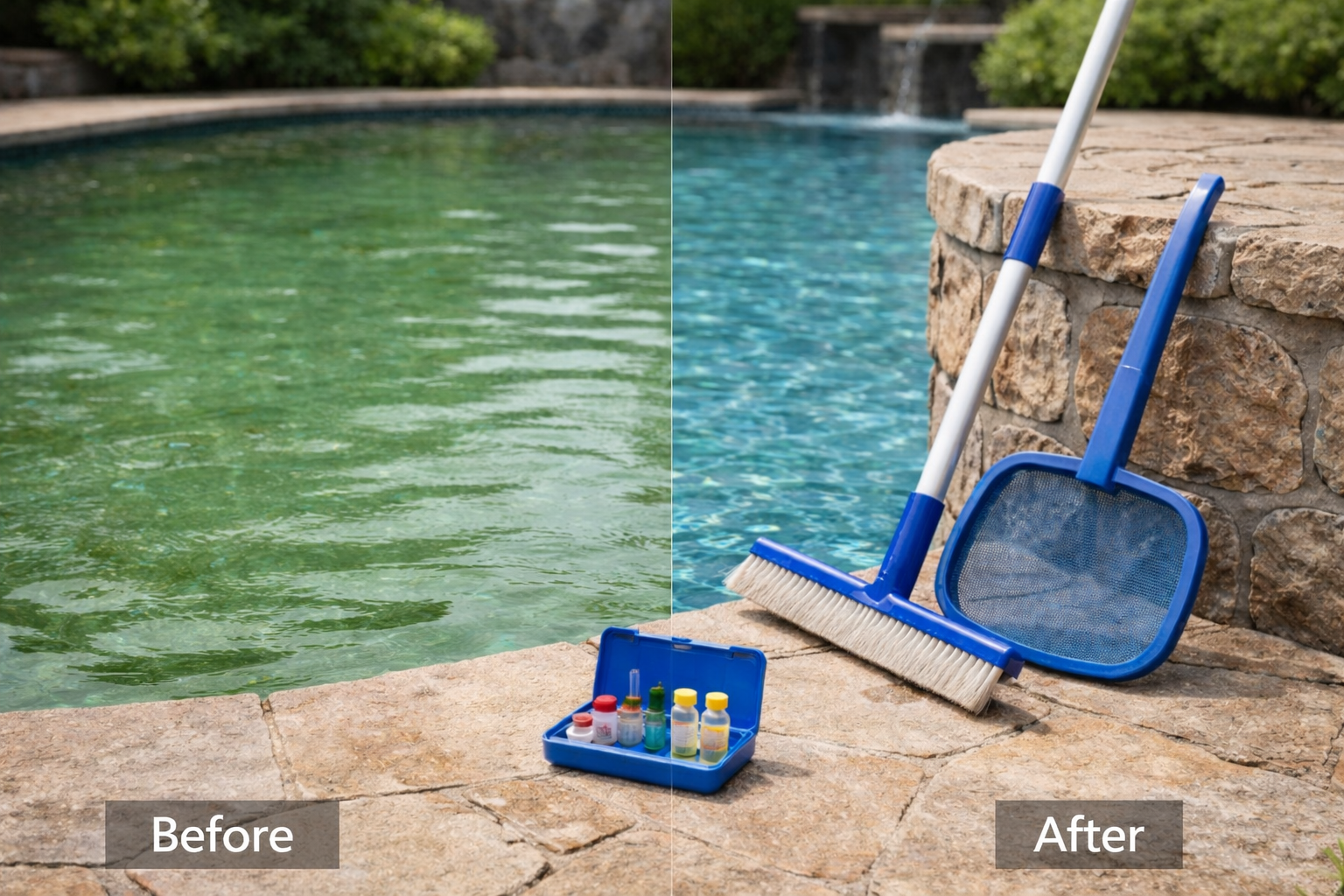
A green pool is the most common emergency we see at Bluewater Pools. It usually happens after a stretch of neglected maintenance, an equipment failure, or a period of heavy rain that dilutes your chemicals.
Green water means algae has taken over. The type of algae determines the treatment approach.
Green algae is the most common and the easiest to treat. It shows up as cloudy water or slimy green patches on the walls. The fix involves brushing all surfaces, shocking the pool to a high chlorine level (20-30 ppm), and running the filter continuously until the water clears.
Yellow/mustard algae is chlorine-resistant and likes to hide in shaded areas. It requires specialized algaecides containing copper or silver.
Black algae is the most stubborn. It forms small, raised dark spots with deep roots and a protective waxy coating. Treatment requires scrubbing with a stainless-steel brush to break through the coating, followed by direct application of chlorine tablets to each spot.
If your pool has reached a full bloom, a professional green-to-clean service is usually more cost-effective than trying to treat it with retail-grade chemicals. Our technicians use a multi-step process that includes chemical treatment, flocculation, vacuuming to waste, and filter sterilization.
What Does Professional Pool Maintenance Cost in Texas?
Costs vary by city, pool size, and the level of service you need. Here’s what the current market looks like in our two primary service areas:
Service Level | Austin (Monthly) | San Antonio (Monthly) | What's Included |
Chemical Only | ~$150 | $99 - $120 | Water testing, chemical balancing, basic equipment check |
Partial Service | $150 - $189 | $130 - $160 | Brushing, skimming, chemical balancing (no vacuuming) |
Full Service | $240 - $320 | $150 - $210+ | Vacuuming, debris removal, wall brushing, chemicals, service reports |
For DIY maintenance, chemical costs alone typically run $30-$60 per month, depending on pool size and usage. You’ll also need to budget $200-$500 annually for cleaning tools and test kits.
Beyond monthly maintenance, pool equipment has a finite lifespan that’s often shortened by Texas heat:
Equipment | Expected Lifespan | Replacement Cost (Installed) |
Variable-Speed Pump | 7 - 10 years | $700 - $1,500 |
Gas Heater | 5 - 8 years | $2,000 - $4,000 |
Salt Chlorinator Cell | 3 - 5 years | $400 - $800 |
LED Lighting | 5 - 7 years | $700 - $1,500 |
Plaster Resurfacing | 10 - 15 years |
When to Call a Professional
Some pool tasks are well within a homeowner’s ability. Testing water, adding chemicals, skimming, and emptying baskets are all things you can do yourself. But certain situations call for someone with the right tools and training.
Equipment replacement involves high-voltage electrical work and pressurized plumbing. In Texas, a Residential Appliance Installer’s License (RAIL) is required for any electrical work on pool equipment, including pump motor replacements.
Leak detection requires specialized ultrasonic equipment and dye testing to pinpoint the source without unnecessary excavation. This is a job for a dedicated leak detection company.
Severe algae blooms that have turned the pool completely opaque typically need professional-grade chemicals and equipment to resolve efficiently.
Pool inspections for home purchases are worth the investment. A qualified inspector can identify equipment issues, structural concerns, and safety code violations before they become your problem. Our technicians hold Certified Pool Inspector (CPI) certifications alongside their CPO, Certified Maintenance Specialist (CMS), RAIL, and OSHA certifications.
Texas Pool Fence Laws and Safety Requirements
If you’re a new pool owner, make sure your pool meets Texas safety code requirements. The state mandates the following for residential pools:
The fence around your pool must be at least 48 inches tall (some cities like Dallas require 6 feet). No opening in or under the fence can exceed 4 inches. Gates must open outward, away from the pool, and be self-closing and self-latching with the latch positioned 54-60 inches above the ground.
If a wall of your house serves as part of the pool enclosure, any door providing direct access to the pool area needs an audible alarm (UL 2017 compliant) and a keyless deadbolt installed 36-48 inches from the floor.
These aren’t optional. Failure to comply can create civil liability if an accident occurs.
Start With the Basics and Build From There
Pool maintenance in Texas has a learning curve, but it’s manageable once you understand the fundamentals. Keep the water circulating, stay on top of cleaning, test and balance your chemistry at least weekly, and adjust your routine with the seasons.
If you’d rather hand all of this off to a professional, Bluewater Pools provides full-service weekly pool maintenance across the San Antonio and Austin metro areas. All of our technicians are CPO, CMS, CPI, RAIL, and OSHA certified, and every visit includes before-and-after photos, a detailed chemical report, and direct access to your assigned technician.
Call us at 512-886-7665 or reach out at info@bluepoolwater.com to schedule a free pool assessment.