The Ultimate Guide to Finding a Pool Service Technician
The difference between a qualified pool service technician and an amateur comes down to three things: certifications, insurance, and technical knowledge. At Bluewater Pools, we’ve seen what happens when homeowners hire the wrong person. Green water, damaged equipment, and repair bills that dwarf the cost of proper service.
After servicing pools across San Antonio and Austin, we’ve learned what separates reliable pool care from the kind that creates problems. This guide shares what we’ve seen work and what questions you should ask any pool service before hiring them. These are the same standards we hold ourselves to, and we believe they’re the minimum any professional should meet.
Whether you’re in Texas or anywhere else, these principles apply. A pool is a significant investment. The person you trust with it should be able to explain exactly how they’ll protect it.
Why the Right Pool Technician Matters
A swimming pool is a complex system that requires professional stewardship. In our years servicing pools across San Antonio and Austin, we’ve seen firsthand what happens when pools are neglected or improperly maintained.
Water that’s chemically imbalanced can become a breeding ground for pathogens like Cryptosporidium and Giardia. These organisms resist standard chlorination levels and pose real health risks. We’ve been called in to rescue pools where the previous service provider didn’t understand this, leaving families swimming in water that looked clean but wasn’t safe.
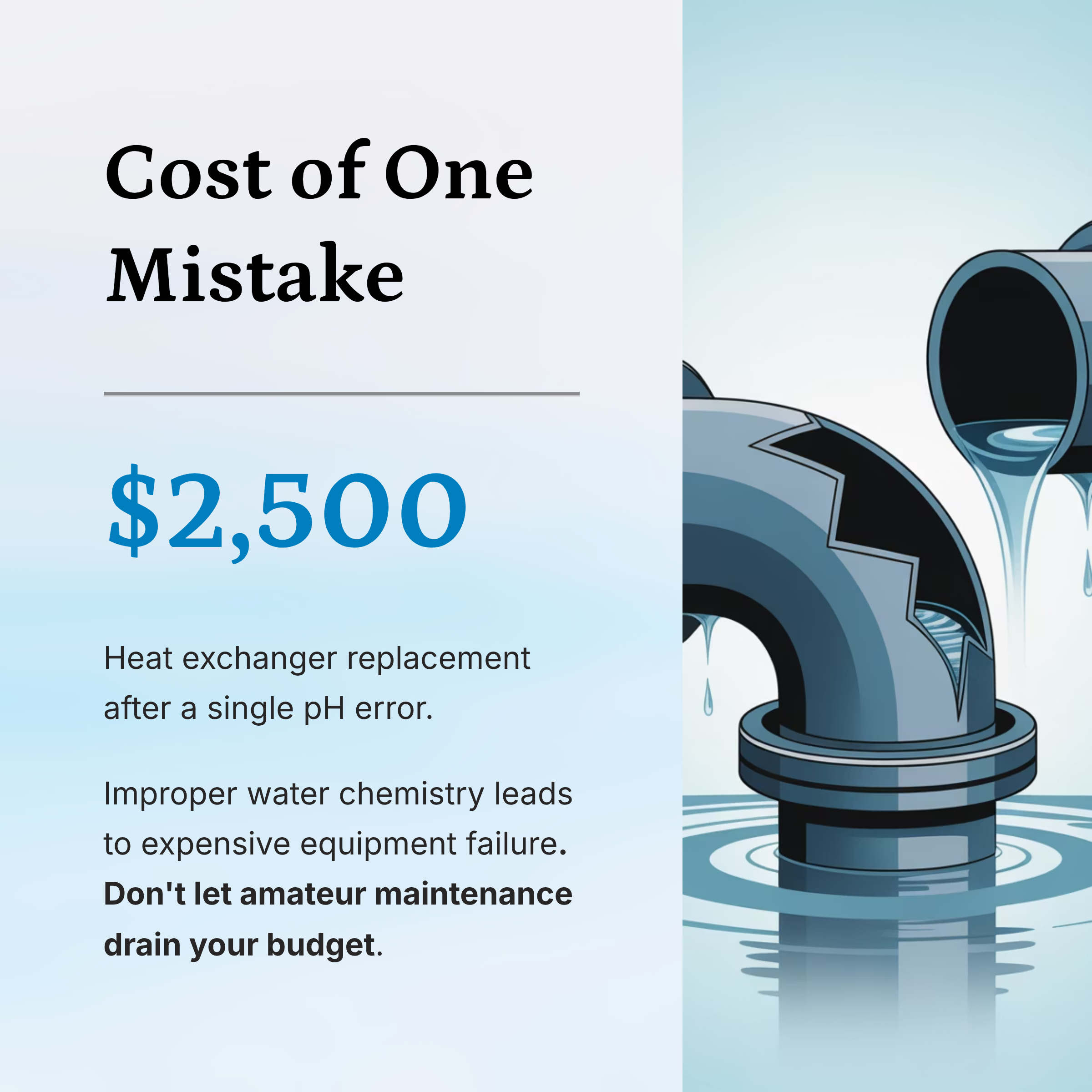
Beyond safety, improper maintenance destroys equipment. Water with a low Langelier Saturation Index (LSI) will etch plaster, corrode copper heater exchangers, and destroy pump seals. We regularly see heater exchangers worth $2,500 ruined by a single pH mistake from an untrained technician.
The legal exposure is also significant. An unlicensed or uninsured technician who gets injured on your property can trigger a lawsuit that targets your personal assets. Your homeowner’s insurance often won’t cover liabilities arising from a hired contractor’s negligence.
The stakes are high. The search for a qualified technician deserves serious attention.
Certifications That Actually Matter
The pool service industry is split between untrained laborers and certified professionals. This distinction is often invisible to consumers but critical to the outcome.
CPO Certification: The Industry Standard
The Certified Pool & Spa Operator (CPO) certification is administered by the Pool & Hot Tub Alliance (PHTA). It’s recognized globally as the gold standard for pool operation. While legally required for commercial pool operators in 25 states, the principles taught apply directly to residential service.
The CPO curriculum covers:
- Calculating pool volumes, turnover rates, and flow rates
- The chemistry of disinfection (free available chlorine vs. combined chlorine)
- Breakpoint chlorination thresholds for oxidizing contaminants
- Identification of entrapment hazards
- Proper storage and handling of hazardous chemicals
- Management of waterborne disease outbreaks
How we handle this at Bluewater: All our technicians hold CPO certification. It’s a non-negotiable requirement for joining our team, even though Texas doesn’t mandate it for residential service. The science behind water chemistry is too important to leave to guesswork.
When we hire a new technician, they must either already hold CPO certification or obtain it within their first 90 days. We cover the cost of the training and exam because we believe it directly impacts service quality. One of our technicians is currently completing this process now. When you’re evaluating any pool service company, ask to see their technicians’ certification cards.
Additional Technical Certifications
Beyond CPO, the PHTA offers specialized designations:
- Certified Service Technician (CST): Focuses on mechanical repair of pumps, heaters, and automation systems
- Certified Maintenance Specialist (CMS): Targets practical aspects of cleaning and circulation
- Certified Building Professional (CBP): Relevant for renovation and structural repair
Modern pools equipped with variable-speed pumps, salt chlorine generators, and smartphone-integrated automation require technicians with skills comparable to IT professionals. The “pool cleaner” of the past isn’t equipped to diagnose a communication error on an RS-485 automation bus.
Professional Association Membership
Membership in a trade association signals commitment to the profession.
Independent Pool & Spa Service Association (IPSSA): This organization operates as a guild for independent technicians. Members have “sick route coverage,” meaning other members service your pool if your technician is ill or injured. IPSSA also mandates liability insurance and water chemistry exam passage.
Pool & Hot Tub Alliance (PHTA): The governing body for the industry, focusing on education, advocacy, and standard-setting. Members are bound by a code of ethics and receive the latest technical bulletins and regulatory updates.
How we use association membership at Bluewater: Our membership in the Pool & Hot Tub Alliance keeps us connected to industry developments and manufacturer support networks. It also means we’re held to a code of ethics and have access to the latest training on equipment and water chemistry standards. Look for PHTA membership as a sign that a company takes professional development seriously.
State Licensing Requirements
A business license only grants an entity the right to pay taxes. It implies zero technical competency or insurance coverage. The true mark of a professional is a state-issued contractor’s license, where applicable.
Texas: The Electrical Focus
Texas takes a distinct approach, focusing on electrical safety rather than general maintenance.
Residential Appliance Installer (RAI): Technicians who install or repair pool pumps, heaters, underwater lights, and other electrical equipment on the “load side” of the electrical disconnect must hold this license. It ensures understanding of the National Electrical Code as it applies to aquatic environments.
The Regulatory Gap: Unlike Florida or California, Texas doesn’t strictly license the act of cleaning a pool or balancing chemicals at the state level. Anyone can claim to be a “pool cleaner.” This makes voluntary certifications like CPO even more important for Texas homeowners.
How we handle electrical work at Bluewater: When we handle pool repairs involving electrical components like pumps, heaters, or underwater lights, proper licensing protects both our team and our customers. We ensure all electrical work meets code requirements, even when state law doesn’t mandate specific credentials for general pool service.
Licensing Requirements by State
State | CPO Required | Key Focus Area |
Texas | Yes (commercial) | Electrical safety (RAI license) |
Florida | Yes | Public health compliance |
California | No (statewide) | Contractor licensing (C-53, D-35) |
Arizona | Yes | Registrar of Contractors system |
Georgia | Yes | State certification |
In California, any home improvement project valued at $500 or more (labor and materials combined) must be performed by a licensed contractor. In Florida, the Certified Pool/Spa Contractor (CPC) license requires four years of field experience and a comprehensive exam.
Insurance Coverage to Verify
Insurance is the financial firewall between a minor accident and a catastrophic loss. A homeowner’s policy often won’t cover liabilities from a hired contractor’s negligence.
General Liability: The Baseline
General Liability (GL) insurance protects against third-party bodily injury and property damage caused by the technician’s operations.
Bodily Injury: Covers medical costs and legal defense if a technician leaves a gate unlatched and a child enters unsupervised, or if a chemical mixing error creates hazardous gas.
Property Damage: Covers accidental damage like spilling acid on a travertine deck, backing a service truck into a garage door, or causing a fire during heater repair.
Coverage Limits: Standard policies offer $1 million per occurrence and $2 million aggregate. For high-value properties, request limits of $2 million to $5 million.
The Pop-Up Endorsement: A Critical Detail
This is one of the most important and overlooked insurance requirements.
When a pool is drained for cleaning or repair, the water’s weight is removed. If the groundwater table is high, hydrostatic pressure can push the empty concrete shell upward. The pool literally “pops” out of the ground, cracking the shell, severing plumbing, and destroying the surrounding deck. Damages can exceed $100,000.
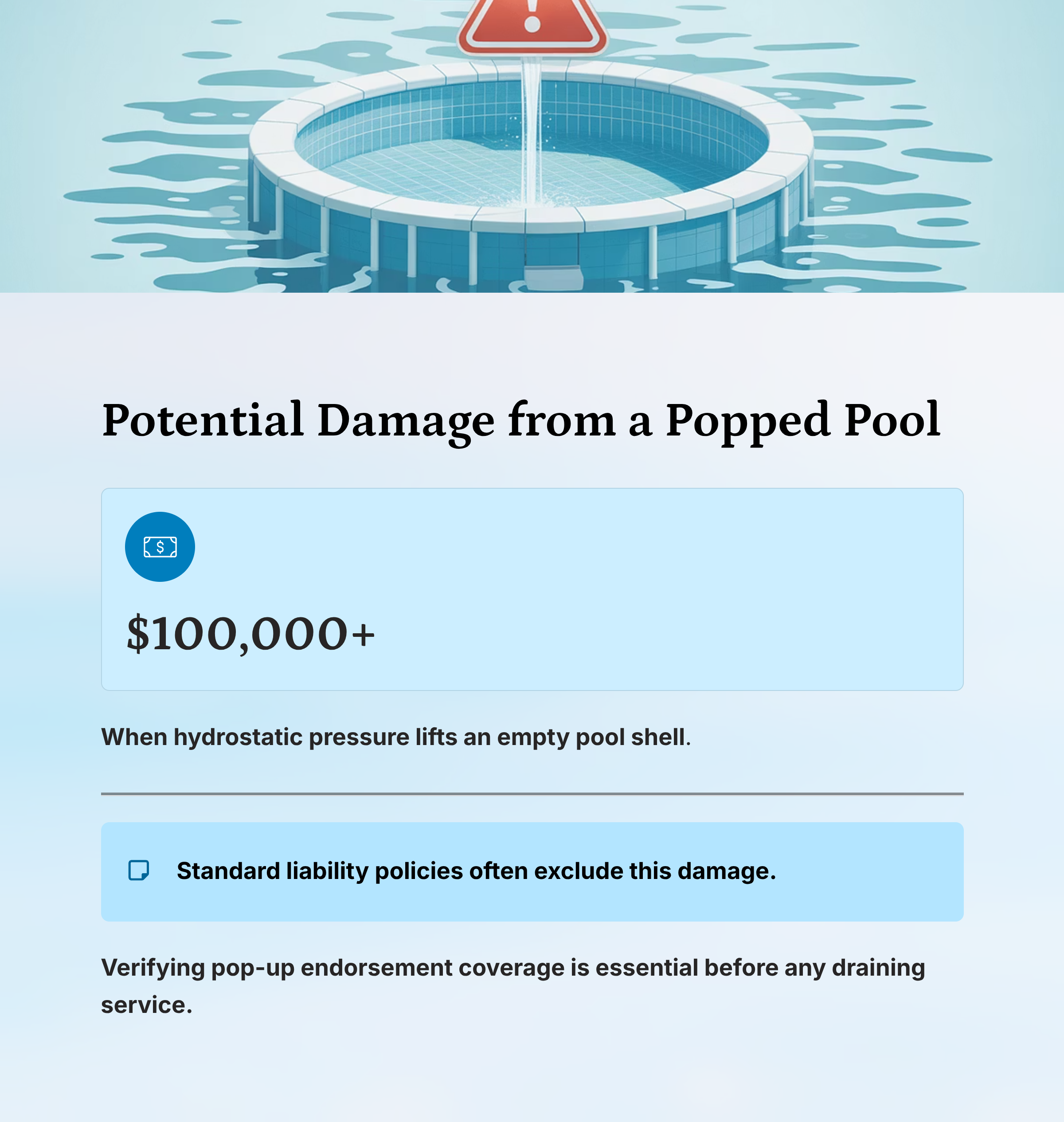
The Problem: Standard GL policies often exclude “subsidence” or “earth movement.” Insurers may deny claims for popped pools under this exclusion.
The Solution: Professional technicians must carry a specific “Pool Pop-Up” endorsement. Before authorizing any service that involves draining your pool (like green-to-clean treatments), verify this endorsement exists on the technician’s certificate of insurance.
How we handle this at Bluewater: We carry full pop-up coverage and provide certificates of insurance on request. When customers ask about our coverage, we walk them through exactly what’s included. Any company that hesitates to show you their certificate or can’t explain their coverage specifics should raise concerns.
Workers’ Compensation
Workers’ comp covers medical expenses and lost wages if a worker is injured on the job.
The Sole Proprietor Loophole: In many states, independent owner-operators can exempt themselves from workers’ comp requirements. If an exempt “pool guy” slips on your wet deck and suffers a spinal injury, they may sue you for negligence. Hiring a company with full workers’ comp coverage creates a shield around you as the homeowner.
How we handle this at Bluewater: We maintain workers’ compensation coverage for our entire team. This protects our technicians if they’re injured, and it protects you from potential lawsuits. When evaluating any pool service, ask specifically whether they carry workers’ comp or if they’ve exempted themselves.
Understanding Service Tiers and Pricing
The cost of pool service is often a source of confusion. Understanding the economic drivers helps you evaluate quotes and identify sustainable partnerships.
What Goes Into a Service Call
Assuming a monthly rate of $160 for weekly service (4 visits), revenue per visit is $40. Here’s how it breaks down:
- Chemical costs: $10-$15 per week during summer (chlorine, acid, sodium bicarbonate, stabilizer). Chemical prices have risen by 40% in recent years.

- Labor and burden: A thorough visit takes 15-30 minutes plus drive time, plus wages, payroll taxes, and workers’ comp.
- Overhead: Vehicle fuel, insurance premiums, software subscriptions, equipment maintenance.
After all expenses, a technician may only net $5-$10 per visit. This explains why additional charges for filter cleaning and specialty treatments are necessary. It also means a technician offering full service for $80/month is likely cutting corners somewhere.
Service Tier Comparison
Feature | Chemical Only | Partial Service | Full Service |
Water Testing & Balancing | Yes | Yes | Yes |
Chemical Application | Yes | Yes | Yes |
Empty Skimmer Baskets | No | Yes | Yes |
Empty Pump Baskets | No | Yes | Yes |
Brush Walls/Steps | No | Yes | Yes |
Skim Surface Debris | No | No | Yes |
Vacuum Floor | No | No | Yes |
Typical Monthly Cost | $80-$120 | $130-$160 | $160-$300+ |
Chemical Only: For homeowners willing to skim leaves and empty baskets but who lack expertise in water chemistry.
Partial Service: Good for screened-in pools with minimal debris, or those with reliable automatic cleaners.
Full Service: The turnkey solution. We recommend this for most Texas pools. The heat, sun exposure, and evaporation rates here cause pools to deteriorate faster than in milder climates. A pool that looks fine on Monday can turn green by Friday if left unattended during summer months.
What full service looks like at Bluewater: Our pool cleaning services and pool maintenance services go beyond basic maintenance. Each weekly visit includes chemical balancing, equipment inspection, and a detailed service report. We run quarterly computerized water testing that analyzes your pool’s full chemistry profile. Your technician texts you 30 minutes before arriving and emails before-and-after photos after each visit so you always know exactly what was done.
DIY vs. Professional: The Real Math
Many homeowners consider DIY maintenance to save money. The full picture:
DIY Costs:
- Chemicals at retail prices (20-30% higher than wholesale)
- Testing kits, poles, nets, vacuums
- Monthly chemical cost: $30-$50
- Time investment: 4-6 hours per month
The Hidden Risk: A single mistake allowing pH to drop too low can destroy a heater exchanger worth $2,500. A neglected algae bloom can cost $500 in chemicals and days to clear.
The premium paid for professional service (roughly $100 over DIY costs) functions as insurance against equipment damage and green water.
Questions to Ask Before Hiring
These are questions customers have asked us over the years, and they’re exactly the right ones to ask any pool service. Most homeowners don’t know industry jargon, and you shouldn’t need to. Here’s how to ask the right questions in plain language and what the answers reveal.
- “What kind of training do your technicians have?”
This question uncovers whether a company invests in professional development. The gold standard is CPO (Certified Pool Operator) certification through the Pool & Hot Tub Alliance. It covers water chemistry, equipment operation, and safety protocols.
What we tell customers: “Every technician on our team holds CPO certification. It’s required to work here, even though Texas doesn’t mandate it for residential service. We can show you our certification cards if you’d like to verify.”
Red flag answer: “We’ve been doing this for years” or “My guys learned on the job.” Experience matters, but it doesn’t replace formal training in water chemistry.
- “What happens if you damage something or someone gets hurt?”
This reveals whether a company carries proper insurance. You want to hear about general liability coverage and, importantly, something called “pop-up coverage” for pool draining.
What we tell customers: “We carry full liability insurance that covers property damage and injuries. We also have specific coverage for pool draining, which is important because standard policies sometimes exclude that. We’re happy to send you a certificate of insurance.”
Red flag answer: “Don’t worry, we’re covered” without specifics, or any hesitation to provide documentation.
- “What if my regular technician is sick or on vacation?”
Consistency matters in pool care. If your technician disappears for two weeks, your pool can turn green.
What we tell customers: “We have backup technicians who can cover your pool. You’ll be notified in advance, and they’ll have full access to your service history and pool specifications so nothing falls through the cracks.”
Red flag answer: “I’ll just add extra chemicals before I leave” or “We’ll catch up when I’m back.”
- “How do you know my pool is actually balanced, not just clean-looking?”
This separates technicians who understand water chemistry from those who just dump chlorine and leave. The answer should mention testing multiple factors, not just chlorine and pH.
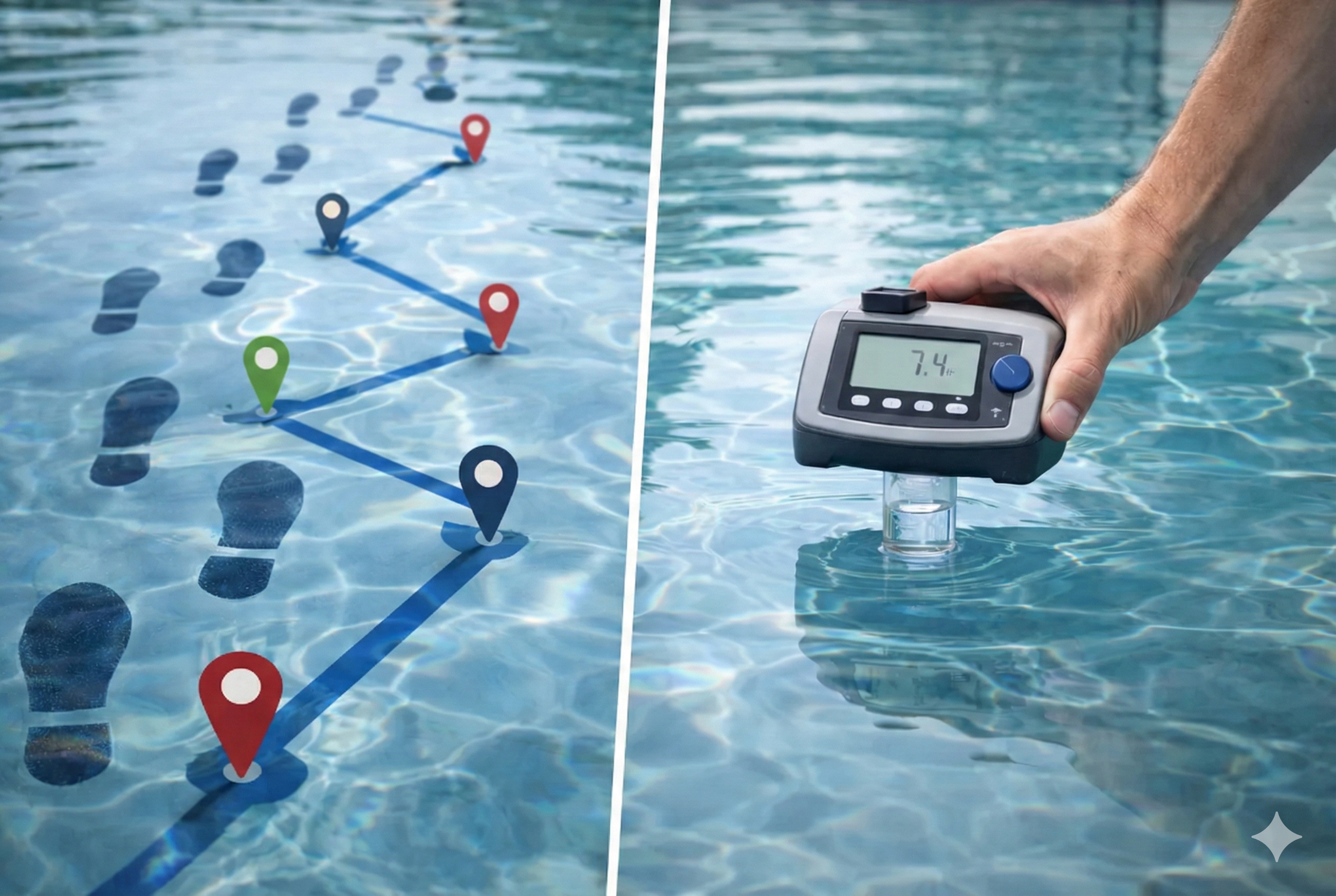
What we tell customers: “We test for several factors including pH, chlorine, alkalinity, calcium hardness, and stabilizer levels. We calculate something called the Langelier Saturation Index, which tells us if your water is corrosive or scale-forming. This protects your heater, plaster, and equipment from damage that basic testing misses.”
Red flag answer: “I check the chlorine and pH” or blank stares when you ask about comprehensive testing.
- “How will I know the work was actually done?”
Accountability separates professional services from “splash and dash” operators who spend five minutes at your pool.
What we tell customers: “After every visit, you’ll receive an email with before-and-after photos of your pool, a complete breakdown of chemical readings, and notes from your technician about anything they noticed. You can see exactly what your pool looked like when we arrived and when we left.”
Red flag answer: “I leave a ticket in the pump basket” or “You’ll know because your pool will look good.”
Red Flags and Scams to Avoid
The pool industry attracts operators who exploit homeowners’ lack of knowledge. We’ve encountered all of these situations when taking over service from other providers.
The Upfront Payment Scam: Be wary of technicians demanding large cash deposits (50% or more) before starting repairs. Legitimate businesses bill after service or require modest deposits only for special-order equipment. At Bluewater, we bill monthly after services are rendered.
Unnecessary Equipment Replacement: A technician who insists on replacing a pump that hums but won’t start without checking the capacitor ($20 part) is likely upselling. We’ve diagnosed this exact issue dozens of times. A $20 capacitor fix saves customers from a $500+ pump replacement. Always get a second opinion on repairs over $500.
The “Splash and Dash”: Technicians who spend less than 5 minutes at your pool, dumping liquid chlorine and leaving without brushing or cleaning. This is one of the most common complaints we hear from customers switching to us from other services.
How we prevent this at Bluewater: Every service visit includes before-and-after photos sent directly to you, along with a detailed report showing chemical readings and any notes from your technician. You can see exactly what your pool looked like when we arrived and when we left. This documentation creates accountability and gives you proof that your pool is actually being serviced.
The FEMA Scam: After natural disasters, scammers claim to be “FEMA Certified” to repair pools. FEMA does not certify pool contractors. We saw this happen across Texas after major storms.
What to Expect in a Service Agreement
A professional relationship requires a clear contract. Handshake agreements leave too much room for ambiguity. Here’s what we include in our service agreements at Bluewater, and what you should expect from any reputable pool service.
Key Contract Elements
Scope of Service: Clearly defined inclusions (e.g., “weekly netting and vacuuming”) and exclusions. At Bluewater, we spell out exactly what’s included in your service tier so there are no surprises.
Extra Charges: It’s standard practice to charge extra for filter cleanings (quarterly/semi-annually), salt cell cleaning, and storm cleanup. These labor-intensive tasks fall outside weekly maintenance. The contract should list prices upfront. We provide a complete fee schedule before you sign anything.
Access and Pets: Stipulations that aggressive dogs must be secured. If a technician can’t enter due to a locked gate or loose dog, the visit is usually still billable. Our technicians are animal lovers and enjoy interacting with your pets, but safety comes first.
Weather Policy: During heavy rain or lightning, service may be limited to a chemical check for technician safety. We don’t skip you entirely. We’ll still balance your water, but physical cleaning waits until conditions are safe.
Stabilizer (CYA) Management: If Cyanuric Acid levels become too high (causing chlorine lock), the pool must be partially drained and refilled at the homeowner’s expense. Technicians can’t chemically remove CYA. We monitor this closely and will alert you before levels become problematic.
Equipment Warranties
Manufacturer Warranties: Cover defects in pumps, heaters, and filters. Equipment purchased online often has void or significantly reduced warranties (60 days vs. 3 years) compared to equipment purchased through licensed professionals.

Workmanship Warranties: Cover installation quality. A standard workmanship warranty is one year.
Professional technicians often handle warranty registration, ensuring serial numbers are recorded and extended warranty periods are activated.
The Science Behind Quality Pool Care
Understanding the technical aspects helps you evaluate whether a technician knows their craft.
The Langelier Saturation Index
The LSI determines whether water is balanced, corrosive, or scale-forming. It calculates the relationship between pH, total alkalinity, calcium hardness, water temperature, cyanuric acid, and total dissolved solids.
Water seeks equilibrium. If LSI is negative (corrosive), water dissolves calcium from plaster (etching) or heat exchangers (corrosion). If LSI is positive (scale-forming), calcium carbonate deposits on surfaces and inside pipes.
A professional balances water to LSI standards, not just sanitization standards. This is one of the clearest ways to distinguish between someone who learned pool care from YouTube and someone with formal training.
How we handle this at Bluewater: When we test your water, we’re calculating LSI and adjusting chemistry based on current water temperature. In winter, we allow slightly higher pH to compensate for cold water. In summer, we adjust for higher temps. We use computerized testing equipment that analyzes multiple factors simultaneously, allowing us to make precise adjustments that protect your equipment and keep your water safe for swimming. We’re not just adding chlorine until a test strip looks right.
Cyanuric Acid and Chlorine Lock
Cyanuric acid (CYA) protects chlorine from UV degradation. But as CYA levels rise from overuse of stabilized chlorine tablets, chlorine efficacy diminishes. This “chlorine lock” means even high chlorine levels may fail to kill algae.
Expert technicians monitor CYA closely and switch to non-stabilized chlorine sources when levels get too high. Amateurs keep adding tablets, worsening the problem.
How to Find Qualified Candidates
Reliance on generic search engines yields mixed results. Industry-specific directories are more effective for identifying committed professionals.
IPSSA Find a Professional: The IPSSA website allows searches by zip code. Membership requires insurance and water chemistry certification, providing baseline vetting.
PHTA Member Directory: The Pool & Hot Tub Alliance directory connects homeowners with companies committed to industry standards. This is where you’ll find us. PHTA membership indicates a company that participates in ongoing education and adheres to industry ethics standards.
Local Pool Supply Stores: Staff at pool supply wholesalers know which technicians pay their bills on time, buy quality parts, and maintain professional conduct. These referrals often lead to the most reliable service providers in your area.
Work with a Team That Meets These Standards
Throughout this guide, we’ve shared what we look for when evaluating pool service quality: trained and certified technicians, proper insurance coverage, scientific water balancing, and transparent service documentation. These aren’t arbitrary standards. They’re the practices that protect your pool and your investment.
At Bluewater Pools, we built our company around these principles. Every technician on our team is CPO certified. We carry full liability insurance with the specialized endorsements that protect you. We use computerized testing equipment for comprehensive water analysis, and we send detailed reports with photos after every visit so you can see exactly what was done.
We’ve maintained a BBB A-rating since March 2021 and back every service with a satisfaction guarantee. But what our customers mention most often is the relationship they build with their dedicated technician. You work with the same person each visit, someone who knows your pool, remembers your preferences, and texts you 30 minutes before arriving rather than just showing up.
Our founder, Stephen Robbins, serves on the board of Step Into Swim, a nonprofit focused on reducing accidental drowning by teaching swimming to underserved communities. His son is a competitive swimmer, and our family life has always revolved around pools and water safety. That’s why we started this company in 2020, and it’s why we hold ourselves to standards that go beyond what’s legally required.
If you’re in San Antonio or Austin, we’d welcome the opportunity to show you what professional pool service looks like. Contact us to schedule a free assessment of your pool, spa, and equipment. Ask us any of the questions from this guide. We’re confident in our answers.