
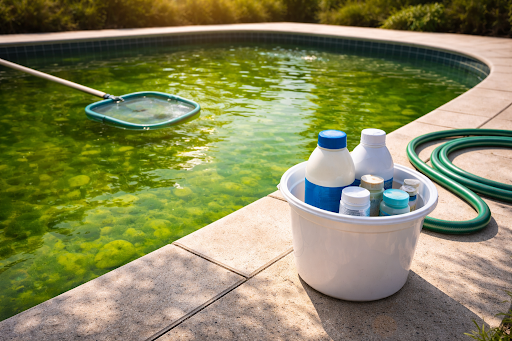
Green Pool Cleanup Costs in Texas: What to Expect in 2026
Restoring a green pool to swimmable condition in Texas typically costs between $300 and $800 for chemical treatment. Severe cases requiring a full drain-and-clean run $500 to $1,500 or more. Those ranges sit above national averages, and Texas-specific factors, including extreme heat, drought restrictions, and elevated water rates, are a big reason why.
At Bluewater Pools, we handle green pool rescues regularly across San Antonio and Austin. A pool that looks fine on Monday can show visible algae growth by Friday if the chemistry is off. That’s not an exaggeration for Texas summers, it’s just how fast conditions can deteriorate when water temperatures stay above 90°F for months at a time. The good news is that acting fast almost always means a cheaper, faster fix.
What Green Pool Cleanup Actually Costs in Texas
Pricing follows severity. The further a pool has gone, the more chemical treatments, technician visits, and filter cleanings it requires. Here’s how the tiers break down:
Severity Level | Description | Typical Cost | Treatment Approach |
Mild (light green tint, bottom visible) | Early algae bloom, water still translucent | $100–$300 | Single shock treatment, algaecide, brushing, filter cleaning |
Moderate (solid green, bottom not visible) | Full algae bloom, murky water | $300–$500 | Multiple chemical treatments over 2–5 days, vacuuming, repeated filter cleaning |
Severe (dark green/black, long-neglected) | Thick algae, heavy debris | $500–$1,000+ | Multi-visit intensive treatment, possible equipment repair |
Drain-and-clean (beyond chemical rescue) | Opaque water, failed prior treatments | $500–$1,500+ | Full drain, acid wash, refill, chemical rebalancing |
Sources: HomeGuide, Angi, Bob Vila, Thumbtack
The most common scenario is a moderately green pool treated chemically over 2–5 days, which lands in the $300–$500 range for most homeowners. Angi reports that acid washing alone averages $450 for a standard residential pool.
Labor makes up a significant portion of those totals. Professional pool service rates in Texas run $50–$150 per hour, with acid wash specialists reaching $200/hour. A typical green-to-clean job involves 2–6 hours per visit across 1–5 visits, so labor alone can represent $200–$600 of the final bill. Chemicals for a moderate cleanup run $30–$150 depending on pool volume, and filter cleaning adds roughly $60–$100 per service.
Why Costs Run Higher in Texas
Texas’s climate is one of the most aggressive environments for algae in the country. When water temperatures exceed 90°F, chlorine burns off faster, pH drifts more quickly, and algae can establish itself in hours. Green algae can replicate every 3–6 hours under ideal conditions, and Texas summers provide those conditions for five or more consecutive months.
Beyond the heat, a few other factors push Texas cleanup costs above national averages.
Water costs. Any cleanup that requires draining a pool becomes expensive fast. Austin Water’s current residential rate schedule shows tiered volume charges reaching $16.52 per 1,000 gallons for mid-to-high usage, and the combined water and wastewater cost to fill a standard 20,000-gallon pool runs approximately $230–$250 in Austin once all tiers, fixed charges, and wastewater fees are factored in. If a water delivery truck is needed, Pool & Spa News reports Texas prices of $0.06–$0.14 per gallon, which can push the cost to refill even a small pool past $4,000.
Drought restrictions. This is the bigger issue. The Edwards Aquifer hit historic lows in May 2025, triggering Stage 5 restrictions across Bexar, Hays, Comal, Caldwell, Guadalupe, and Medina counties. Cedar Park entered Stage 3 conservation in March 2025 due to low Lake Travis levels. During active restrictions, draining and refilling a pool may be prohibited or require special authorization, which effectively forces homeowners toward chemical-only treatments regardless of how severe the situation is.
Chemical prices. Liquid chlorine averaged $790 per metric ton in Q4 2025, well above pre-pandemic norms. Supply chain disruptions, including a 2024 fire at a major Georgia chemical facility, combined with new tariffs and increased rail shipping costs, continue to keep chemical prices elevated heading into 2026.
Labor scarcity. According to the Pool & Hot Tub Alliance’s Q3 2025 Quarterly Pulse Survey, 47% of pool industry companies cite recruiting and retaining skilled employees as a top-three challenge. The Skimmer 2025 State of Pool Service report, based on data from 2,000+ pool professionals, identifies inflation and labor shortages as the leading concerns heading into 2025. This is a real factor in what you pay.
How the Cleanup Process Works
A professional green pool recovery follows a consistent sequence regardless of severity:
- Initial assessment and water testing
- Debris removal using specialized underwater vacuuming equipment
- Chemical treatment calibrated to lab-grade water analysis
- Equipment inspection and optimization
- Final testing with before-and-after documentation
For chemical-only cleanup, timeline depends on how far the pool has gone:
- Mild (light green, bottom visible): Typically clears within 24 hours with a single shock treatment
- Moderate (recently turned green): 24–48 hours, at least two visits
- Severe (green for an extended period, very murky): 3–5 days of continuous filtration, multiple chemical treatments, repeated filter cleaning
A full drain-and-clean takes approximately 2–3 days: up to 14 hours to drain, several hours for acid washing, 12–24 hours to refill, plus at least another day to balance chemistry.
When to Drain vs. Treat Chemically
Most green pools in Texas should be treated chemically if at all possible. Draining is reserved for pools that are essentially ponds: opaque black or dark green water, multiple prior treatment failures, extremely high total dissolved solids, or severe staining that chemical treatment can’t address.
There’s a structural reason to be especially cautious about draining in Texas. As AQUA Magazine documents, expansive clay soils common across North and Central Texas can exert expansion pressure of up to 15,000 pounds per square foot. That soil type is widespread precisely in the semi-arid climates with distinct wet and dry seasons, like most of Texas. Draining a pool when groundwater is high, which often happens after spring rains, creates a hydrostatic pressure risk that can literally pop the pool shell out of the ground. That destroys the entire structure, and it’s something we raise with every customer before recommending a drain.
What Affects Your Final Price
Several variables can move your quote significantly in either direction:
- Pool volume: Chemical costs scale directly with gallons. A 30,000-gallon pool costs more to treat than a 15,000-gallon pool.
- Surface material: Concrete and gunite pools are the most expensive to treat because porous surfaces harbor algae in crevices. Fiberglass is the cheapest.
- Equipment condition: A failing pump or undersized filter can extend cleanup by days and add repair costs on top of the treatment bill.
- Debris load: Heavy leaf accumulation increases labor time significantly.
- Cyanuric acid levels: High cyanuric acid suppresses chlorine effectiveness, requiring more product to achieve the same result. This is a common issue in Texas pools that have been over-stabilized.
What to Look for When Hiring a Pool Service
Texas does not require a specific license for basic pool cleaning, but any work involving electrical equipment, such as replacing pumps, lights, or heaters, requires a Residential Appliance Installer License (RAIL) from the Texas Department of Licensing and Regulation. The RAIL exam has a pass rate of just 23–28%, and fines for unlicensed electrical work range from $2,000 to $5,000 per occurrence.
Beyond licensing, CPO (Certified Pool/Spa Operator) certification from the National Swimming Pool Foundation is the most reliable quality signal. Texas health departments accept it for commercial pool oversight, and it reflects genuine knowledge of water chemistry and equipment operation.
At Bluewater Pools, all technicians hold CPO certification before working independently. Our team also carries Certified Maintenance Specialist (CMS), Certified Pool Inspector (CPI), RAIL, and OSHA certifications, and we’ve maintained a BBB A-rating since March 2021.
When evaluating quotes, watch for these red flags:
- Quoting a flat rate without inspecting the pool first
- Promising overnight results for a severely green pool
- Proposing to drain without discussing hydrostatic pressure risk
- Not testing water chemistry before beginning treatment
- Declining to provide license or insurance documentation
Bob Vila and Thumbtack both recommend getting at least two or three estimates. A reputable provider should explain their severity assessment, outline expected visit count, confirm chemicals are included in the price, and describe what happens if the pool doesn’t clear within the estimated timeframe.
2026 Market Conditions Affecting Pool Service Costs
Texas is the third-largest residential pool market in the U.S., with approximately 801,000 pools, behind only Florida and California. New construction has slowed considerably since the pandemic era, with permits declining 31% in 2023 and 18% in 2024 across Texas’s major metros. That contraction makes the service and maintenance segment proportionally more important. The Pool & Hot Tub Alliance’s Q3 2025 survey found that 55% of pool companies reported increased service call volume, and service, maintenance, and repair was the only industry sector posting year-over-year profit growth.
The cost pressures aren’t going away. Chemical prices remain elevated, labor is the binding constraint across the industry, and water is becoming more expensive and harder to access. San Antonio Water System plans $3.2 billion in infrastructure improvements funded by rate increases averaging $4.77 per year through 2029.
The real takeaway for Texas pool owners: a climate that can turn a balanced pool green in 48 hours, chemical prices 40–70% above pre-pandemic levels, and a strained water supply make prevention far cheaper than recovery. The cheapest green pool cleanup is the one you never need. In Texas’s heat, that means weekly professional maintenance or disciplined DIY chemistry testing year-round. When algae does take hold, acting fast matters. A mild bloom treatable with a single visit can escalate to a $500+ multi-day project within a week of inaction.
Frequently Asked Questions
How much does it cost to clean a green pool in Texas?
Most green pool cleanups in Texas cost $300–$800 for chemical treatment. Severe cases or situations requiring a full drain-and-clean can reach $500–$1,500 or more, depending on pool size, debris load, and equipment condition.
How long does it take to clean a green pool?
A mildly green pool can clear in 24 hours with a single shock treatment. A moderately green pool typically takes 2–5 days. Severely neglected pools requiring drain-and-clean service take approximately 2–3 days just for the drain, wash, and refill process, plus additional time to balance chemistry.
Can you drain a green pool in Texas?
You can, but it carries risks specific to Texas. Drought restrictions in many Texas counties currently limit or prohibit pool draining and refilling. Texas’s expansive clay soils also create hydrostatic pressure risk: draining a pool when groundwater levels are high can cause the shell to pop out of the ground. Always discuss these risks with a professional before draining.
Is weekly pool service really necessary in Texas?
In most cases, yes. Texas heat accelerates chemical breakdown and algae growth faster than almost anywhere else in the country. Weekly pool service is the most reliable way to stay ahead of chemistry problems before they become visible, and before they become expensive.
If your pool has already turned green, or if you want to avoid getting there in the first place, Bluewater Pools serves homeowners across San Antonio and Austin with certified technicians and a satisfaction guarantee. Call us at 512-886-7665 or email info@bluepoolwater.com to schedule an assessment.